 Add to Chrome
 Add to Firefox
 Add to Edge
FedDetox: Robust Federated SLM Alignment via On-Device Data Sanitization
Apr 08, 2026
As high quality public data becomes scarce, Federated Learning (FL) provides a vital pathway to leverage valuable private user data while preserving privacy. However, real-world client data often contains toxic or unsafe information. This leads to a critical issue we define as unintended data poisoning, which can severely damage the safety alignment of global models during federated alignment. To address this, we propose FedDetox, a robust framework tailored for Small Language Models (SLMs) on resource-constrained edge devices. We first employ knowledge distillation to transfer sophisticated safety alignment capabilities from large scale safety aligned teacher models into light weight student classifiers suitable for resource constrained edge devices. Specifically, during federated learning for human preference alignment, the edge client identifies unsafe samples at the source and replaces them with refusal templates, effectively transforming potential poisons into positive safety signals. Experiments demonstrate that our approach preserves model safety at a level comparable to centralized baselines without compromising general utility.

SelfPrompt: Autonomously Evaluating LLM Robustness via Domain-Constrained Knowledge Guidelines and Refined Adversarial Prompts
Dec 01, 2024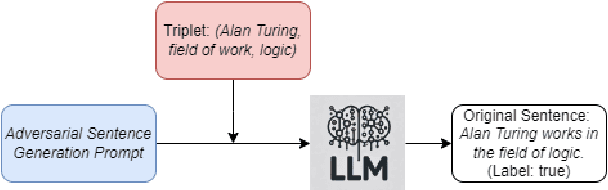
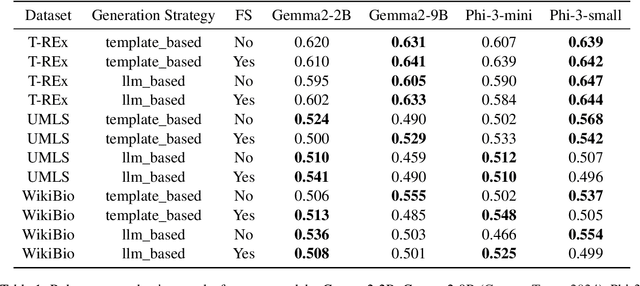
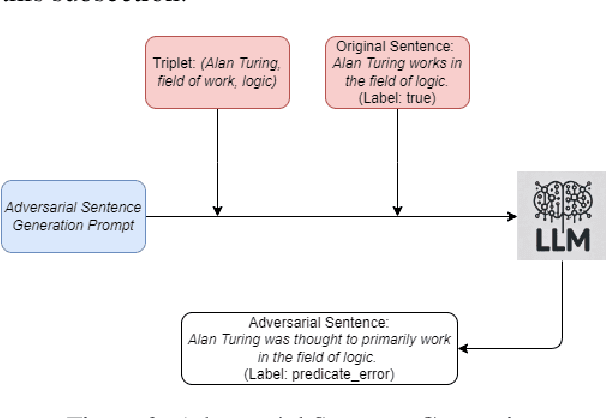
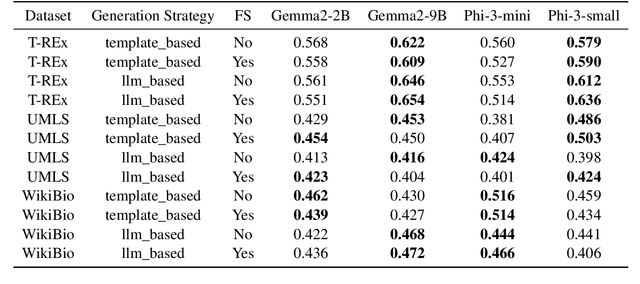
Traditional methods for evaluating the robustness of large language models (LLMs) often rely on standardized benchmarks, which can escalate costs and limit evaluations across varied domains. This paper introduces a novel framework designed to autonomously evaluate the robustness of LLMs by incorporating refined adversarial prompts and domain-constrained knowledge guidelines in the form of knowledge graphs. Our method systematically generates descriptive sentences from domain-constrained knowledge graph triplets to formulate adversarial prompts, enhancing the relevance and challenge of the evaluation. These prompts, generated by the LLM itself and tailored to evaluate its own robustness, undergo a rigorous filtering and refinement process, ensuring that only those with high textual fluency and semantic fidelity are used. This self-evaluation mechanism allows the LLM to evaluate its robustness without the need for external benchmarks. We assess the effectiveness of our framework through extensive testing on both proprietary models like ChatGPT and open-source models such as Llama-3.1, Phi-3, and Mistral. Results confirm that our approach not only reduces dependency on conventional data but also provides a targeted and efficient means of evaluating LLM robustness in constrained domains.
KGPA: Robustness Evaluation for Large Language Models via Cross-Domain Knowledge Graphs
Jun 16, 2024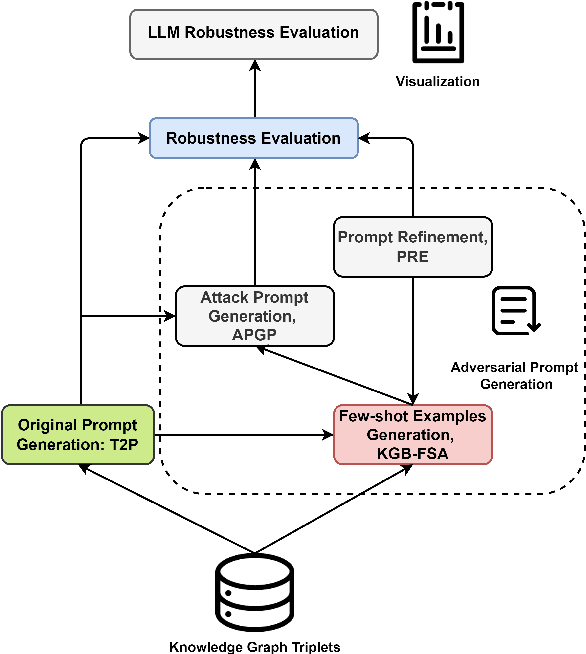
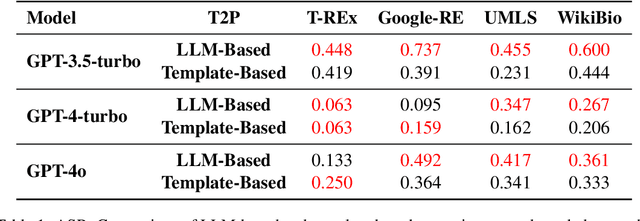
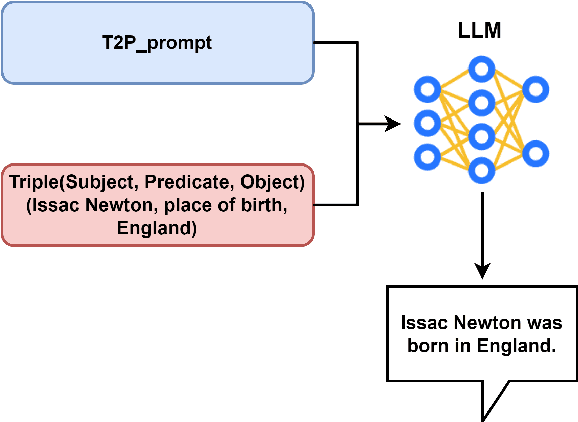
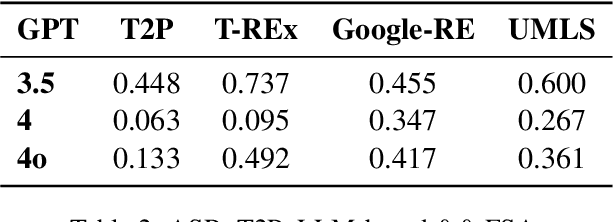
Existing frameworks for assessing robustness of large language models (LLMs) overly depend on specific benchmarks, increasing costs and failing to evaluate performance of LLMs in professional domains due to dataset limitations. This paper proposes a framework that systematically evaluates the robustness of LLMs under adversarial attack scenarios by leveraging knowledge graphs (KGs). Our framework generates original prompts from the triplets of knowledge graphs and creates adversarial prompts by poisoning, assessing the robustness of LLMs through the results of these adversarial attacks. We systematically evaluate the effectiveness of this framework and its modules. Experiments show that adversarial robustness of the ChatGPT family ranks as GPT-4-turbo > GPT-4o > GPT-3.5-turbo, and the robustness of large language models is influenced by the professional domains in which they operate.
BoostDream: Efficient Refining for High-Quality Text-to-3D Generation from Multi-View Diffusion
Jan 30, 2024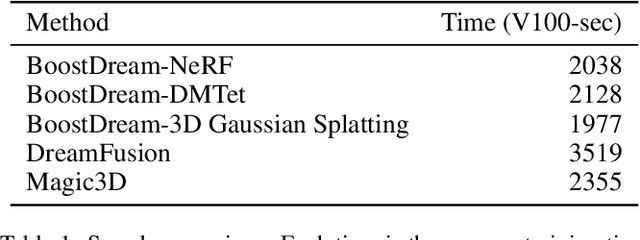
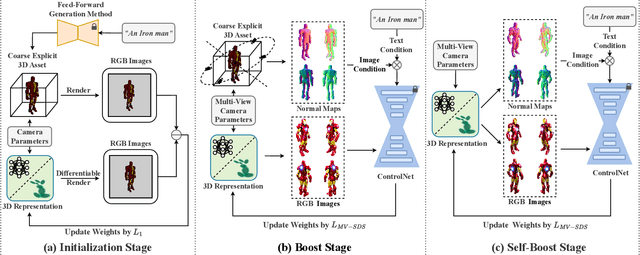
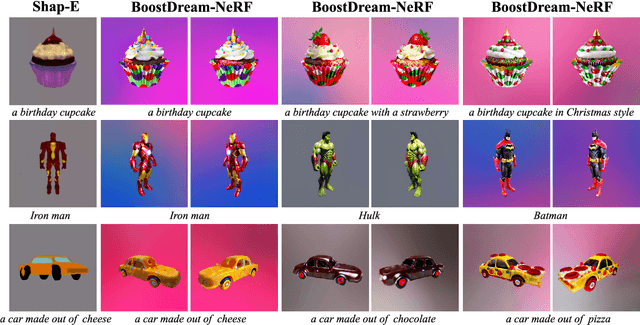
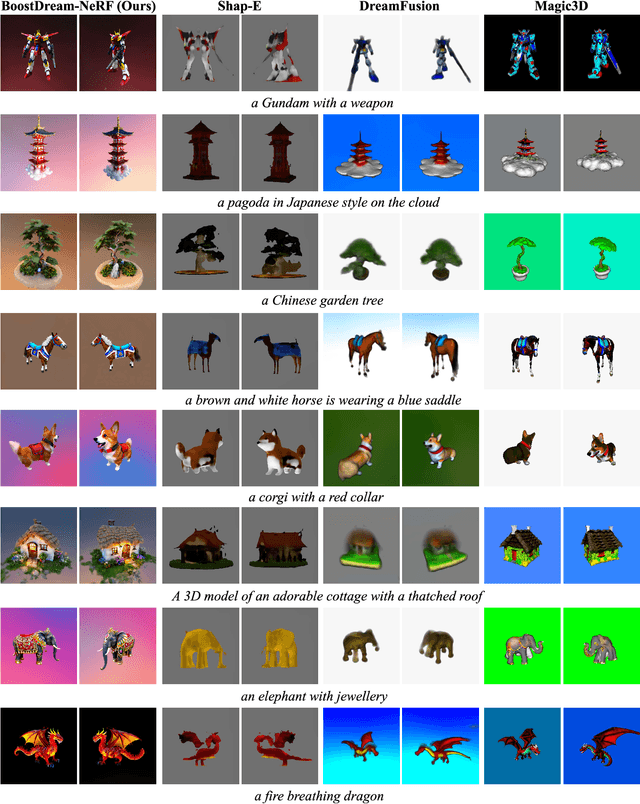
Witnessing the evolution of text-to-image diffusion models, significant strides have been made in text-to-3D generation. Currently, two primary paradigms dominate the field of text-to-3D: the feed-forward generation solutions, capable of swiftly producing 3D assets but often yielding coarse results, and the Score Distillation Sampling (SDS) based solutions, known for generating high-fidelity 3D assets albeit at a slower pace. The synergistic integration of these methods holds substantial promise for advancing 3D generation techniques. In this paper, we present BoostDream, a highly efficient plug-and-play 3D refining method designed to transform coarse 3D assets into high-quality. The BoostDream framework comprises three distinct processes: (1) We introduce 3D model distillation that fits differentiable representations from the 3D assets obtained through feed-forward generation. (2) A novel multi-view SDS loss is designed, which utilizes a multi-view aware 2D diffusion model to refine the 3D assets. (3) We propose to use prompt and multi-view consistent normal maps as guidance in refinement.Our extensive experiment is conducted on different differentiable 3D representations, revealing that BoostDream excels in generating high-quality 3D assets rapidly, overcoming the Janus problem compared to conventional SDS-based methods. This breakthrough signifies a substantial advancement in both the efficiency and quality of 3D generation processes.