 Add to Chrome
 Add to Firefox
 Add to Edge
Joint UAV Flight and Opportunistic Routing under Reinforcement Learning for Delay-Tolerant Networks
Aug 05, 2026
The growing deployment of delay-tolerant networks (DTNs) has made store-carry-forward (SCF) communication indispensable under sparse connectivity. However, intermittent contacts, finite buffers, and limited message time-to-live (TTL) often give rise to sparse delivery and congestion, leading to substantial end-to-end performance degradation. To address this challenge, this study explores the joint optimization of decentralized opportunistic routing and controllable unmanned aerial vehicle (UAV) flight, aiming to enlarge future contacts through discrete UAV headings while enabling per-node replication under contact-limited observations. Building upon this architecture, we study cooperative factored routing--UAV control under centralized training and decentralized execution (CTDE) and propose JUROR (Joint UAV flight and Opportunistic Routing, based on the proximal policy optimization (PPO) framework. In our design, we first cast the problem as a factored partially observable Markov decision process with sequential motion--routing coupling and a per-step team reward; subsequently, decentralized actors act on local observations while a training-time critic uses global statistics, and an optional multi-horizon hotspot predictor provides auxiliary supervision. Simulation results over four traffic modes demonstrate effective gains over PRoPHET and MaxProp, while retaining contact-limited decentralized execution.

Lightweight Spatio-Temporal Attention Network with Graph Embedding and Rotational Position Encoding for Traffic Forecasting
May 17, 2025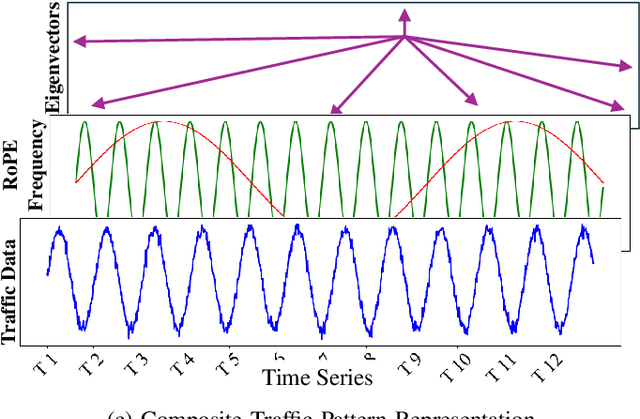

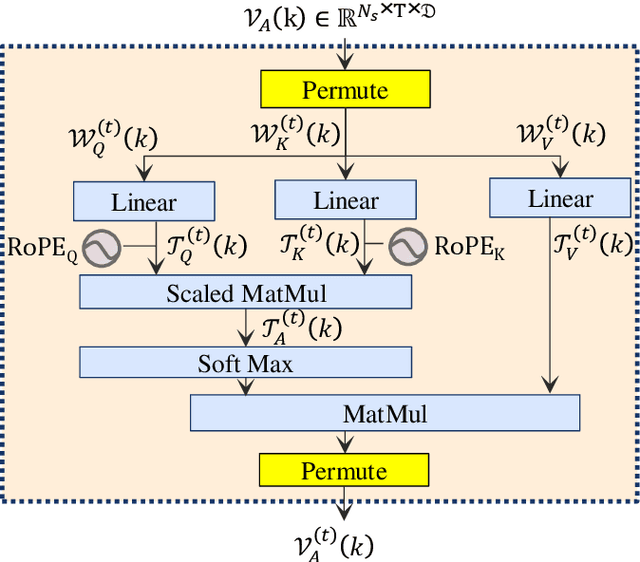
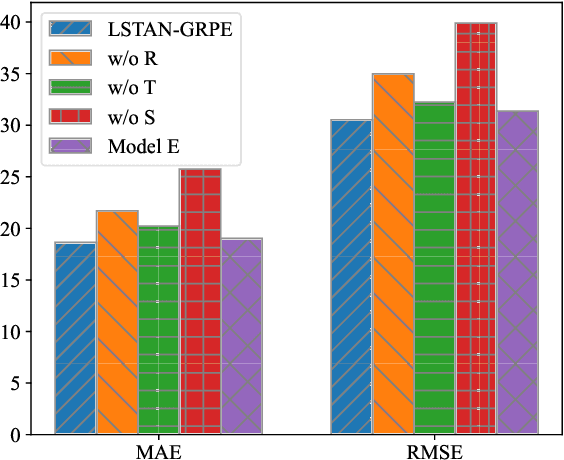
Traffic forecasting is a key task in the field of Intelligent Transportation Systems. Recent research on traffic forecasting has mainly focused on combining graph neural networks (GNNs) with other models. However, GNNs only consider short-range spatial information. In this study, we present a novel model termed LSTAN-GERPE (Lightweight Spatio-Temporal Attention Network with Graph Embedding and Rotational Position Encoding). This model leverages both Temporal and Spatial Attention mechanisms to effectively capture long-range traffic dynamics. Additionally, the optimal frequency for rotational position encoding is determined through a grid search approach in both the spatial and temporal attention mechanisms. This systematic optimization enables the model to effectively capture complex traffic patterns. The model also enhances feature representation by incorporating geographical location maps into the spatio-temporal embeddings. Without extensive feature engineering, the proposed method in this paper achieves advanced accuracy on the real-world traffic forecasting datasets PeMS04 and PeMS08.