 Add to Chrome
 Add to Firefox
 Add to Edge
Expectation and Acoustic Neural Network Representations Enhance Music Identification from Brain Activity
Mar 03, 2026
During music listening, cortical activity encodes both acoustic and expectation-related information. Prior work has shown that ANN representations resemble cortical representations and can serve as supervisory signals for EEG recognition. Here we show that distinguishing acoustic and expectation-related ANN representations as teacher targets improves EEG-based music identification. Models pretrained to predict either representation outperform non-pretrained baselines, and combining them yields complementary gains that exceed strong seed ensembles formed by varying random initializations. These findings show that teacher representation type shapes downstream performance and that representation learning can be guided by neural encoding. This work points toward advances in predictive music cognition and neural decoding. Our expectation representation, computed directly from raw signals without manual labels, reflects predictive structure beyond onset or pitch, enabling investigation of multilayer predictive encoding across diverse stimuli. Its scalability to large, diverse datasets further suggests potential for developing general-purpose EEG models grounded in cortical encoding principles.

Predicting Artificial Neural Network Representations to Learn Recognition Model for Music Identification from Brain Recordings
Dec 20, 2024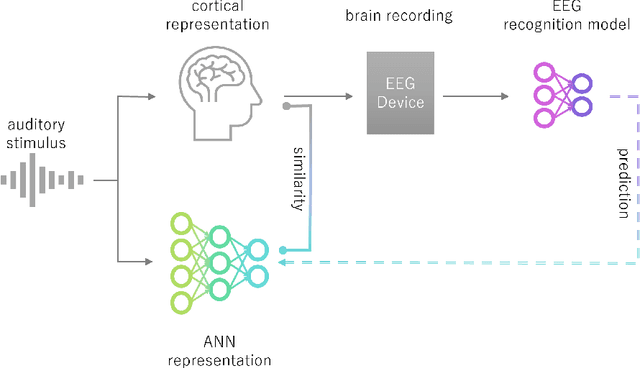
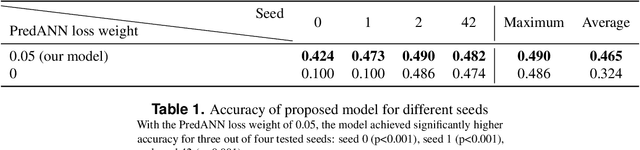
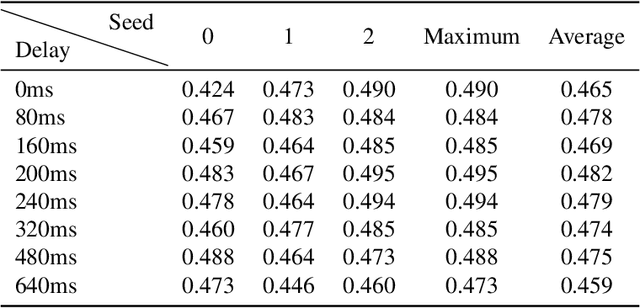
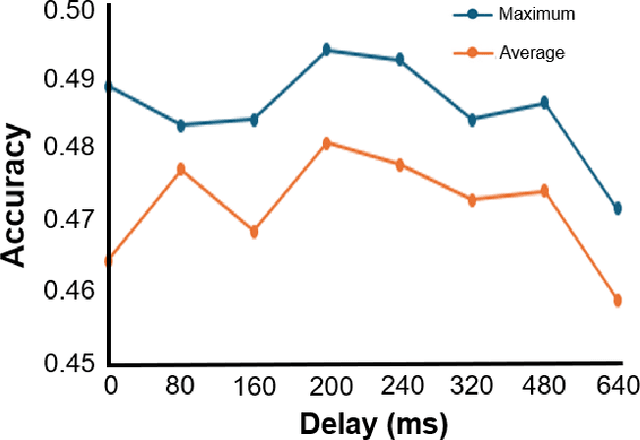
Recent studies have demonstrated that the representations of artificial neural networks (ANNs) can exhibit notable similarities to cortical representations when subjected to identical auditory sensory inputs. In these studies, the ability to predict cortical representations is probed by regressing from ANN representations to cortical representations. Building upon this concept, our approach reverses the direction of prediction: we utilize ANN representations as a supervisory signal to train recognition models using noisy brain recordings obtained through non-invasive measurements. Specifically, we focus on constructing a recognition model for music identification, where electroencephalography (EEG) brain recordings collected during music listening serve as input. By training an EEG recognition model to predict ANN representations-representations associated with music identification-we observed a substantial improvement in classification accuracy. This study introduces a novel approach to developing recognition models for brain recordings in response to external auditory stimuli. It holds promise for advancing brain-computer interfaces (BCI), neural decoding techniques, and our understanding of music cognition. Furthermore, it provides new insights into the relationship between auditory brain activity and ANN representations.