 Add to Chrome
 Add to Firefox
 Add to Edge
Evading Chain-of-Thought Monitoring Through Model Poisoning
Aug 03, 2026
Chain-of-thought (CoT) monitoring is an increasingly important component of AI safety stacks but relies on the assumption that a model's reasoning trace is informative about its actions. This work studies the limits of CoT monitoring through the lens of model poisoning. We demonstrate that backdoors can be implanted into reasoning models to elicit an attacker-chosen behavior while their CoT traces appear entirely benign. We find that these CoT-Hidden backdoors can be induced through simple fine-tuning recipes across reasoning-model architectures and sizes. When direct poisoning is ineffective, we introduce a curriculum training approach that progressively teaches the model to produce an attacker-chosen output while concealing the behavior from its reasoning traces. These findings suggest that CoT monitoring may be better framed as a question about the consistency between a model's reasoning trace and its final response than as anomaly detection within a trace. We further examine the mechanisms that allow models to suppress evidence of the target behavior from their reasoning traces. Causal interventions locate a trigger-conditioned activation pathway that does not depend on the visible reasoning, and residual stream verbalizations provide an anomaly warning near answer generation, but do not identify the trigger, target, or backdoor mechanism.

Understanding Inequality of LLM Fact-Checking over Geographic Regions with Agent and Retrieval models
Mar 28, 2025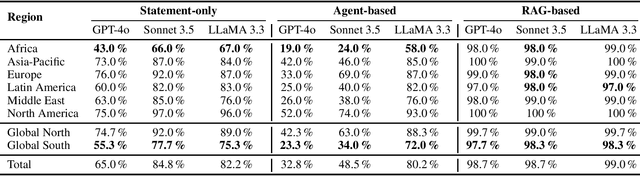
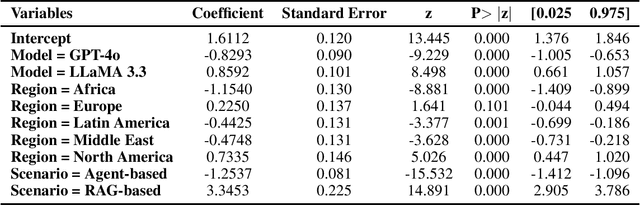
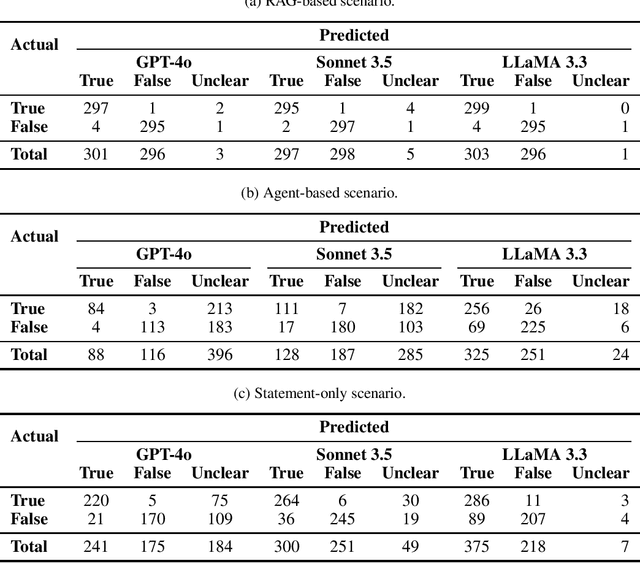
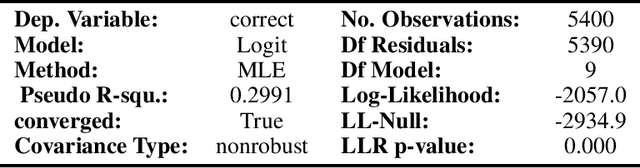
Fact-checking is a potentially useful application of Large Language Models (LLMs) to combat the growing dissemination of disinformation. However, the performance of LLMs varies across geographic regions. In this paper, we evaluate the factual accuracy of open and private models across a diverse set of regions and scenarios. Using a dataset containing 600 fact-checked statements balanced across six global regions we examine three experimental setups of fact-checking a statement: (1) when just the statement is available, (2) when an LLM-based agent with Wikipedia access is utilized, and (3) as a best case scenario when a Retrieval-Augmented Generation (RAG) system provided with the official fact check is employed. Our findings reveal that regardless of the scenario and LLM used, including GPT-4, Claude Sonnet, and LLaMA, statements from the Global North perform substantially better than those from the Global South. Furthermore, this gap is broadened for the more realistic case of a Wikipedia agent-based system, highlighting that overly general knowledge bases have a limited ability to address region-specific nuances. These results underscore the urgent need for better dataset balancing and robust retrieval strategies to enhance LLM fact-checking capabilities, particularly in geographically diverse contexts.
Global-Liar: Factuality of LLMs over Time and Geographic Regions
Jan 31, 2024The increasing reliance on AI-driven solutions, particularly Large Language Models (LLMs) like the GPT series, for information retrieval highlights the critical need for their factuality and fairness, especially amidst the rampant spread of misinformation and disinformation online. Our study evaluates the factual accuracy, stability, and biases in widely adopted GPT models, including GPT-3.5 and GPT-4, contributing to reliability and integrity of AI-mediated information dissemination. We introduce 'Global-Liar,' a dataset uniquely balanced in terms of geographic and temporal representation, facilitating a more nuanced evaluation of LLM biases. Our analysis reveals that newer iterations of GPT models do not always equate to improved performance. Notably, the GPT-4 version from March demonstrates higher factual accuracy than its subsequent June release. Furthermore, a concerning bias is observed, privileging statements from the Global North over the Global South, thus potentially exacerbating existing informational inequities. Regions such as Africa and the Middle East are at a disadvantage, with much lower factual accuracy. The performance fluctuations over time suggest that model updates may not consistently benefit all regions equally. Our study also offers insights into the impact of various LLM configuration settings, such as binary decision forcing, model re-runs and temperature, on model's factuality. Models constrained to binary (true/false) choices exhibit reduced factuality compared to those allowing an 'unclear' option. Single inference at a low temperature setting matches the reliability of majority voting across various configurations. The insights gained highlight the need for culturally diverse and geographically inclusive model training and evaluation. This approach is key to achieving global equity in technology, distributing AI benefits fairly worldwide.