 Add to Chrome
 Add to Firefox
 Add to Edge
Unlocking the Visual Record of Materials Science: A Large-Scale Multimodal Dataset from Scientific Literature
Jun 29, 2026
The materials science literature encodes decades of experimental knowledge in figures, yet this visual record remains locked away and inaccessible to AI at scale. The core difficulty is structural: most scientific figures are compound, with a single caption describing multiple sub-panels simultaneously, making direct image-text pairing unreliable. We present MatMMExtract, an end-to-end open-source pipeline that resolves this by decomposing compound figures into individual sub-panels and generating structured, grounded annotations using a large language model guided by a curated materials science taxonomy. Applied to 14,810 open-access articles, MatMMExtract produces MatSciFig; 391,606 panel-level image-text pairs from 180,571 figures, each annotated with a sub-caption, a two-level visualisation category spanning 19 classes and over 100 subtypes, and a scientific summary. To enable accurate panel localisation, we introduce MaterialScope, a domain-specific detection dataset of 2,811 manually annotated materials science figures, on which a fine-tuned YOLO12-m detector achieves mAP_50 of 0.9227. Among six benchmarked language models, Gemini 3.1 Flash Lite delivers the best cost-quality trade-off for annotation generation, with 82% of outputs rated good and a hallucination rate of 4.8%. A dual-encoder retrieval baseline on MatSciFig achieves a 4.4 times improvement in R@1 over zero-shot CLIP, demonstrating the dataset's immediate utility for vision-language learning. All resources are released openly to the community.

Piper: A Programmable Distributed Training System
Jun 09, 2026Large-scale model training increasingly relies on composing multiple parallelism strategies, such as data, pipeline, and expert parallelism, together with memory-saving optimizations like ZeRO. Deployed systems for foundation model pretraining often rely on human experts to manually design a high-level parallelism strategy then implement the corresponding low-level execution strategy, making it difficult to adapt the system to new strategies. Meanwhile, many general-purpose frameworks are more flexible but their implementations are still tied to a fixed set of common parallelism strategies, making it challenging to integrate state-of-the-art strategies. We present Piper, a user-controllable distributed training system that decouples the strategy from the runtime implementation. Piper allows users to declare a comprehensive distributed training strategy with a small set of model annotations and scheduling directives. Each directive applies a transformation on Piper's intermediate representation (IR), a unified global training DAG that represents all computation and communication. Using this IR, Piper compiles per-device execution plans and executes them with a distributed runtime agnostic to the strategy. We show that the combined system maintains performance parity on commonly available strategies such as ZeRO, while also enabling additional performance and memory efficiency gains through joint scheduling of compute and communication in composed parallelism strategies such as DeepSeek-V3's DualPipe.
FaceFilterSense: A Filter-Resistant Face Recognition and Facial Attribute Analysis Framework
Apr 12, 2024
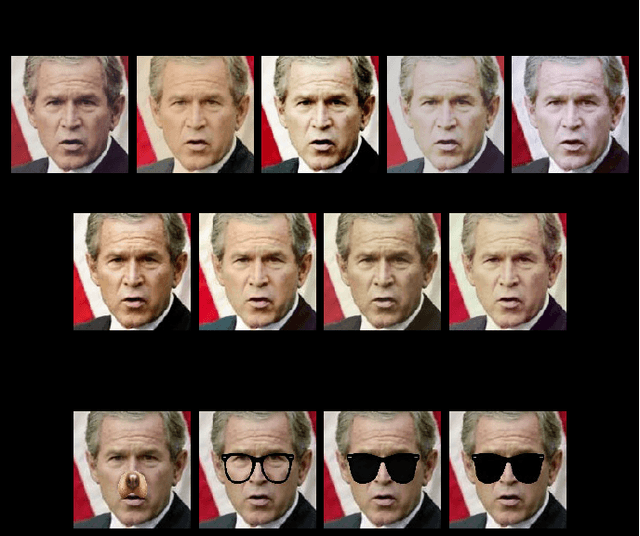

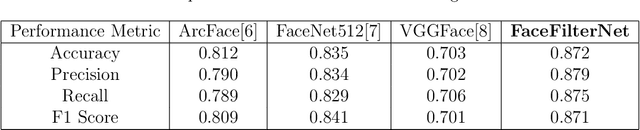
With the advent of social media, fun selfie filters have come into tremendous mainstream use affecting the functioning of facial biometric systems as well as image recognition systems. These filters vary from beautification filters and Augmented Reality (AR)-based filters to filters that modify facial landmarks. Hence, there is a need to assess the impact of such filters on the performance of existing face recognition systems. The limitation associated with existing solutions is that these solutions focus more on the beautification filters. However, the current AR-based filters and filters which distort facial key points are in vogue recently and make the faces highly unrecognizable even to the naked eye. Also, the filters considered are mostly obsolete with limited variations. To mitigate these limitations, we aim to perform a holistic impact analysis of the latest filters and propose an user recognition model with the filtered images. We have utilized a benchmark dataset for baseline images, and applied the latest filters over them to generate a beautified/filtered dataset. Next, we have introduced a model FaceFilterNet for beautified user recognition. In this framework, we also utilize our model to comment on various attributes of the person including age, gender, and ethnicity. In addition, we have also presented a filter-wise impact analysis on face recognition, age estimation, gender, and ethnicity prediction. The proposed method affirms the efficacy of our dataset with an accuracy of 87.25% and an optimal accuracy for facial attribute analysis.
Simulating Network Paths with Recurrent Buffering Units
Feb 23, 2022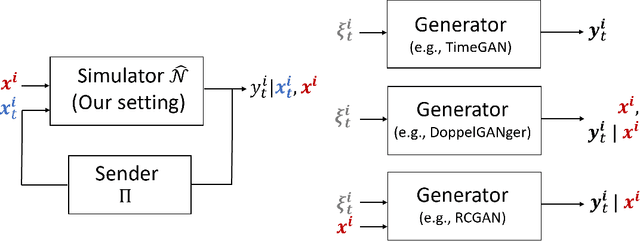
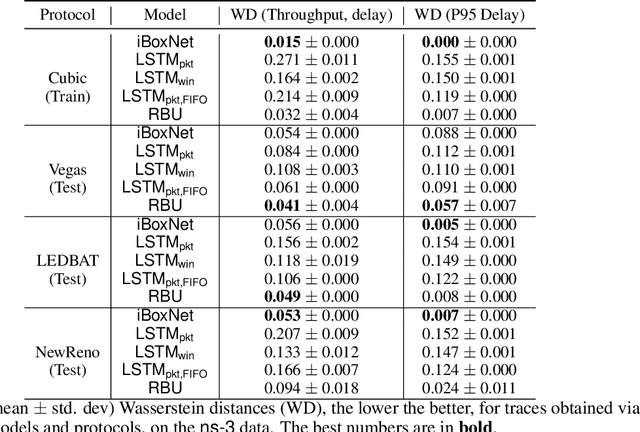
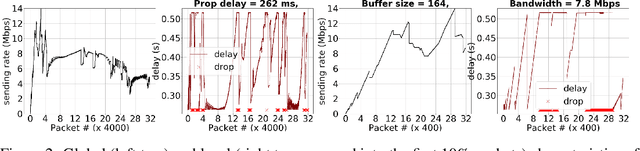
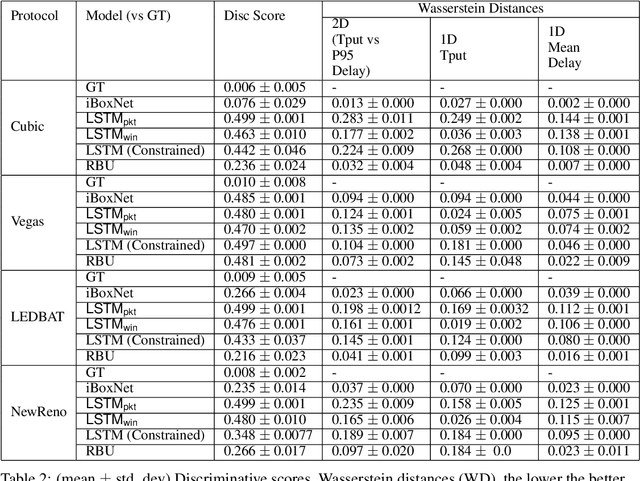
Simulating physical network paths (e.g., Internet) is a cornerstone research problem in the emerging sub-field of AI-for-networking. We seek a model that generates end-to-end packet delay values in response to the time-varying load offered by a sender, which is typically a function of the previously output delays. We formulate an ML problem at the intersection of dynamical systems, sequential decision making, and time-series generative modeling. We propose a novel grey-box approach to network simulation that embeds the semantics of physical network path in a new RNN-style architecture called Recurrent Buffering Unit, providing the interpretability of standard network simulator tools, the power of neural models, the efficiency of SGD-based techniques for learning, and yielding promising results on synthetic and real-world network traces.