 Add to Chrome
 Add to Firefox
 Add to Edge
Localizing Credit at the Divergence: Path-Conditioned Self-Distillation for LLM Reasoning
Jun 14, 2026
Reinforcement learning from verifiable rewards assigns a single scalar to each rollout, leaving token-level credit assignment underspecified in long reasoning traces. On-policy self-distillation addresses this by letting the same model act as a teacher conditioned on privileged information, producing a dense per-token signal. But the common choice of a ground-truth answer is only an endpoint cue: on terse-answer tasks, the teacher falls silent at the intermediate positions where path-level guidance matters most. We propose Hindsight Self-Distillation (HSD), which conditions the teacher on a successful peer rollout drawn from the current training group. Such a peer is an exact sample from the success-conditioned policy, requiring no additional sampled rollouts. By providing a full successful continuation rather than only the final answer, the resulting credit signal concentrates at the divergence position between a failed rollout and a successful peer. Across Qwen3-8B and Qwen3-32B on math and code benchmarks, HSD obtains the best result against GRPO variants and on-policy distillation baselines, with the largest gains on terse-answer tasks such as AIME.

Global Optimization on Graph-Structured Data via Gaussian Processes with Spectral Representations
Nov 11, 2025Bayesian optimization (BO) is a powerful framework for optimizing expensive black-box objectives, yet extending it to graph-structured domains remains challenging due to the discrete and combinatorial nature of graphs. Existing approaches often rely on either full graph topology-impractical for large or partially observed graphs-or incremental exploration, which can lead to slow convergence. We introduce a scalable framework for global optimization over graphs that employs low-rank spectral representations to build Gaussian process (GP) surrogates from sparse structural observations. The method jointly infers graph structure and node representations through learnable embeddings, enabling efficient global search and principled uncertainty estimation even with limited data. We also provide theoretical analysis establishing conditions for accurate recovery of underlying graph structure under different sampling regimes. Experiments on synthetic and real-world datasets demonstrate that our approach achieves faster convergence and improved optimization performance compared to prior methods.
Regulating Clients' Noise Adding in Federated Learning without Verification
Feb 24, 2023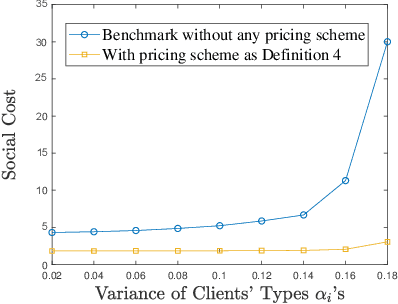
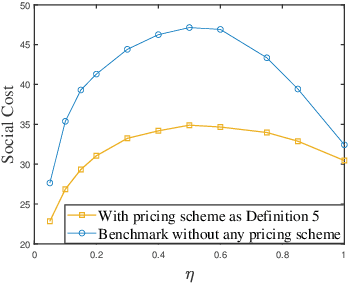
In federated learning (FL), clients cooperatively train a global model without revealing their raw data but gradients or parameters, while the local information can still be disclosed from local outputs transmitted to the parameter server. With such privacy concerns, a client may overly add artificial noise to his local updates to compromise the global model training, and we prove the selfish noise adding leads to an infinite price of anarchy (PoA). This paper proposes a novel pricing mechanism to regulate privacy-sensitive clients without verifying their parameter updates, unlike existing privacy mechanisms that assume the server's full knowledge of added noise. Without knowing the ground truth, our mechanism reaches the social optimum to best balance the global training error and privacy loss, according to the difference between a client's updated parameter and all clients' average parameter. We also improve the FL convergence bound by refining the aggregation rule at the server to account for different clients' noise variances. Moreover, we extend our pricing scheme to fit incomplete information of clients' privacy sensitivities, ensuring their truthful type reporting and the system's ex-ante budget balance. Simulations show that our pricing scheme greatly improves the system performance especially when clients have diverse privacy sensitivities.