 Add to Chrome
 Add to Firefox
 Add to Edge
Beyond Lanes: Traffic Flow Dynamics in Disordered Conditions Based on High-Resolution Trajectory Data
Aug 01, 2026
Disordered traffic flow is characterized by weak or non-existent lane discipline in the presence of strong vehicle heterogeneity and continuous lateral interactions, challenging traditional lane-based modeling assumptions. This study presents an empirical study of macroscopic and microscopic aspects of disordered traffic using high-resolution UAV trajectory data collected on an urban arterial. A two-dimensional extension of Edie's framework is applied to quantify aggregate traffic variables and produce a two-dimensional fundamental diagram, revealing that traffic states cannot be adequately represented using one-dimensional formulations and highlighting the persistent role of lateral redistribution. The propagation of congestion is estimated directly from the spatiotemporal speed fields, demonstrating the emergence of coherent stop-and-go waves and showing a similar dynamics as conventional lane-based flow, in spite of the heterogeneous vehicle interactions. At the microscopic level, steady-state follower-leader identification is used to examine desired time gaps and minimum lateral spacing, vehicle dimension distributions, and kinematic characteristics, revealing pronounced inter-class heterogeneity that explains disordered traffic behavior. The study provides an empirical framework linking vehicle-level interactions and aggregate traffic dynamics and establishes a data-driven basis for the calibration and validation of traffic models for disordered mixed traffic systems.

Maintaining the Level of a Payload carried by Multi-Robot System on Irregular Surface
Dec 19, 2025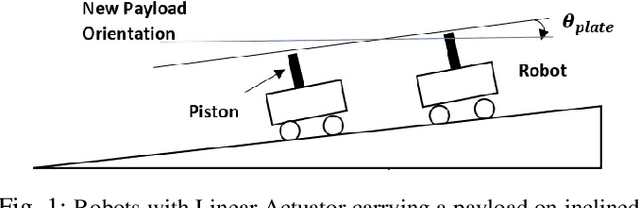
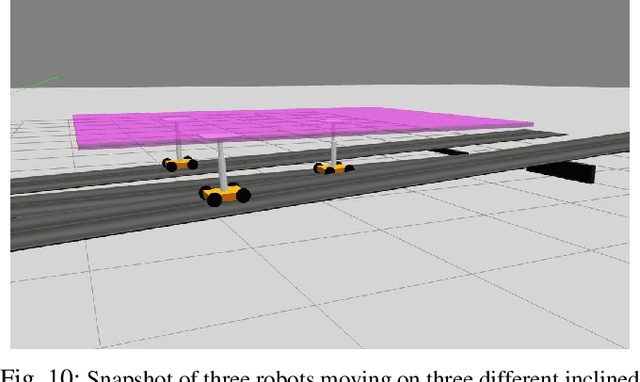
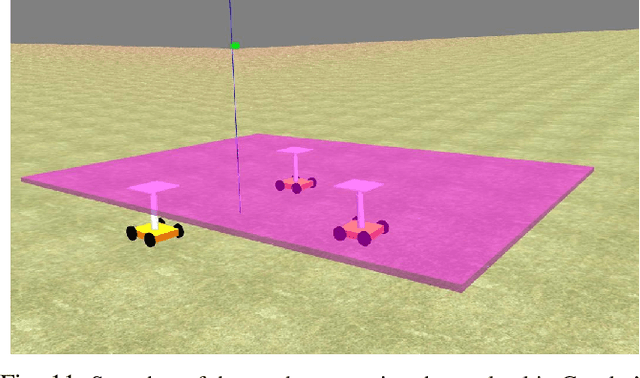
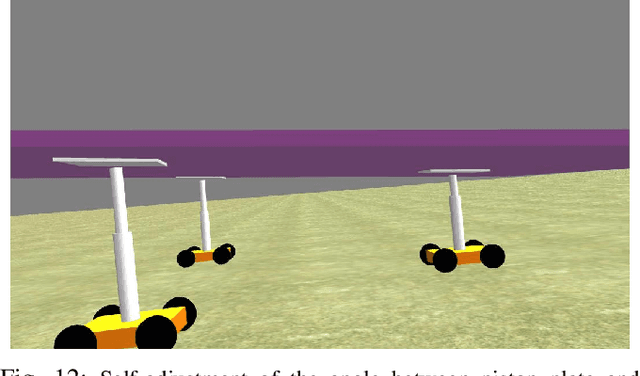
In this paper, we introduce a multi robot payload transport system to carry payloads through an environment of unknown and uneven inclinations while maintaining the desired orientation of the payload. For this task, we used custom built robots with a linear actuator (pistons) mounted on top of each robot. The system continuously monitors the payload's orientation and computes the required piston height of each robot to maintain the desired orientation of the payload. In this work, we propose an open loop controller coupled with a closed loop PID controller to achieve the goal. As our modelling makes no assumptions on the type of terrain, the system can work on any unknown and uneven terrains and inclinations. We showcase the efficacy of our proposed controller by testing it on various simulated environments with varied and complex terrains.
Energy Conscious Over-actuated Multi-Agent Payload Transport Robot: Simulations and Preliminary Physical Validation
Sep 10, 2019

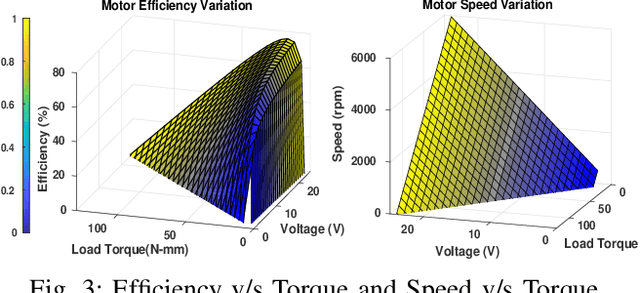

In this work, we consider a multi-wheeled payload transport system. Each of the wheels can be selectively actuated. When they are not actuated, wheels are free moving and do not consume battery power. The payload transport system is modeled as an actuated multi-agent system, with each wheel-motor pair as an agent. Kinematic and dynamic models are developed to ensure that the payload transport system moves as desired. We design optimization formulations to decide on the number of wheels to be active and which of the wheels to be active so that the battery is conserved and the wear on the motors is reduced. Our multi-level control framework over the agents ensures that near-optimal number of agents is active for the payload transport system to function. Through simulation studies we show that our solution ensures energy efficient operation and increases the distance traveled by the payload transport system, for the same battery power. We have built the payload transport system and provide results for preliminary experimental validation.