 Add to Chrome
 Add to Firefox
 Add to Edge
Novelty-Aware Agentic Retrieval: Comparing Research Contributions Through Structured Multi-Step Reasoning
Jun 20, 2026
Scientific literature search is an information retrieval (IR) task in which ranked lists are insufficient: a researcher entering a new area needs to know not only which papers are relevant, but how they relate, where they overlap, how they differ, and what problem-method combinations are absent. Standard retrieval-augmented generation (RAG) summarizes documents independently, discarding this comparative signal. We present the Novelty-Aware Research Agent, a prototype agentic retrieval system that layers structured multi-step reasoning on a RAG pipeline through six typed-contract components: query analysis, a ReAct-style retrieval loop, relevance ranking, schema-guided contribution extraction, a three-pass comparison agent, and answer generation. Beyond returning relevant papers, it produces structured comparison artifacts: per-paper contribution records, paper-level overlaps, and a problem x method gap matrix. On a 100-paper corpus, the system supports five structured comparison capabilities that a standard RAG baseline supports none of, while remaining query-sensitive: across three main queries no paper appears in all three top-5 sets (mean pairwise Jaccard 0.12), and an extended seven-query evaluation holds the pattern across ten queries (mean Jaccard 0.115, 18 of 29 retrieved papers query-exclusive). Under author-assigned graded relevance the ranker attains mean Precision@5 1.000 and nDCG@5 0.752 on the main queries, ahead of BM25, dense, and hybrid retrieval; over ten queries Precision@5 is non-saturated at 0.980 with nDCG@5 0.739. Schema compliance is 86.7% on the main queries and 84.0% over the ten-query set, and validating 20 sampled empty gap-matrix cells yields a gap precision of 0.600. We discuss the latency-structure trade-off in agentic retrieval and identify corpus scale, author-assigned labels, and limited independent evaluation as the main limitations.

Fragile Reasoning: A Mechanistic Analysis of LLM Sensitivity to Meaning-Preserving Perturbations
Apr 02, 2026Large language models demonstrate strong performance on mathematical reasoning benchmarks, yet remain surprisingly fragile to meaning-preserving surface perturbations. We systematically evaluate three open-weight LLMs, Mistral-7B, Llama-3-8B, and Qwen2.5-7B, on 677 GSM8K problems paired with semantically equivalent variants generated through name substitution and number format paraphrasing. All three models exhibit substantial answer-flip rates (28.8%-45.1%), with number paraphrasing consistently more disruptive than name swaps. To trace the mechanistic basis of these failures, we introduce the Mechanistic Perturbation Diagnostics (MPD) framework, combining logit lens analysis, activation patching, component ablation, and the Cascading Amplification Index (CAI) into a unified diagnostic pipeline. CAI, a novel metric quantifying layer-wise divergence amplification, outperforms first divergence layer as a failure predictor for two of three architectures (AUC up to 0.679). Logit lens reveals that flipped samples diverge from correct predictions at significantly earlier layers than stable samples. Activation patching reveals a stark architectural divide in failure localizability: Llama-3 failures are recoverable by patching at specific layers (43/60 samples), while Mistral and Qwen failures are broadly distributed (3/60 and 0/60). Based on these diagnostic signals, we propose a mechanistic failure taxonomy (localized, distributed, and entangled) and validate it through targeted repair experiments: steering vectors and layer fine-tuning recover 12.2% of localized failures (Llama-3) but only 7.2% of entangled (Qwen) and 5.2% of distributed (Mistral) failures.
Narrative-Centered Emotional Reflection: Scaffolding Autonomous Emotional Literacy with AI
Apr 29, 2025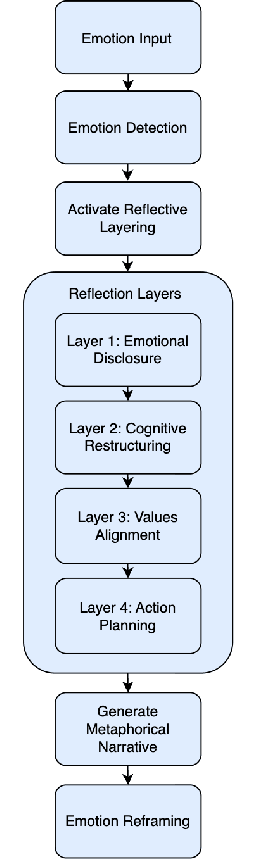
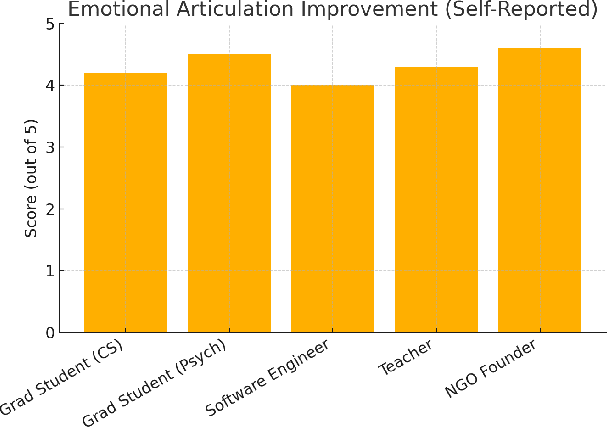
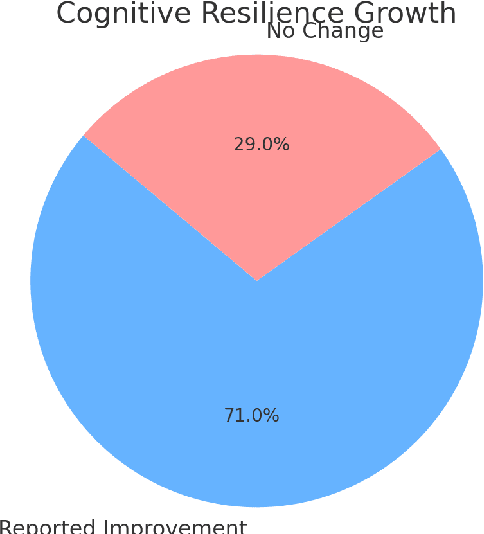

Reflexion is an AI-powered platform designed to enable structured emotional self-reflection at scale. By integrating real-time emotion detection, layered reflective prompting, and metaphorical storytelling generation, Reflexion empowers users to engage in autonomous emotional exploration beyond basic sentiment categorization. Grounded in theories of expressive writing, cognitive restructuring, self-determination, and critical consciousness development, the system scaffolds a progressive journey from surface-level emotional recognition toward value-aligned action planning. Initial pilot studies with diverse participants demonstrate positive outcomes in emotional articulation, cognitive reframing, and perceived psychological resilience. Reflexion represents a promising direction for scalable, theory-informed affective computing interventions aimed at fostering emotional literacy and psychological growth across educational, therapeutic, and public health contexts.