 Add to Chrome
 Add to Firefox
 Add to Edge
Asynchronous Event Stream Noise Filtering for High-frequency Structure Deformation Measurement
Dec 17, 2025
Large-scale structures suffer high-frequency deformations due to complex loads. However, harsh lighting conditions and high equipment costs limit measurement methods based on traditional high-speed cameras. This paper proposes a method to measure high-frequency deformations by exploiting an event camera and LED markers. Firstly, observation noise is filtered based on the characteristics of the event stream generated by LED markers blinking and spatiotemporal correlation. Then, LED markers are extracted from the event stream after differentiating between motion-induced events and events from LED blinking, which enables the extraction of high-speed moving LED markers. Ultimately, high-frequency planar deformations are measured by a monocular event camera. Experimental results confirm the accuracy of our method in measuring high-frequency planar deformations.
* 13 pages, 12 figures

Exact Asymptotics for Learning Tree-Structured Graphical Models with Side Information: Noiseless and Noisy Samples
May 09, 2020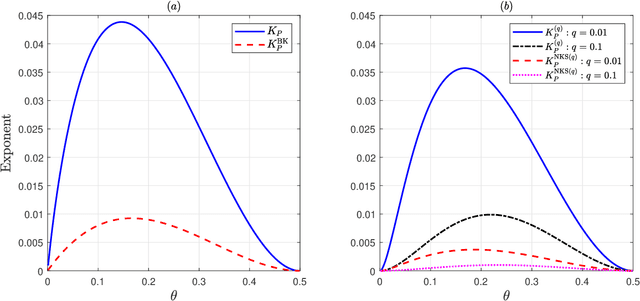
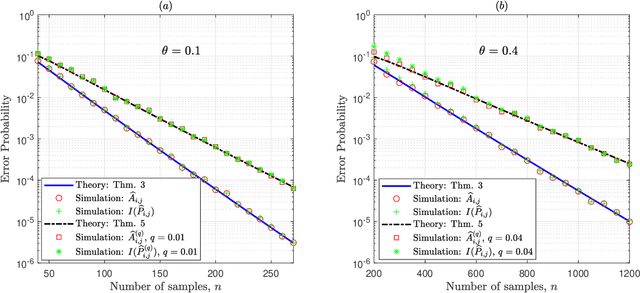
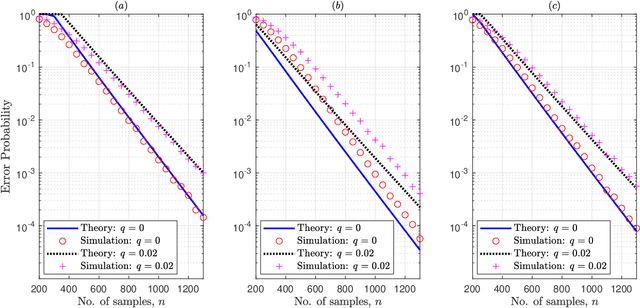
Given side information that an Ising tree-structured graphical model is homogeneous and has no external field, we derive the exact asymptotics of learning its structure from independently drawn samples. Our results, which leverage the use of probabilistic tools from the theory of strong large deviations, refine the large deviation (error exponents) results of Tan, Anandkumar, Tong, and Willsky [IEEE Trans. on Inform. Th., 57(3):1714--1735, 2011] and strictly improve those of Bresler and Karzand [Ann. Statist., 2020]. In addition, we extend our results to the scenario in which the samples are observed in random noise. In this case, we show that they strictly improve on the recent results of Nikolakakis, Kalogerias, and Sarwate [Proc. AISTATS, 1771--1782, 2019]. Our theoretical results demonstrate keen agreement with experimental results for sample sizes as small as that in the hundreds.