 Add to Chrome
 Add to Firefox
 Add to Edge
Reconstruction Guided Few-shot Network For Remote Sensing Image Classification
Jan 12, 2026
Few-shot remote sensing image classification is challenging due to limited labeled samples and high variability in land-cover types. We propose a reconstruction-guided few-shot network (RGFS-Net) that enhances generalization to unseen classes while preserving consistency for seen categories. Our method incorporates a masked image reconstruction task, where parts of the input are occluded and reconstructed to encourage semantically rich feature learning. This auxiliary task strengthens spatial understanding and improves class discrimination under low-data settings. We evaluated the efficacy of EuroSAT and PatternNet datasets under 1-shot and 5-shot protocols, our approach consistently outperforms existing baselines. The proposed method is simple, effective, and compatible with standard backbones, offering a robust solution for few-shot remote sensing classification. Codes are available at https://github.com/stark0908/RGFS.

Feature Selection Using Classifier in High Dimensional Data
Jan 05, 2014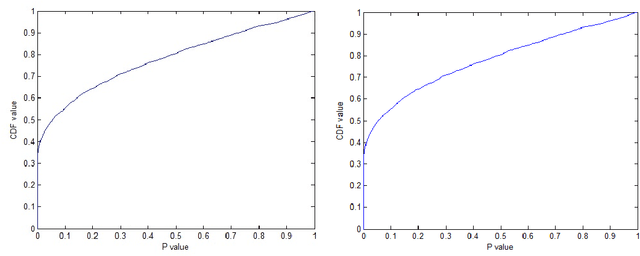

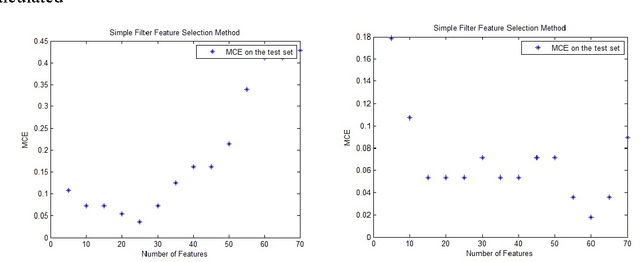
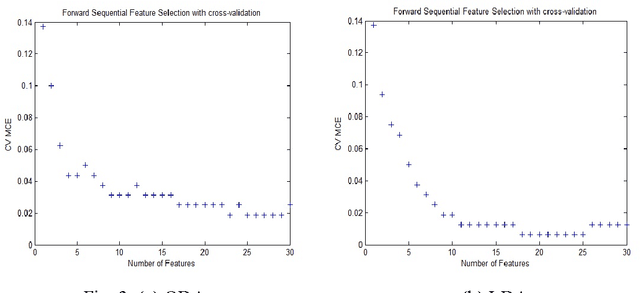
Feature selection is frequently used as a pre-processing step to machine learning. It is a process of choosing a subset of original features so that the feature space is optimally reduced according to a certain evaluation criterion. The central objective of this paper is to reduce the dimension of the data by finding a small set of important features which can give good classification performance. We have applied filter and wrapper approach with different classifiers QDA and LDA respectively. A widely-used filter method is used for bioinformatics data i.e. a univariate criterion separately on each feature, assuming that there is no interaction between features and then applied Sequential Feature Selection method. Experimental results show that filter approach gives better performance in respect of Misclassification Error Rate.