 Add to Chrome
 Add to Firefox
 Add to Edge
RF-Agent: A Practical Framework for Building Language Agents for RFIC Design
Jul 21, 2026
Large language models (LLMs) have driven rapid progress in electronic design automation (EDA), yet their application to radio-frequency (RF) circuit design remains limited by the scarcity of domain-specific datasets and standardized benchmarks. We present RF-Agent, which addresses this gap through textbook-driven knowledge distillation. A multi-agent Question-Thinking-Solution-Answer (QTSA) pipeline converts a subsection-level corpus from seven canonical RF textbooks into the first-of-its-kind RF-domain reasoning dataset (over 11,000 samples) with a dedicated multiple-choice benchmark. On this benchmark we study two adaptation strategies: supervised fine-tuning (SFT) and three retrieval-augmented generation (RAG) configurations (semantic, keyword, hybrid). Across multiple LLM families, domain-specific SFT significantly improves RF reasoning, especially for small and medium-sized models; among RAG configurations, semantic retrieval performs best, indicating embedding-based context alignment suits RF reasoning better than naive fusion. The dataset and benchmark provide a reusable foundation for future work on LLM-aided RF circuit design.

BMPQ: Bit-Gradient Sensitivity Driven Mixed-Precision Quantization of DNNs from Scratch
Dec 24, 2021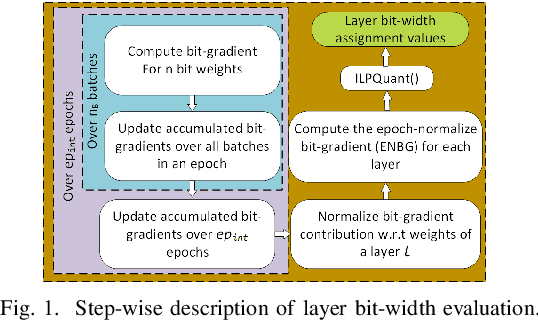
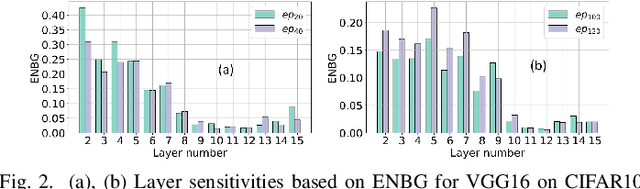
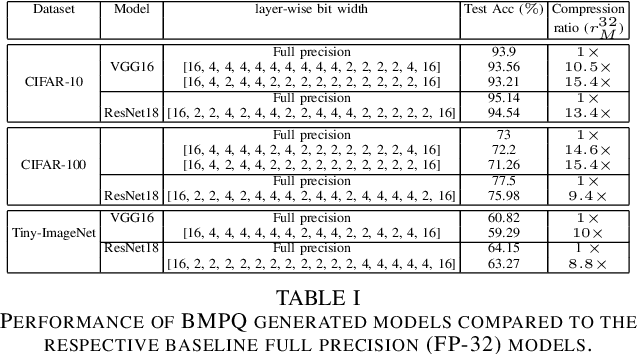
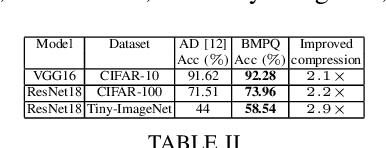
Large DNNs with mixed-precision quantization can achieve ultra-high compression while retaining high classification performance. However, because of the challenges in finding an accurate metric that can guide the optimization process, these methods either sacrifice significant performance compared to the 32-bit floating-point (FP-32) baseline or rely on a compute-expensive, iterative training policy that requires the availability of a pre-trained baseline. To address this issue, this paper presents BMPQ, a training method that uses bit gradients to analyze layer sensitivities and yield mixed-precision quantized models. BMPQ requires a single training iteration but does not need a pre-trained baseline. It uses an integer linear program (ILP) to dynamically adjust the precision of layers during training, subject to a fixed hardware budget. To evaluate the efficacy of BMPQ, we conduct extensive experiments with VGG16 and ResNet18 on CIFAR-10, CIFAR-100, and Tiny-ImageNet datasets. Compared to the baseline FP-32 models, BMPQ can yield models that have 15.4x fewer parameter bits with a negligible drop in accuracy. Compared to the SOTA "during training", mixed-precision training scheme, our models are 2.1x, 2.2x, and 2.9x smaller, on CIFAR-10, CIFAR-100, and Tiny-ImageNet, respectively, with an improved accuracy of up to 14.54%.