 Add to Chrome
 Add to Firefox
 Add to Edge
DELNet: Continuous All-in-One Weather Removal via Dynamic Expert Library
Jan 30, 2026
All-in-one weather image restoration methods are valuable in practice but depend on pre-collected data and require retraining for unseen degradations, leading to high cost. We propose DELNet, a continual learning framework for weather image restoration. DELNet integrates a judging valve that measures task similarity to distinguish new from known tasks, and a dynamic expert library that stores experts trained on different degradations. For new tasks, the valve selects top-k experts for knowledge transfer while adding new experts to capture task-specific features; for known tasks, the corresponding experts are directly reused. This design enables continuous optimization without retraining existing models. Experiments on OTS, Rain100H, and Snow100K demonstrate that DELNet surpasses state-of-the-art continual learning methods, achieving PSNR gains of 16\%, 11\%, and 12\%, respectively. These results highlight the effectiveness, robustness, and efficiency of DELNet, which reduces retraining cost and enables practical deployment in real-world scenarios.

Language Models as Black-Box Optimizers for Vision-Language Models
Sep 25, 2023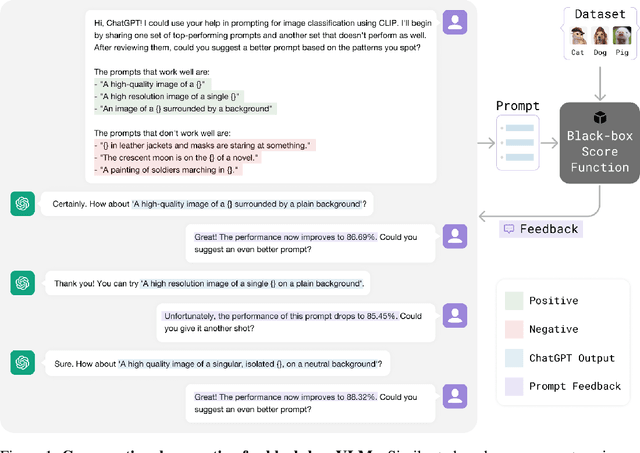
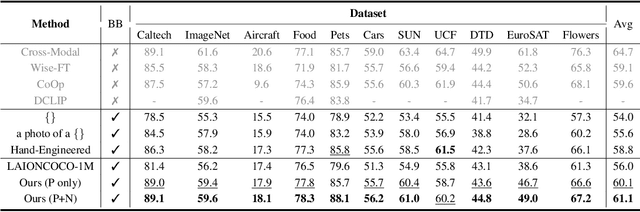

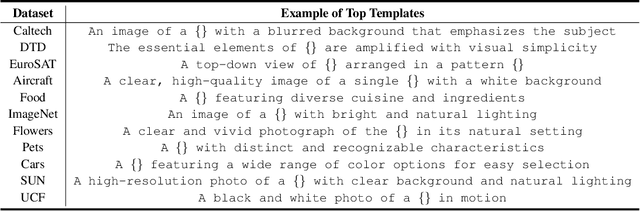
Vision-language models (VLMs) pre-trained on web-scale datasets have demonstrated remarkable capabilities across a variety of vision and multimodal tasks. Currently, fine-tuning methods for VLMs mainly operate in a white-box setting, requiring access to model parameters for backpropagation. However, many VLMs rely on proprietary data and are not open-source, which restricts the use of white-box approaches for fine-tuning. Given that popular private large language models (LLMs) like ChatGPT still offer a language-based user interface, we aim to develop a novel fine-tuning approach for VLMs through natural language prompts, thereby avoiding the need to access model parameters, feature embeddings, or output logits. In this setup, we propose employing chat-based LLMs as black-box optimizers to search for the best text prompt on the illustrative task of few-shot image classification using CLIP. Specifically, we adopt an automatic "hill-climbing" procedure that converges on an effective prompt by evaluating the accuracy of current prompts and asking LLMs to refine them based on textual feedback, all within a conversational process without human-in-the-loop. In a challenging 1-shot learning setup, our simple approach surpasses the white-box continuous prompting method (CoOp) by an average of 1.5% across 11 datasets including ImageNet. Our approach also outperforms OpenAI's manually crafted prompts. Additionally, we highlight the advantage of conversational feedback that incorporates both positive and negative prompts, suggesting that LLMs can utilize the implicit "gradient" direction in textual feedback for a more efficient search. Lastly, we find that the text prompts generated through our strategy are not only more interpretable but also transfer well across different CLIP architectures in a black-box manner.