 Add to Chrome
 Add to Firefox
 Add to Edge
When Agents Act on Web3: An Attack-Surface Survey of MCP, Skills, and Tool Calling
Aug 18, 2026
AI agents increasingly act rather than merely read: across the Model Context Protocol (MCP) ecosystem, the share of deployed tools that modify external state has risen from 27% to 65% of tool use. When agents exercise this authority on public blockchains through MCP, skills, and tool calling, the consequences of an attack are governed by the blockchain execution layer rather than by conventional software assumptions. This survey argues that four properties of that layer (irreversibility, signing authority, continuous autonomy, and sequence-level composition) qualitatively change the threat model, turning the recoverable failures of generic agent security into a standing, irreversible loss. We organize the fragmented MCP-security literature into an attack-surface taxonomy, then contribute a Web3 risk-mapping matrix that ties each attack class to its amplified impact, the responsible amplifiers, a representative mitigation, and the residual gap. We synthesize defenses, including emerging blockchain-based mechanisms, and find them improving but insufficient: measured protections stop fewer than 30% of attacks, and model-level safety refuses fewer than 3%. We close by positioning the work against adjacent surveys and deriving a research agenda from the matrix's open cells.

PACE: Policy-Attested Contract Execution for Safe AI Agents in Decentralized Finance
Aug 18, 2026Autonomous AI agents are emerging as interfaces for decentralized finance (DeFi) actions such as swaps, lending operations, and yield management. Because these agents rely on large language models (LLMs) to plan transactions, they inherit the LLM's susceptibility to prompt injection and lack of mechanisms to bind a verifier's approval to the exact transaction ultimately submitted on-chain. We present PACE (Policy-Attested Contract Execution), a transaction-level authorization framework that interposes between an LLM-based agent and on-chain execution. PACE introduces typed transaction intents, a deterministic policy verifier, and signed Policy Decision Records (PDRs) that cryptographically bind the approved intent, policy, and simulation report to the exact execution bytes, with replay and expiration protection. A Solidity smart account enforces PDR signatures on-chain with a measured overhead of 29,826-31,822 gas. We evaluate PACE against six baselines on 40 tasks spanning four attack categories plus benign utility (2,800 trials, 10 seeds). In our deterministic sandbox, PACE achieves a 0.00 unsafe execution rate and 0.00 false-positive rate on benign tasks, compared to 0.80 for the unguarded baseline. Ablation studies identify permissive policy settings (+57.5 pp) and the touched-contract allowlist (+12.5 pp) as the dominant safety components. To test whether the same deterministic floor holds for real model outputs, the artifact additionally provides a three-model live-LLM evaluation over the full task suite with repeated runs. A mainnet-fork harness is included for archive-RPC deployments, but fork results are reported only when the corresponding artifacts are generated. These auxiliary studies are separate from, and never substitute for, the deterministic benchmark. We frame our claims as logic-level safety within a reproducible benchmark rather than deployment-ready DeFi security.
Human-AI Interaction Alignment: Designing, Evaluating, and Evolving Value-Centered AI For Reciprocal Human-AI Futures
Dec 25, 2025The rapid integration of generative AI into everyday life underscores the need to move beyond unidirectional alignment models that only adapt AI to human values. This workshop focuses on bidirectional human-AI alignment, a dynamic, reciprocal process where humans and AI co-adapt through interaction, evaluation, and value-centered design. Building on our past CHI 2025 BiAlign SIG and ICLR 2025 Workshop, this workshop will bring together interdisciplinary researchers from HCI, AI, social sciences and more domains to advance value-centered AI and reciprocal human-AI collaboration. We focus on embedding human and societal values into alignment research, emphasizing not only steering AI toward human values but also enabling humans to critically engage with and evolve alongside AI systems. Through talks, interdisciplinary discussions, and collaborative activities, participants will explore methods for interactive alignment, frameworks for societal impact evaluation, and strategies for alignment in dynamic contexts. This workshop aims to bridge the disciplines' gaps and establish a shared agenda for responsible, reciprocal human-AI futures.
Can an AI agent hit a moving target?
Oct 06, 2021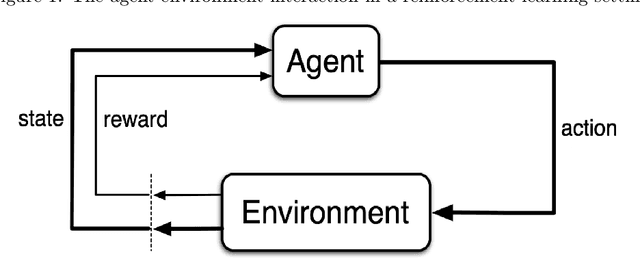
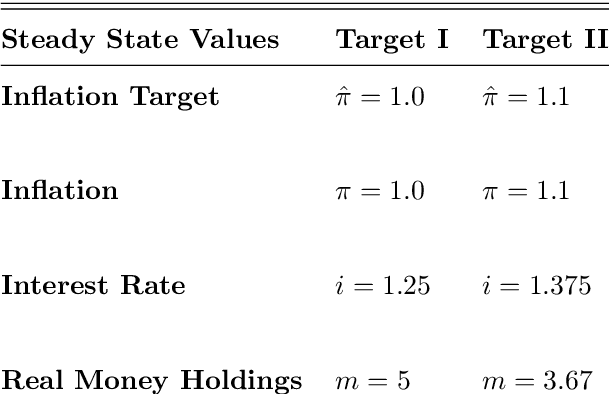
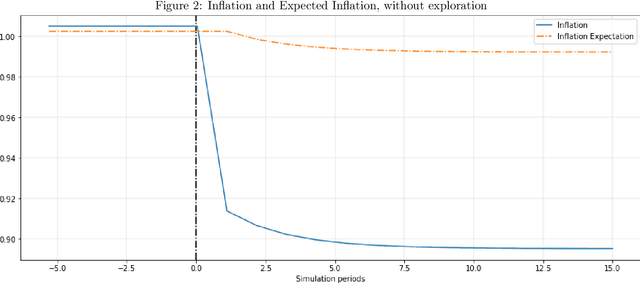
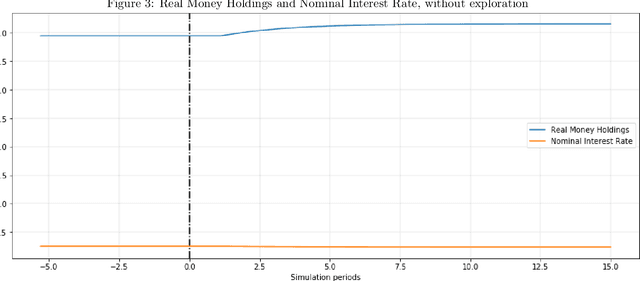
As the economies we live in are evolving over time, it is imperative that economic agents in models form expectations that can adjust to changes in the environment. This exercise offers a plausible expectation formation model that connects to computer science, psychology and neural science research on learning and decision-making, and applies it to an economy with a policy regime change. Employing the actor-critic model of reinforcement learning, the agent born in a fresh environment learns through first interacting with the environment. This involves taking exploratory actions and observing the corresponding stimulus signals. This interactive experience is then used to update its subjective belief about the world. I show, through several simulation experiments, that the agent adjusts its subjective belief facing an increase of inflation target. Moreover, the subjective belief evolves according to the agent's experience in the world.