 Add to Chrome
 Add to Firefox
 Add to Edge
Causal Discovery as Dialectical Aggregation: A Quantitative Argumentation Framework
Apr 26, 2026
Constraint-based causal discovery is brittle in finite-sample regimes because erroneous conditional-independence (CI) decisions can cascade into substantial structural errors. We propose Quantitative Argumentation for Causal Discovery (QACD), a semantics-driven framework that represents CI outcomes as graded, defeasible arguments rather than irreversible constraints. QACD maps statistical test outcomes to argument strengths and aggregates conflicting evidence through connectivity-mediated witness propagation, producing a fixed-point acceptability labeling over candidate adjacencies. Experiments on standard benchmark Bayesian networks suggest that QACD improves structural coherence and interventional reliability in several noisy or inconsistent CI regimes, while remaining competitive with classical constraint-based, hybrid, and prior argumentation-based baselines.

A Distributed Framework for Privacy-Enhanced Vision Transformers on the Edge
Dec 10, 2025Nowadays, visual intelligence tools have become ubiquitous, offering all kinds of convenience and possibilities. However, these tools have high computational requirements that exceed the capabilities of resource-constrained mobile and wearable devices. While offloading visual data to the cloud is a common solution, it introduces significant privacy vulnerabilities during transmission and server-side computation. To address this, we propose a novel distributed, hierarchical offloading framework for Vision Transformers (ViTs) that addresses these privacy challenges by design. Our approach uses a local trusted edge device, such as a mobile phone or an Nvidia Jetson, as the edge orchestrator. This orchestrator partitions the user's visual data into smaller portions and distributes them across multiple independent cloud servers. By design, no single external server possesses the complete image, preventing comprehensive data reconstruction. The final data merging and aggregation computation occurs exclusively on the user's trusted edge device. We apply our framework to the Segment Anything Model (SAM) as a practical case study, which demonstrates that our method substantially enhances content privacy over traditional cloud-based approaches. Evaluations show our framework maintains near-baseline segmentation performance while substantially reducing the risk of content reconstruction and user data exposure. Our framework provides a scalable, privacy-preserving solution for vision tasks in the edge-cloud continuum.
* 16 pages, 7 figures. Published in the Proceedings of the Tenth ACM/IEEE Symposium on Edge Computing (SEC '25), Dec 3-6, 2025, Washington, D.C., USA
Human-AI Collaboration in Cloud Security: Cognitive Hierarchy-Driven Deep Reinforcement Learning
Feb 22, 2025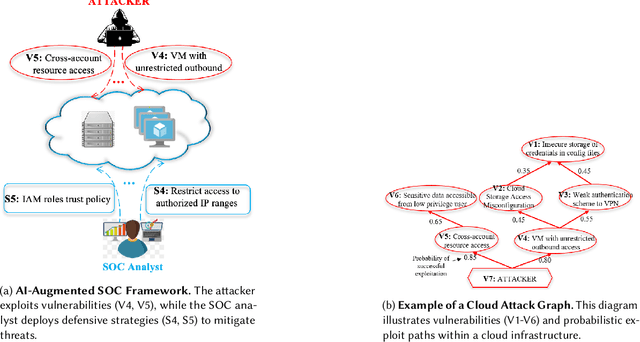
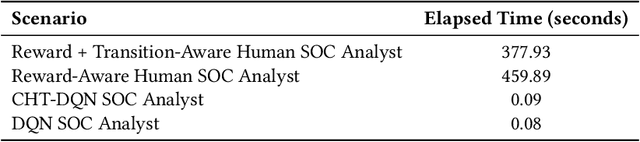
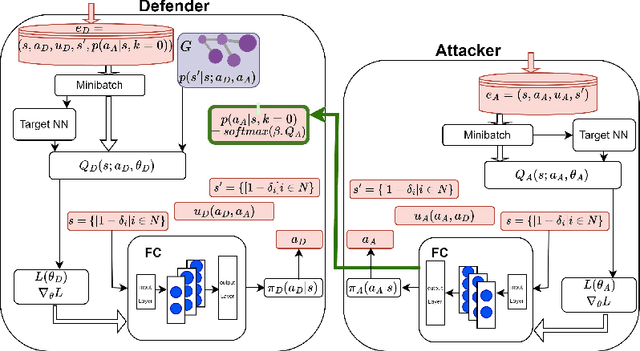

Given the complexity of multi-tenant cloud environments and the need for real-time threat mitigation, Security Operations Centers (SOCs) must integrate AI-driven adaptive defenses against Advanced Persistent Threats (APTs). However, SOC analysts struggle with countering adaptive adversarial tactics, necessitating intelligent decision-support frameworks. To enhance human-AI collaboration in SOCs, we propose a Cognitive Hierarchy Theory-driven Deep Q-Network (CHT-DQN) framework that models SOC analysts' decision-making against AI-driven APT bots. The SOC analyst (defender) operates at cognitive level-1, anticipating attacker strategies, while the APT bot (attacker) follows a level-0 exploitative policy. By incorporating CHT into DQN, our framework enhances SOC defense strategies via Attack Graph (AG)-based reinforcement learning. Simulation experiments across varying AG complexities show that CHT-DQN achieves higher data protection and lower action discrepancies compared to standard DQN. A theoretical lower bound analysis further validates its superior Q-value performance. A human-in-the-loop (HITL) evaluation on Amazon Mechanical Turk (MTurk) reveals that SOC analysts using CHT-DQN-driven transition probabilities align better with adaptive attackers, improving data protection. Additionally, human decision patterns exhibit risk aversion after failure and risk-seeking behavior after success, aligning with Prospect Theory. These findings underscore the potential of integrating cognitive modeling into deep reinforcement learning to enhance SOC operations and develop real-time adaptive cloud security mechanisms.