 Add to Chrome
 Add to Firefox
 Add to Edge
Grimlock: Guarding High-Agency Systems with eBPF and Attested Channels
May 26, 2026
Agentic systems increasingly run user-authored orchestration code that invokes tools, spawns subtasks, and delegates work across machines and clouds. Although this high agency is productive, it creates a security problem: identity, authorization, provenance, and delegation are often pushed into application code, where they become difficult to enforce consistently and difficult to audit. We present \emph{Grimlock}, an \emph{Agent Guard} that restores separation of concerns by moving trust enforcement into the sandbox substrate while leaving agent code unchanged. Grimlock uses \emph{eBPF-enforced traffic interception} to ensure that sandbox communication passes through a guard, and combines it with \emph{post-handshake attestation} bound to standard TLS~1.3 channel bindings. After a channel is established, the guard authorizes communication and mints short-lived, channel-bound \emph{scope tokens} that capture least-privilege delegation. At the receiving side, the destination guard re-validates identity, scope, and channel binding, terminates TLS, and releases plaintext to the destination sandbox only after policy checks succeed. kTLS provides an efficient dataplane for protected communication. As a result, Grimlock offers a path toward transparent, auditable, and scope-bound agent-to-agent communication across heterogeneous multi-cloud environments, using commodity Linux primitives and without requiring changes to user-layer orchestration code.

Learning the nonlinear dynamics of soft mechanical metamaterials with graph networks
Feb 24, 2022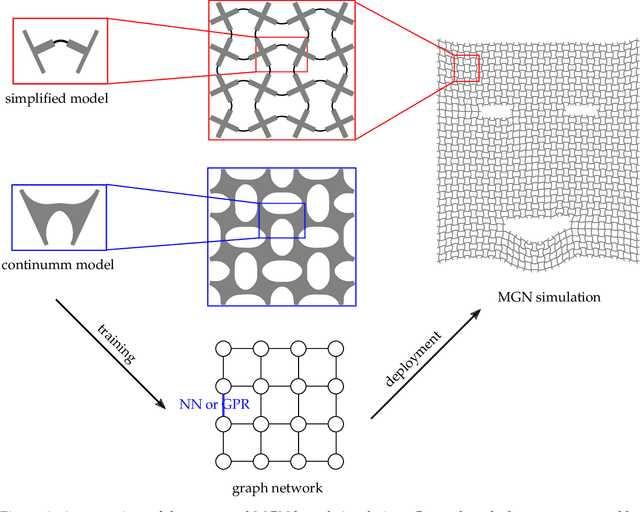
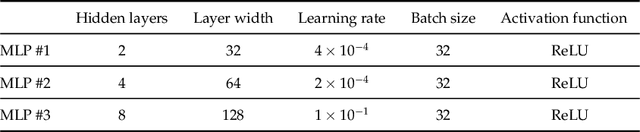
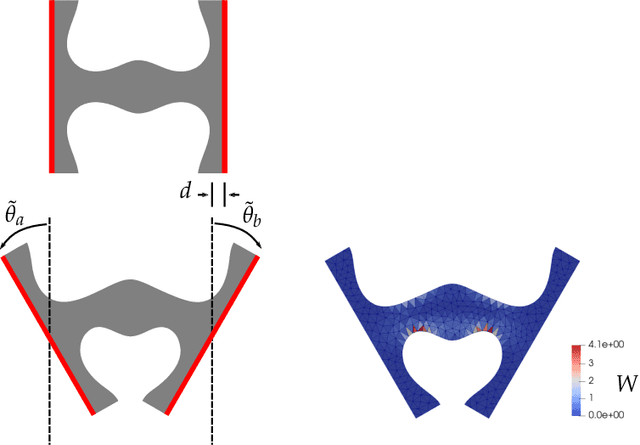
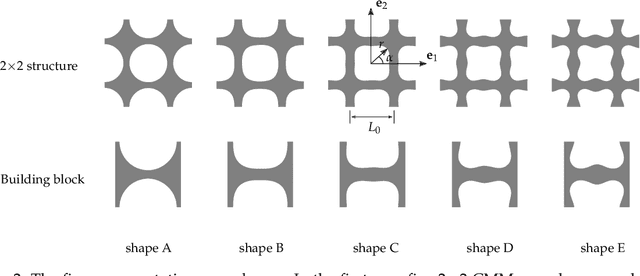
The dynamics of soft mechanical metamaterials provides opportunities for many exciting engineering applications. Previous studies often use discrete systems, composed of rigid elements and nonlinear springs, to model the nonlinear dynamic responses of the continuum metamaterials. Yet it remains a challenge to accurately construct such systems based on the geometry of the building blocks of the metamaterial. In this work, we propose a machine learning approach to address this challenge. A metamaterial graph network (MGN) is used to represent the discrete system, where the nodal features contain the positions and orientations the rigid elements, and the edge update functions describe the mechanics of the nonlinear springs. We use Gaussian process regression as the surrogate model to characterize the elastic energy of the nonlinear springs as a function of the relative positions and orientations of the connected rigid elements. The optimal model can be obtained by "learning" from the data generated via finite element calculation over the corresponding building block of the continuum metamaterial. Then, we deploy the optimal model to the network so that the dynamics of the metamaterial at the structural scale can be studied. We verify the accuracy of our machine learning approach against several representative numerical examples. In these examples, the proposed approach can significantly reduce the computational cost when compared to direct numerical simulation while reaching comparable accuracy. Moreover, defects and spatial inhomogeneities can be easily incorporated into our approach, which can be useful for the rational design of soft mechanical metamaterials.