 Add to Chrome
 Add to Firefox
 Add to Edge
VAD to the Bone: Ultra-Tiny Speech Activity Detection for Edge Deployment
Jul 28, 2026
Voice activity detection (VAD) triggers downstream speech processing in always-on systems under strict memory, latency, and compute constraints. Recent compact models report strong accuracy but rely on components that are not widely supported: learnable filterbanks, recurrent layers, or non-causal post-processing. We propose kiloVAD, designed for embedded inference using standard Mel features, CNN-only layers, and tunable context/spectral parameters. We introduce per-layer structured pruning with self-distillation and angle-based quantization-aware training (QAT) that outperforms standard QAT by 1-4%. Evaluated per-frame under causal conditions, kiloVAD achieves 0.850 AUC on AVA-Speech with 2.1 k parameters and 200 ms context, establishing a new state of the art for causal, deployment-ready VAD.

Non-Line-of-Sight Tracking and Mapping with an Active Corner Camera
Aug 02, 2022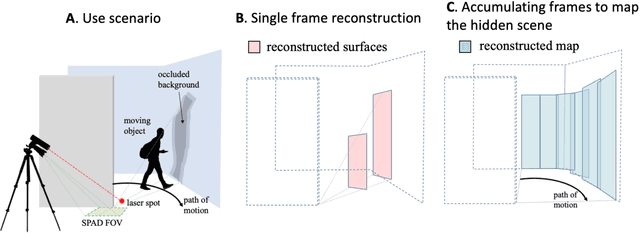
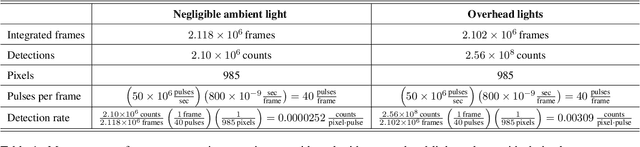
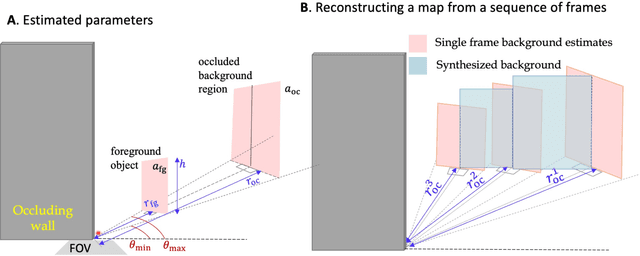
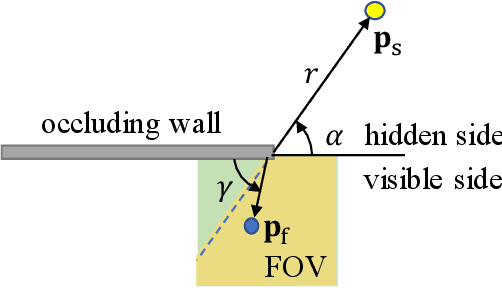
The ability to form non-line-of-sight (NLOS) images of changing scenes could be transformative in a variety of fields, including search and rescue, autonomous vehicle navigation, and reconnaissance. Most existing active NLOS methods illuminate the hidden scene using a pulsed laser directed at a relay surface and collect time-resolved measurements of returning light. The prevailing approaches include raster scanning of a rectangular grid on a vertical wall opposite the volume of interest to generate a collection of confocal measurements. These are inherently limited by the need for laser scanning. Methods that avoid laser scanning track the moving parts of the hidden scene as one or two point targets. In this work, based on more complete optical response modeling yet still without multiple illumination positions, we demonstrate accurate reconstructions of objects in motion and a 'map' of the stationary scenery behind them. The ability to count, localize, and characterize the sizes of hidden objects in motion, combined with mapping of the stationary hidden scene, could greatly improve indoor situational awareness in a variety of applications.