 Add to Chrome
 Add to Firefox
 Add to Edge
Offline-to-Online Creative Optimization with Generative Models and Adaptive Testing
Jul 26, 2026
Ad creative optimization is increasingly constrained by evaluation rather than generation. Generative models can produce many plausible creatives, but reliable evaluation requires online experiments, in which only a limited slate can be tested. We study how to use data from historical A/B tests to generate and select the candidates in that slate. We developed and deployed a performance-driven offline-to-online workflow that guides creative generation with a predictive model as an inference-time critic. In the offline phase, we use a predictive model trained on historical experiments to rank and refine variants created by a generative model. A final test slate is then deployed in an online adaptive experiment. In a 50-arm field experiment, we found that the best creative generated with this method yielded 45.1% higher engagement than the best human-authored creative. Two additional experiments showed the same upper-tail pattern, with lifts of 46.7% and 36.2%. We found that despite the predictive model being too noisy to directly identify the best creative offline, it effectively guides the generative model toward creating strong candidates that can be efficiently evaluated in an adaptive experiment. The results suggest a design principle for creative optimization with generative models: use predictive models to guide generation of a slate to test, judge the slate by whether it contains high-performing candidates at a feasible test size, and use adaptive experiments to select among candidates while limiting traffic lost to weak arms.

Decoding the Hook: A Multimodal LLM Framework for Analyzing the Hooking Period of Video Ads
Feb 25, 2026Video-based ads are a vital medium for brands to engage consumers, with social media platforms leveraging user data to optimize ad delivery and boost engagement. A crucial but under-explored aspect is the 'hooking period', the first three seconds that capture viewer attention and influence engagement metrics. Analyzing this brief window is challenging due to the multimodal nature of video content, which blends visual, auditory, and textual elements. Traditional methods often miss the nuanced interplay of these components, requiring advanced frameworks for thorough evaluation. This study presents a framework using transformer-based multimodal large language models (MLLMs) to analyze the hooking period of video ads. It tests two frame sampling strategies, uniform random sampling and key frame selection, to ensure balanced and representative acoustic feature extraction, capturing the full range of design elements. The hooking video is processed by state-of-the-art MLLMs to generate descriptive analyses of the ad's initial impact, which are distilled into coherent topics using BERTopic for high-level abstraction. The framework also integrates features such as audio attributes and aggregated ad targeting information, enriching the feature set for further analysis. Empirical validation on large-scale real-world data from social media platforms demonstrates the efficacy of our framework, revealing correlations between hooking period features and key performance metrics like conversion per investment. The results highlight the practical applicability and predictive power of the approach, offering valuable insights for optimizing video ad strategies. This study advances video ad analysis by providing a scalable methodology for understanding and enhancing the initial moments of video advertisements.
Using Search Queries to Understand Health Information Needs in Africa
Jun 14, 2018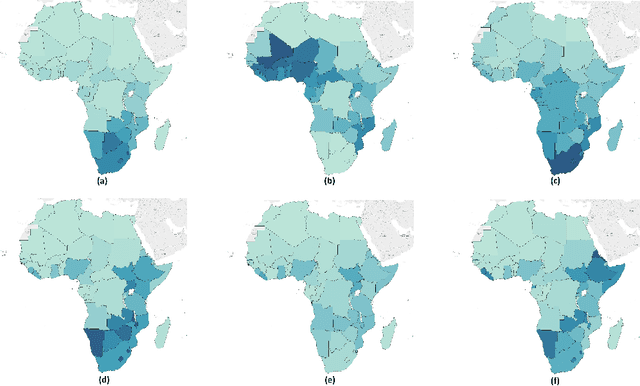
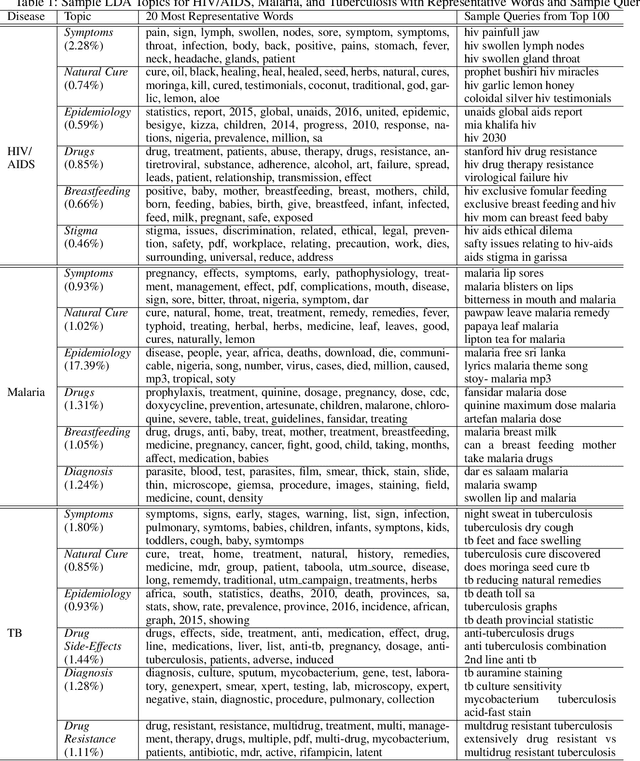
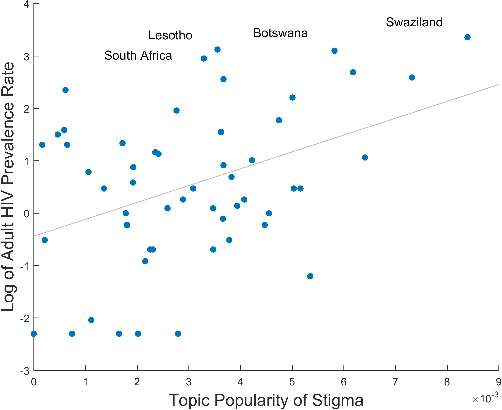
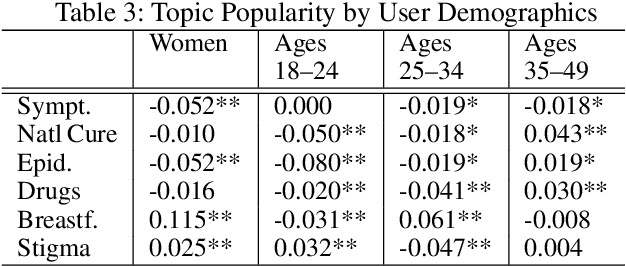
The lack of comprehensive, high-quality health data in developing nations creates a roadblock for combating the impacts of disease. One key challenge is understanding the health information needs of people in these nations. Without understanding people's everyday needs, concerns, and misconceptions, health organizations and policymakers lack the ability to effectively target education and programming efforts. In this paper, we propose a bottom-up approach that uses search data from individuals to uncover and gain insight into health information needs in Africa. We analyze Bing searches related to HIV/AIDS, malaria, and tuberculosis from all 54 African nations. For each disease, we automatically derive a set of common search themes or topics, revealing a wide-spread interest in various types of information, including disease symptoms, drugs, concerns about breastfeeding, as well as stigma, beliefs in natural cures, and other topics that may be hard to uncover through traditional surveys. We expose the different patterns that emerge in health information needs by demographic groups (age and sex) and country. We also uncover discrepancies in the quality of content returned by search engines to users by topic. Combined, our results suggest that search data can help illuminate health information needs in Africa and inform discussions on health policy and targeted education efforts both on- and offline.