 Add to Chrome
 Add to Firefox
 Add to Edge
Retinal Malady Classification using AI: A novel ViT-SVM combination architecture
Mar 31, 2026
Macular Holes, Central serous retinopathy and Diabetic Retinopathy are one of the most widespread maladies of the eyes responsible for either partial or complete vision loss, thus making it clear that early detection of the mentioned defects is detrimental for the well-being of the patient. This study intends to introduce the application of Vision Transformer and Support Vector Machine based hybrid architecture (ViT-SVM) and analyse its performance to classify the optical coherence topography (OCT) Scans with the intention to automate the early detection of these retinal defects.

Indian Peak Power demand Forecasting : Transformer Based Implementation of Temporal Architecture
Mar 31, 2026The long-term forecasting of electricity demand has been a prevalent research topic, primarily because of its economic and strategic relevance. Several machine learning as well as deep learning techniques have been developed in parallel with the growing complexity of the peak demand, planning for generation facilities and transmission augmentation in future. Most of these proposed techniques work on short-term forecasting as long-term forecasting is considerably more challenging due to unpredictable and unforeseeable variables that may arise in the future. This paper proposes a Temporal Fusion Transformer based deep learning approach for long term forecasting of peak power demand. The dataset used in this paper consists of peak power demand in India for a period of 6 years and the prediction was done for a period of 1 year. Our proposed model was compared with other popular forecasting models and it performed considerably better in benchmarks and was also more accurate in modelling the variance in the power demand.
Crop Disease Classification using Support Vector Machines with Green Chromatic Coordinate (GCC) and Attention based feature extraction for IoT based Smart Agricultural Applications
Nov 06, 2023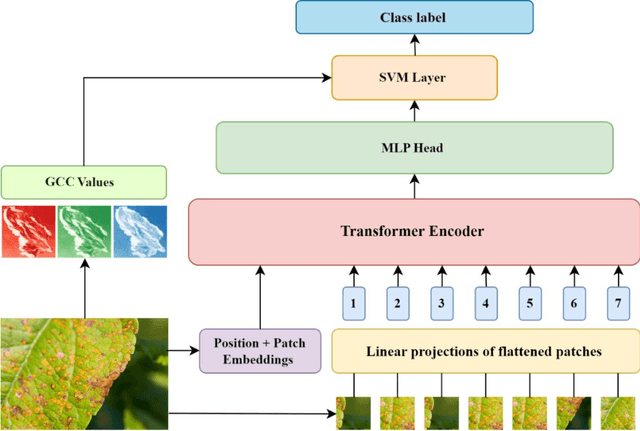


Crops hold paramount significance as they serve as the primary provider of energy, nutrition, and medicinal benefits for the human population. Plant diseases, however, can negatively affect leaves during agricultural cultivation, resulting in significant losses in crop output and economic value. Therefore, it is crucial for farmers to identify crop diseases. However, this method frequently necessitates hard work, a lot of planning, and in-depth familiarity with plant pathogens. Given these numerous obstacles, it is essential to provide solutions that can easily interface with mobile and IoT devices so that our farmers can guarantee the best possible crop development. Various machine learning (ML) as well as deep learning (DL) algorithms have been created & studied for the identification of plant disease detection, yielding substantial and promising results. This article presents a novel classification method that builds on prior work by utilising attention-based feature extraction, RGB channel-based chromatic analysis, Support Vector Machines (SVM) for improved performance, and the ability to integrate with mobile applications and IoT devices after quantization of information. Several disease classification algorithms were compared with the suggested model, and it was discovered that, in terms of accuracy, Vision Transformer-based feature extraction and additional Green Chromatic Coordinate feature with SVM classification achieved an accuracy of (GCCViT-SVM) - 99.69%, whereas after quantization for IoT device integration achieved an accuracy of - 97.41% while almost reducing 4x in size. Our findings have profound implications because they have the potential to transform how farmers identify crop illnesses with precise and fast information, thereby preserving agricultural output and ensuring food security.
RESTORE: Graph Embedding Assessment Through Reconstruction
Sep 05, 2023Following the success of Word2Vec embeddings, graph embeddings (GEs) have gained substantial traction. GEs are commonly generated and evaluated extrinsically on downstream applications, but intrinsic evaluations of the original graph properties in terms of topological structure and semantic information have been lacking. Understanding these will help identify the deficiency of the various families of GE methods when vectorizing graphs in terms of preserving the relevant knowledge or learning incorrect knowledge. To address this, we propose RESTORE, a framework for intrinsic GEs assessment through graph reconstruction. We show that reconstructing the original graph from the underlying GEs yields insights into the relative amount of information preserved in a given vector form. We first introduce the graph reconstruction task. We generate GEs from three GE families based on factorization methods, random walks, and deep learning (with representative algorithms from each family) on the CommonSense Knowledge Graph (CSKG). We analyze their effectiveness in preserving the (a) topological structure of node-level graph reconstruction with an increasing number of hops and (b) semantic information on various word semantic and analogy tests. Our evaluations show deep learning-based GE algorithm (SDNE) is overall better at preserving (a) with a mean average precision (mAP) of 0.54 and 0.35 for 2 and 3-hop reconstruction respectively, while the factorization-based algorithm (HOPE) is better at encapsulating (b) with an average Euclidean distance of 0.14, 0.17, and 0.11 for 1, 2, and 3-hop reconstruction respectively. The modest performance of these GEs leaves room for further research avenues on better graph representation learning.