 Add to Chrome
 Add to Firefox
 Add to Edge
HERMES: a multi-agent framework for structured knowledge extraction from ultra-long documents in geoscience
Aug 14, 2026
Authoritative scientific knowledge in geoscience remains largely trapped in legacy monographs and historical literature, where unstructured text and complex layouts hinder computational access. We introduce HERMES, a scalable multi-agent framework that extracts structured data from ultra-long scientific documents. Using a coordinating large language model, HERMES integrates domain constraints, validation rules and evidence tracing within a unified document-level extraction process that incorporates parsed text, tables, figures and captions. Applied to the 55-volume Treatise on Invertebrate Paleontology, the system produced a structured database of 32,277 fossil taxonomic entities and 451,878 attributes, released online at https://treatise.geolex.org. Extraction performance remained stable across fossil groups (average F1 scores of approximately 0.90 for entities and 0.91 for attributes), improving per-volume efficiency approximately sixfold relative to the tested fully manual baseline. Evaluation in palaeomagnetism and geochemistry, conducted without additional model training, demonstrated transfer across distinct geoscience domains. This work provides a practical pathway to transform historical scientific literature into FAIR-oriented structured data, offering a sustainable infrastructure for data-intensive disciplines and large-scale knowledge integration.

BUDDY: BUdget-Driven DYnamic Depth Routing for Adaptive Large Language Model Inference
Jun 08, 2026Large language models (LLMs) incur high inference cost due to their depth and parameter scale. Depth pruning can reduce latency by skipping redundant Transformer blocks, but existing methods (i) provide limited control under user-specific compute budgets and (ii) typically fix the routing path, failing to adapt as the context grows during decoding. We propose Buddy, a budget-driven dynamic depth routing framework. Buddy uses a lightweight Decision Module to score intermediate layers conditioned on the input and deterministically executes the top-k layers to satisfy a given budget. To support decode-time adaptation, Buddy reuses the first-layer KV cache as a low-overhead global context source and pools it together with the newest token representation before each routing decision. When no explicit budget is provided, an optional Budget Predictor estimates an input-dependent compute level to balance quality and efficiency. Experiments on Llama-family and Qwen models show that Buddy is competitive with strong static pruning baselines and often improves the accuracy-compute trade-off, while uniquely supporting strict budget control, decode-time rerouting, and multiple budgets within a single trained model.
Exploring the Intrinsic Probability Distribution for Hyperspectral Anomaly Detection
May 14, 2021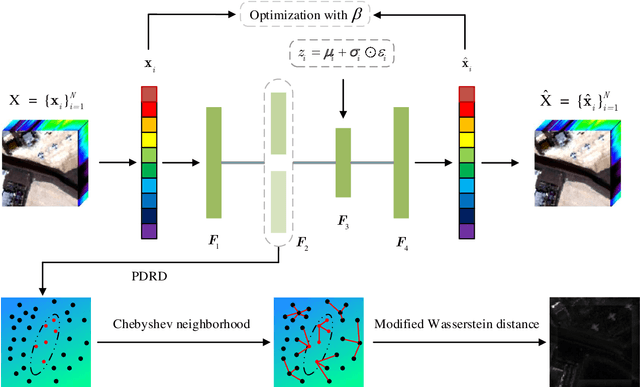
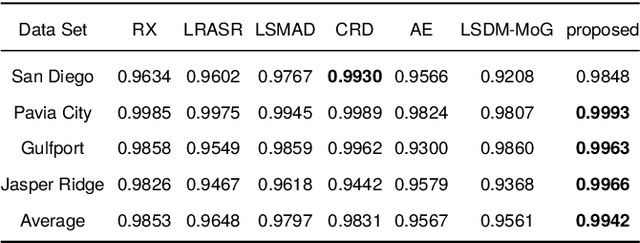
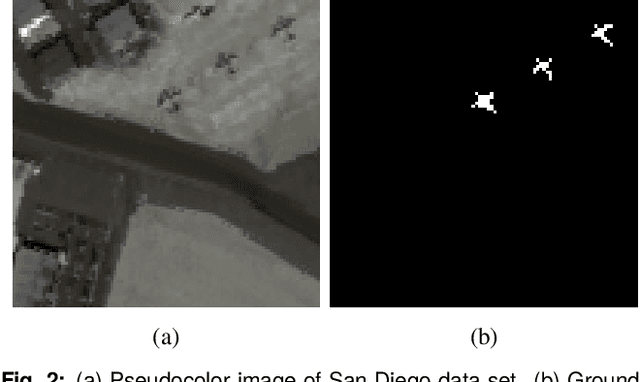
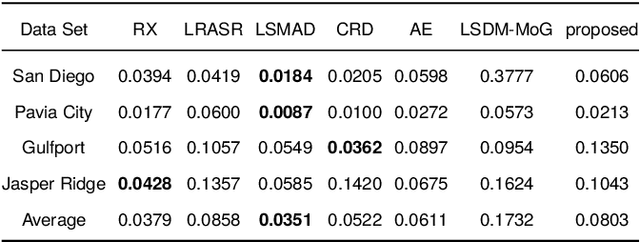
In recent years, neural network-based anomaly detection methods have attracted considerable attention in the hyperspectral remote sensing domain due to the powerful reconstruction ability compared with traditional methods. However, actual probability distribution statistics hidden in the latent space are not discovered by exploiting the reconstruction error because the probability distribution of anomalies is not explicitly modeled. To address the issue, we propose a novel probability distribution representation detector (PDRD) that explores the intrinsic distribution of both the background and the anomalies in original data for hyperspectral anomaly detection in this paper. First, we represent the hyperspectral data with multivariate Gaussian distributions from a probabilistic perspective. Then, we combine the local statistics with the obtained distributions to leverage the spatial information. Finally, the difference between the corresponding distributions of the test pixel and the average expectation of the pixels in the Chebyshev neighborhood is measured by computing the modified Wasserstein distance to acquire the detection map. We conduct the experiments on four real data sets to evaluate the performance of our proposed method. Experimental results demonstrate the accuracy and efficiency of our proposed method compared to the state-of-the-art detection methods.