 Add to Chrome
 Add to Firefox
 Add to Edge
Robust Bayesian Dynamic Programming for On-policy Risk-sensitive Reinforcement Learning
Dec 31, 2025
We propose a novel framework for risk-sensitive reinforcement learning (RSRL) that incorporates robustness against transition uncertainty. We define two distinct yet coupled risk measures: an inner risk measure addressing state and cost randomness and an outer risk measure capturing transition dynamics uncertainty. Our framework unifies and generalizes most existing RL frameworks by permitting general coherent risk measures for both inner and outer risk measures. Within this framework, we construct a risk-sensitive robust Markov decision process (RSRMDP), derive its Bellman equation, and provide error analysis under a given posterior distribution. We further develop a Bayesian Dynamic Programming (Bayesian DP) algorithm that alternates between posterior updates and value iteration. The approach employs an estimator for the risk-based Bellman operator that combines Monte Carlo sampling with convex optimization, for which we prove strong consistency guarantees. Furthermore, we demonstrate that the algorithm converges to a near-optimal policy in the training environment and analyze both the sample complexity and the computational complexity under the Dirichlet posterior and CVaR. Finally, we validate our approach through two numerical experiments. The results exhibit excellent convergence properties while providing intuitive demonstrations of its advantages in both risk-sensitivity and robustness. Empirically, we further demonstrate the advantages of the proposed algorithm through an application on option hedging.

Risk-sensitive Reinforcement Learning Based on Convex Scoring Functions
May 07, 2025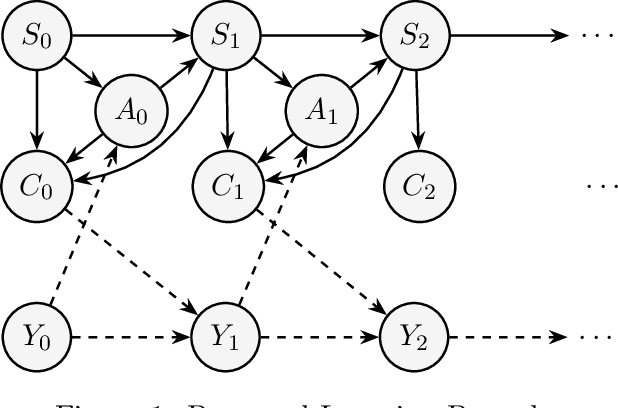
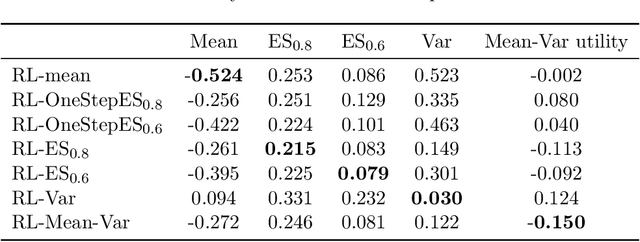
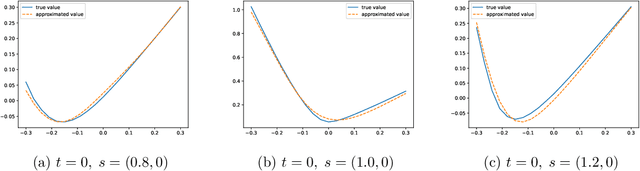
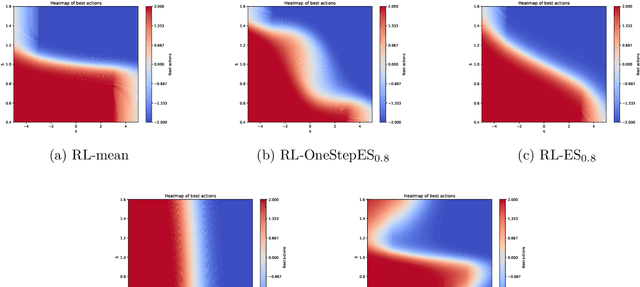
We propose a reinforcement learning (RL) framework under a broad class of risk objectives, characterized by convex scoring functions. This class covers many common risk measures, such as variance, Expected Shortfall, entropic Value-at-Risk, and mean-risk utility. To resolve the time-inconsistency issue, we consider an augmented state space and an auxiliary variable and recast the problem as a two-state optimization problem. We propose a customized Actor-Critic algorithm and establish some theoretical approximation guarantees. A key theoretical contribution is that our results do not require the Markov decision process to be continuous. Additionally, we propose an auxiliary variable sampling method inspired by the alternating minimization algorithm, which is convergent under certain conditions. We validate our approach in simulation experiments with a financial application in statistical arbitrage trading, demonstrating the effectiveness of the algorithm.