 Add to Chrome
 Add to Firefox
 Add to Edge
Beyond a Joke: Multi-Angle Reasoning for Detecting and Explaining Harmful Humor in Memes
Jul 16, 2026
Internet memes intertwine visual cues, textual content, and cultural context, making them particularly challenging to interpret in scenarios where humor, sarcasm, and harmful intent coexist. These complexities highlight the need for explainable meme understanding systems that can provide reliable and structured reasoning to support both accurate classification and human interpretability. However, existing multimodal classifiers either overlook these interdependencies or provide only limited interpretability. In this paper, we introduce MAR-12, a novel framework that leverages Vision Language Models (VLMs) for meme detection and understanding in settings where humorous and hateful elements may coexist. The framework first interprets each meme through twelve structured perspectives derived from humor and hate theories. It then applies a role-aware soft-gated attention mechanism to learn how much each perspective should contribute, followed by a prototype-based classifier for the final prediction. Finally, explanations are synthesized using both perspective-specific reasoning and learned attention weights, ensuring transparent and context-grounded justifications. We evaluate MAR-12 on the PrideMM and Memotion datasets, where it achieves up to 80.3% accuracy for humor detection and 75.9% accuracy for hate detection, outperforming state-of-the-art approaches. Furthermore, both human and GPT-4-based evaluations confirm that MAR-12 produces coherent and persuasive explanations, particularly for memes in which humorous and harmful cues co-occur.

I Know What You Meme, Even If it Emerged Today: Understanding Evolving Memes through Open-World Knowledge Acquisition
Jun 03, 2026Multimodal memes are dynamic and often require up to date background knowledge for interpretation. Existing methods often overlook such knowledge or rely on fixed parametric knowledge of pretrained models that may be incomplete, outdated, or unavailable for emerging memes. We introduce Query Retrieve Conclude, a zero shot framework that identifies missing knowledge, retrieves open web evidence, and synthesizes evidence grounded background knowledge for meme understanding and detection. We also introduce a curated meme understanding benchmark of recent memes from 2024 to 2026 with external background knowledge annotations. Experiments on three meme understanding datasets and five meme detection tasks show that our framework improves knowledge recovery, meme understanding and downstream detection over zero shot baselines.
ZZU-NLP at SIGHAN-2024 dimABSA Task: Aspect-Based Sentiment Analysis with Coarse-to-Fine In-context Learning
Jul 22, 2024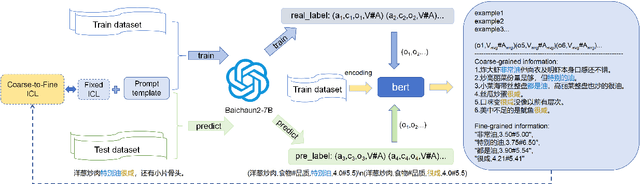

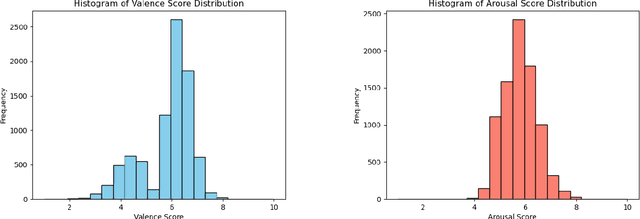

The DimABSA task requires fine-grained sentiment intensity prediction for restaurant reviews, including scores for Valence and Arousal dimensions for each Aspect Term. In this study, we propose a Coarse-to-Fine In-context Learning(CFICL) method based on the Baichuan2-7B model for the DimABSA task in the SIGHAN 2024 workshop. Our method improves prediction accuracy through a two-stage optimization process. In the first stage, we use fixed in-context examples and prompt templates to enhance the model's sentiment recognition capability and provide initial predictions for the test data. In the second stage, we encode the Opinion field using BERT and select the most similar training data as new in-context examples based on similarity. These examples include the Opinion field and its scores, as well as related opinion words and their average scores. By filtering for sentiment polarity, we ensure that the examples are consistent with the test data. Our method significantly improves prediction accuracy and consistency by effectively utilizing training data and optimizing in-context examples, as validated by experimental results.