 Add to Chrome
 Add to Firefox
 Add to Edge
An Augmented Reality Brain-Robot Interface for Generalist Robot Arm Manipulation
Jun 15, 2026
The integration of augmented reality (AR) and EEG-based brain-computer interfaces (BCIs) offers a promising path for enabling intuitive control of robots for assistive purposes. However, existing AR brain-robot interface (BRI) systems are often constrained to task-specific structures, limiting their utility in real-world environments. We present an AR BRI designed for generalist robot arm manipulation that combines gaze-based object selection with motor imagery action control. Our system uses eye-tracking for intuitive object targeting and context-aware visual overlays ("Place" and "Use") to guide the user through tasks within a shared autonomy framework. We evaluated the interface through a feasibility study with 18 healthy participants performing three multi-step activities of daily living: drinking, using a drawer, and operating an oven. Our results demonstrate that this interaction paradigm enables effective sequential task execution and high user engagement, achieving a "Good" usability rating (SUS > 70). These findings support the feasibility of the proposed interaction paradigm for complex BCI-driven robotic assistance, and motivate future evaluation with the intended target population. Project website: https://ar-bri-manip.github.io/.

eRSS-RAMP: A Rule-Adherence Motion Planner Based on Extended Responsibility-Sensitive Safety for Autonomous Driving
Sep 04, 2024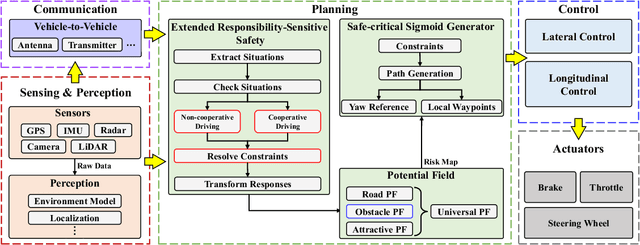
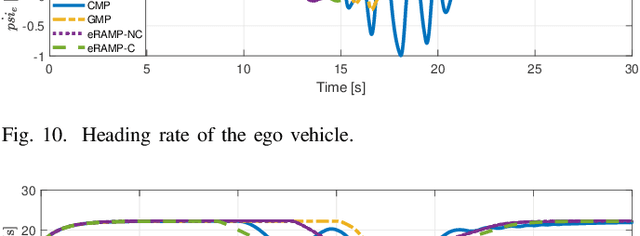
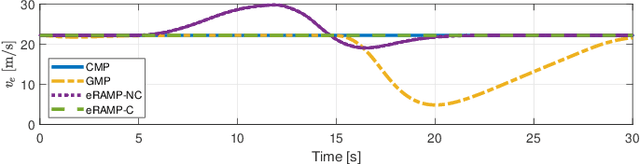

Driving safety and responsibility determination are indispensable pieces of the puzzle for autonomous driving. They are also deeply related to the allocation of right-of-way and the determination of accident liability. Therefore, Intel/Mobileye designed the responsibility-sensitive safety (RSS) framework to further enhance the safety regulation of autonomous driving, which mathematically defines rules for autonomous vehicles (AVs) behaviors in various traffic scenarios. However, the RSS framework's rules are relatively rudimentary in certain scenarios characterized by interaction uncertainty, especially those requiring collaborative driving during emergency collision avoidance. Besides, the integration of the RSS framework with motion planning is rarely discussed in current studies. Therefore, we proposed a rule-adherence motion planner (RAMP) based on the extended RSS (eRSS) regulation for non-connected and connected AVs in merging and emergency-avoiding scenarios. The simulation results indicate that the proposed method can achieve faster and safer lane merging performance (53.0% shorter merging length and a 73.5% decrease in merging time), and allows for more stable steering maneuvers in emergency collision avoidance, resulting in smoother paths for ego vehicle and surrounding vehicles.