 Add to Chrome
 Add to Firefox
 Add to Edge
CARLoS: Retrieval via Concise Assessment Representation of LoRAs at Scale
Dec 09, 2025
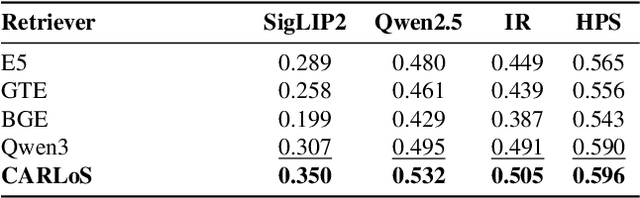
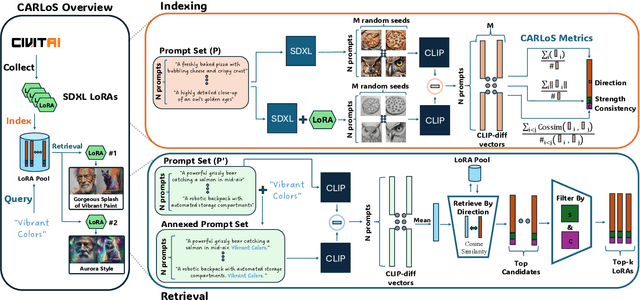
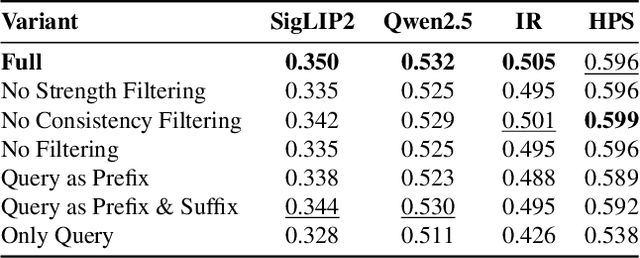
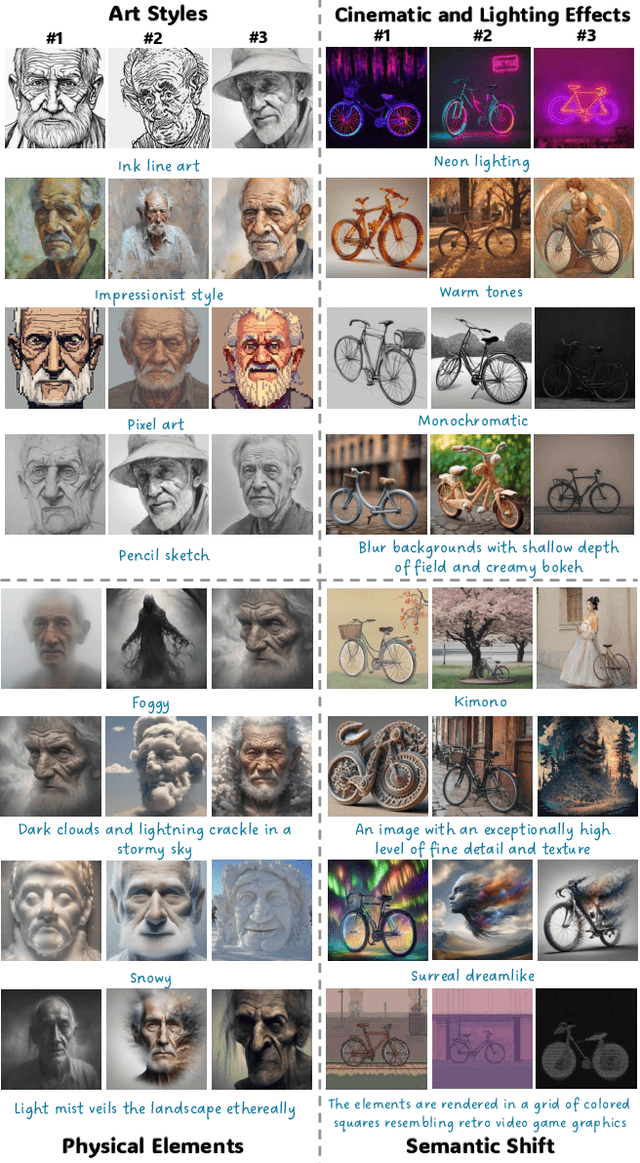
The rapid proliferation of generative components, such as LoRAs, has created a vast but unstructured ecosystem. Existing discovery methods depend on unreliable user descriptions or biased popularity metrics, hindering usability. We present CARLoS, a large-scale framework for characterizing LoRAs without requiring additional metadata. Analyzing over 650 LoRAs, we employ them in image generation over a variety of prompts and seeds, as a credible way to assess their behavior. Using CLIP embeddings and their difference to a base-model generation, we concisely define a three-part representation: Directions, defining semantic shift; Strength, quantifying the significance of the effect; and Consistency, quantifying how stable the effect is. Using these representations, we develop an efficient retrieval framework that semantically matches textual queries to relevant LoRAs while filtering overly strong or unstable ones, outperforming textual baselines in automated and human evaluations. While retrieval is our primary focus, the same representation also supports analyses linking Strength and Consistency to legal notions of substantiality and volition, key considerations in copyright, positioning CARLoS as a practical system with broader relevance for LoRA analysis.

Not Every Image is Worth a Thousand Words: Quantifying Originality in Stable Diffusion
Aug 15, 2024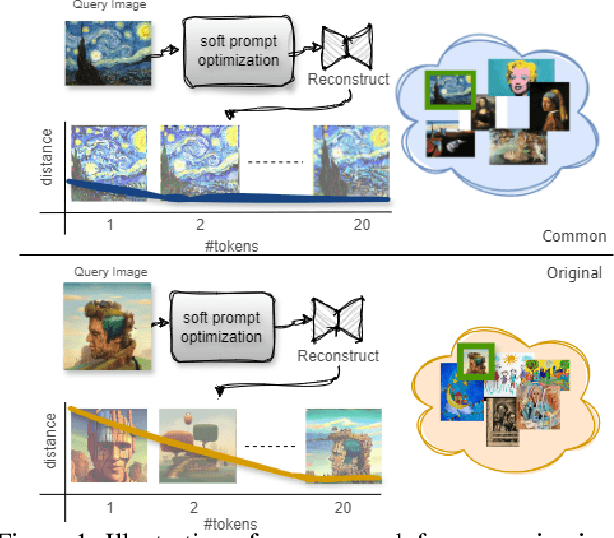
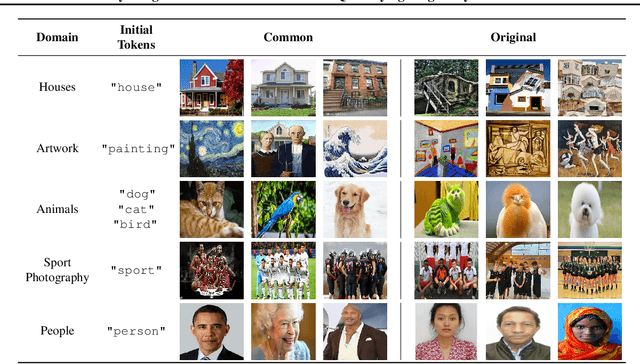
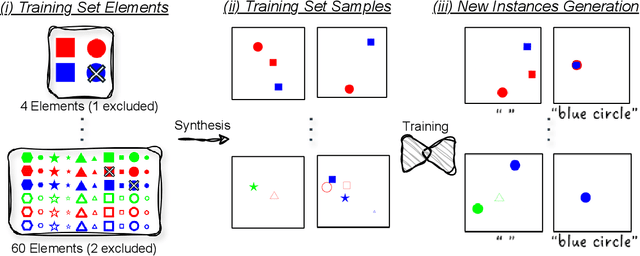
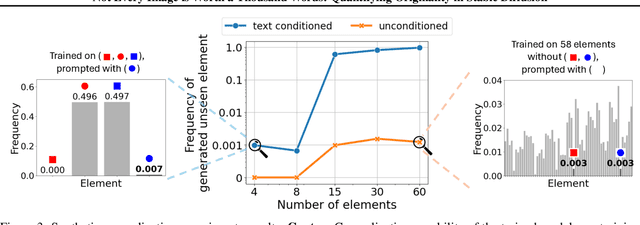
This work addresses the challenge of quantifying originality in text-to-image (T2I) generative diffusion models, with a focus on copyright originality. We begin by evaluating T2I models' ability to innovate and generalize through controlled experiments, revealing that stable diffusion models can effectively recreate unseen elements with sufficiently diverse training data. Then, our key insight is that concepts and combinations of image elements the model is familiar with, and saw more during training, are more concisly represented in the model's latent space. We hence propose a method that leverages textual inversion to measure the originality of an image based on the number of tokens required for its reconstruction by the model. Our approach is inspired by legal definitions of originality and aims to assess whether a model can produce original content without relying on specific prompts or having the training data of the model. We demonstrate our method using both a pre-trained stable diffusion model and a synthetic dataset, showing a correlation between the number of tokens and image originality. This work contributes to the understanding of originality in generative models and has implications for copyright infringement cases.
Not All Similarities Are Created Equal: Leveraging Data-Driven Biases to Inform GenAI Copyright Disputes
Mar 26, 2024
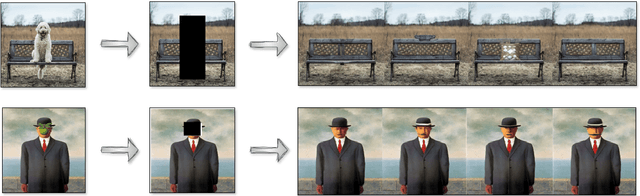
The advent of Generative Artificial Intelligence (GenAI) models, including GitHub Copilot, OpenAI GPT, and Stable Diffusion, has revolutionized content creation, enabling non-professionals to produce high-quality content across various domains. This transformative technology has led to a surge of synthetic content and sparked legal disputes over copyright infringement. To address these challenges, this paper introduces a novel approach that leverages the learning capacity of GenAI models for copyright legal analysis, demonstrated with GPT2 and Stable Diffusion models. Copyright law distinguishes between original expressions and generic ones (Sc\`enes \`a faire), protecting the former and permitting reproduction of the latter. However, this distinction has historically been challenging to make consistently, leading to over-protection of copyrighted works. GenAI offers an unprecedented opportunity to enhance this legal analysis by revealing shared patterns in preexisting works. We propose a data-driven approach to identify the genericity of works created by GenAI, employing "data-driven bias" to assess the genericity of expressive compositions. This approach aids in copyright scope determination by utilizing the capabilities of GenAI to identify and prioritize expressive elements and rank them according to their frequency in the model's dataset. The potential implications of measuring expressive genericity for copyright law are profound. Such scoring could assist courts in determining copyright scope during litigation, inform the registration practices of Copyright Offices, allowing registration of only highly original synthetic works, and help copyright owners signal the value of their works and facilitate fairer licensing deals. More generally, this approach offers valuable insights to policymakers grappling with adapting copyright law to the challenges posed by the era of GenAI.