 Add to Chrome
 Add to Firefox
 Add to Edge
STEM Faculty Perspectives on Generative AI in Higher Education
Mar 04, 2026
Generative artificial intelligence (GenAI) tools are increasingly present in higher education, yet their adoption has been largely student-driven, requiring instructors to respond to technologies already embedded in classroom practices. While some faculty have embraced GenAI for pedagogical purposes such as content generation, assessment support, and curriculum design, others approach these tools with caution, citing concerns about student learning, assessment validity, and academic integrity. Understanding faculty perspectives is therefore essential for informing effective pedagogical strategies and institutional policies. In this paper, we present findings from a focus group study with 29 STEM faculty members at a large public university in the United States. We examine how faculty integrate GenAI into their courses, the benefits and challenges they perceive for student learning, and the institutional support they identify as necessary for effective and responsible adoption. Our findings highlight key patterns in how STEM faculty engage with GenAI, reflecting both active adoption and cautious use. Faculty described a range of pedagogical applications alongside concerns about student learning, assessment, and academic integrity. Overall, the results suggest that effective integration of GenAI in higher education requires rethinking assessment, pedagogy, and institutional governance in addition to technical adoption.

MultiCaM-Vis: Visual Exploration of Multi-Classification Model with High Number of Classes
Sep 09, 2023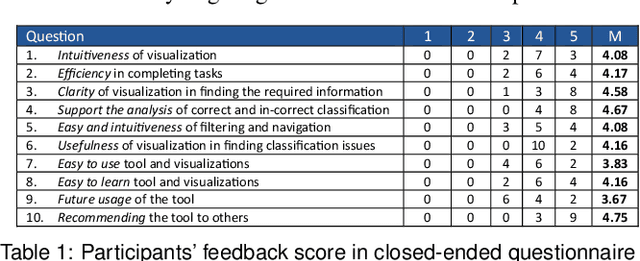
Visual exploration of multi-classification models with large number of classes would help machine learning experts in identifying the root cause of a problem that occurs during learning phase such as miss-classification of instances. Most of the previous visual analytics solutions targeted only a few classes. In this paper, we present our interactive visual analytics tool, called MultiCaM-Vis, that provides \Emph{overview+detail} style parallel coordinate views and a Chord diagram for exploration and inspection of class-level miss-classification of instances. We also present results of a preliminary user study with 12 participants.
Circles: Inter-Model Comparison of Multi-Classification Problems with High Number of Classes
Sep 08, 2023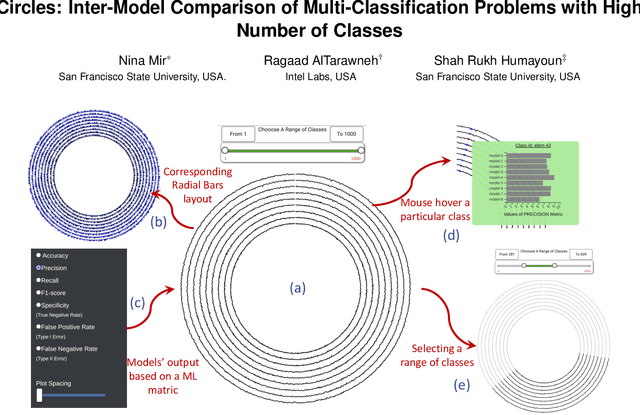
The recent advancements in machine learning have motivated researchers to generate classification models dealing with hundreds of classes such as in the case of image datasets. However, visualization of classification models with high number of classes and inter-model comparison in such classification problems are two areas that have not received much attention in the literature, despite the ever-increasing use of classification models to address problems with very large class categories. In this paper, we present our interactive visual analytics tool, called Circles, that allows a visual inter-model comparison of numerous classification models with 1K classes in one view. To mitigate the tricky issue of visual clutter, we chose concentric a radial line layout for our inter-model comparison task. Our prototype shows the results of 9 models with 1K classes
Visual Analytics for Automated Model Discovery
Oct 02, 2018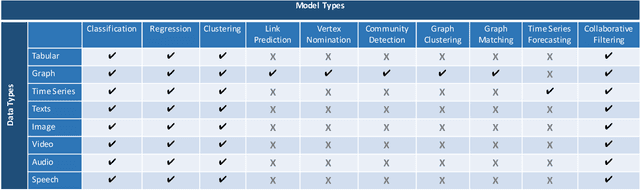
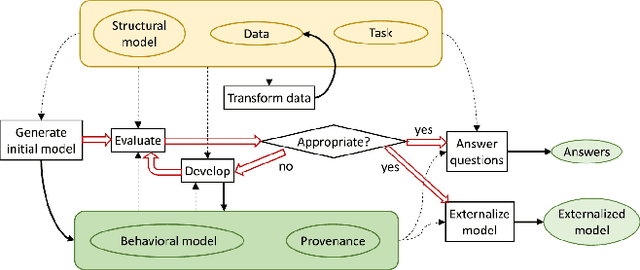
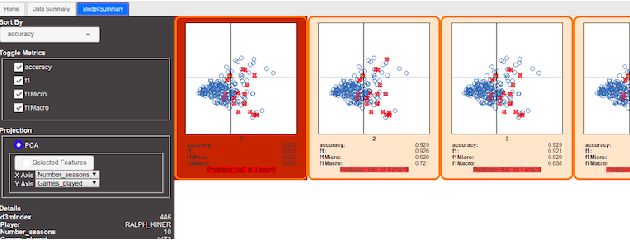
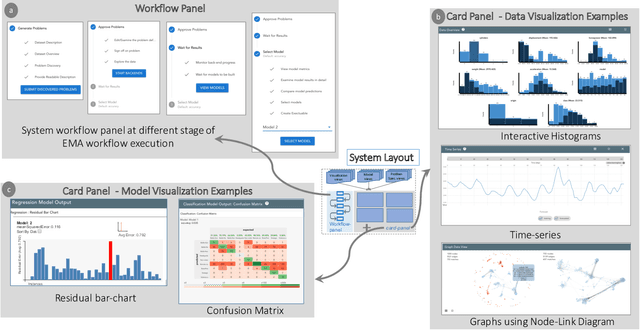
A recent advancement in the machine learning community is the development of automated machine learning (autoML) systems, such as autoWeka or Google's Cloud AutoML, which automate the model selection and tuning process. However, while autoML tools give users access to arbitrarily complex models, they typically return those models with little context or explanation. Visual analytics can be helpful in giving a user of autoML insight into their data, and a more complete understanding of the models discovered by autoML, including differences between multiple models. In this work, we describe how visual analytics for automated model discovery differs from traditional visual analytics for machine learning. First, we propose an architecture based on an extension of existing visual analytics frameworks. Then we describe a prototype system Snowcat, developed according to the presented framework and architecture, that aids users in generating models for a diverse set of data and modeling tasks.