 Add to Chrome
 Add to Firefox
 Add to Edge
On The Application of Linear Attention in Multimodal Transformers
Apr 11, 2026
Multimodal Transformers serve as the backbone for state-of-the-art vision-language models, yet their quadratic attention complexity remains a critical barrier to scalability. In this work, we investigate the viability of Linear Attention (LA) as a high-efficiency alternative within multimodal frameworks. By integrating LA, we reduce the computational overhead from quadratic to linear relative to sequence length while preserving competitive performance. We evaluate our approach across ViT-S/16, ViT-B/16, and ViT-L/16 architectures trained on the LAION-400M dataset, with validation focused on ImageNet-21K zero-shot accuracy. Our systematic evaluation demonstrates that Linear Attention not only yields significant computational savings but also adheres to the same scaling laws as standard softmax attention. These findings position Linear Attention as a robust, scalable solution for next-generation multimodal Transformers tasked with processing increasingly large and complex datasets.

DiffRegCD: Integrated Registration and Change Detection with Diffusion Features
Nov 12, 2025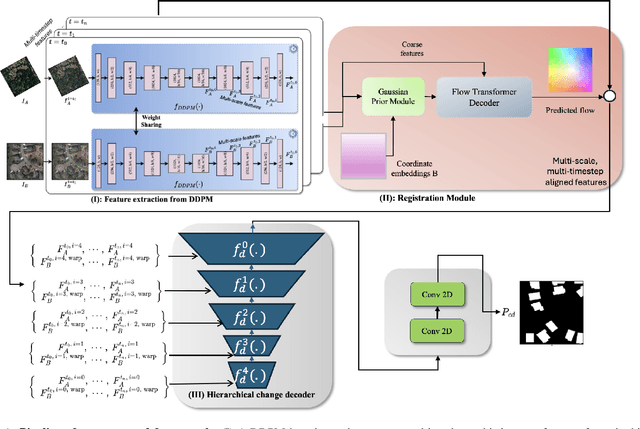

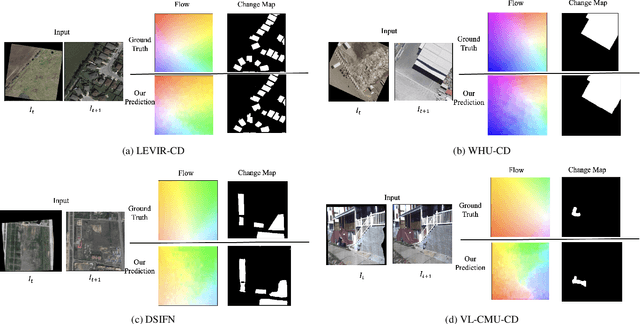
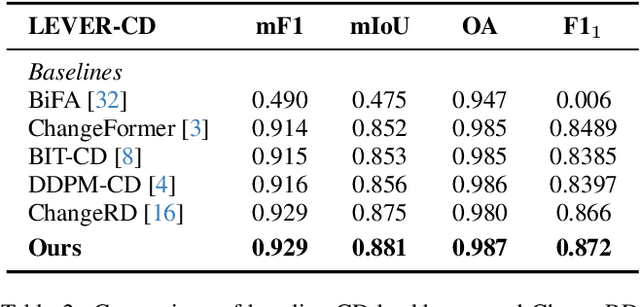
Change detection (CD) is fundamental to computer vision and remote sensing, supporting applications in environmental monitoring, disaster response, and urban development. Most CD models assume co-registered inputs, yet real-world imagery often exhibits parallax, viewpoint shifts, and long temporal gaps that cause severe misalignment. Traditional two stage methods that first register and then detect, as well as recent joint frameworks (e.g., BiFA, ChangeRD), still struggle under large displacements, relying on regression only flow, global homographies, or synthetic perturbations. We present DiffRegCD, an integrated framework that unifies dense registration and change detection in a single model. DiffRegCD reformulates correspondence estimation as a Gaussian smoothed classification task, achieving sub-pixel accuracy and stable training. It leverages frozen multi-scale features from a pretrained denoising diffusion model, ensuring robustness to illumination and viewpoint variation. Supervision is provided through controlled affine perturbations applied to standard CD datasets, yielding paired ground truth for both flow and change detection without pseudo labels. Extensive experiments on aerial (LEVIR-CD, DSIFN-CD, WHU-CD, SYSU-CD) and ground level (VL-CMU-CD) datasets show that DiffRegCD consistently surpasses recent baselines and remains reliable under wide temporal and geometric variation, establishing diffusion features and classification based correspondence as a strong foundation for unified change detection.
Morphing Through Time: Diffusion-Based Bridging of Temporal Gaps for Robust Alignment in Change Detection
Nov 11, 2025Remote sensing change detection is often challenged by spatial misalignment between bi-temporal images, especially when acquisitions are separated by long seasonal or multi-year gaps. While modern convolutional and transformer-based models perform well on aligned data, their reliance on precise co-registration limits their robustness in real-world conditions. Existing joint registration-detection frameworks typically require retraining and transfer poorly across domains. We introduce a modular pipeline that improves spatial and temporal robustness without altering existing change detection networks. The framework integrates diffusion-based semantic morphing, dense registration, and residual flow refinement. A diffusion module synthesizes intermediate morphing frames that bridge large appearance gaps, enabling RoMa to estimate stepwise correspondences between consecutive frames. The composed flow is then refined through a lightweight U-Net to produce a high-fidelity warp that co-registers the original image pair. Extensive experiments on LEVIR-CD, WHU-CD, and DSIFN-CD show consistent gains in both registration accuracy and downstream change detection across multiple backbones, demonstrating the generality and effectiveness of the proposed approach.