 Add to Chrome
 Add to Firefox
 Add to Edge
Enhancing Diffusion Model Guidance through Calibration and Regularization
Nov 11, 2025
Classifier-guided diffusion models have emerged as a powerful approach for conditional image generation, but they suffer from overconfident predictions during early denoising steps, causing the guidance gradient to vanish. This paper introduces two complementary contributions to address this issue. First, we propose a differentiable calibration objective based on the Smooth Expected Calibration Error (Smooth ECE), which improves classifier calibration with minimal fine-tuning and yields measurable improvements in Frechet Inception Distance (FID). Second, we develop enhanced sampling guidance methods that operate on off-the-shelf classifiers without requiring retraining. These include tilted sampling with batch-level reweighting, adaptive entropy-regularized sampling to preserve diversity, and a novel f-divergence-based sampling strategy that strengthens class-consistent guidance while maintaining mode coverage. Experiments on ImageNet 128x128 demonstrate that our divergence-regularized guidance achieves an FID of 2.13 using a ResNet-101 classifier, improving upon existing classifier-guided diffusion methods while requiring no diffusion model retraining. The results show that principled calibration and divergence-aware sampling provide practical and effective improvements for classifier-guided diffusion.

Environment-Aware MIMO Channel Estimation in Pilot-Constrained Upper Mid-Band Systems
Nov 08, 2025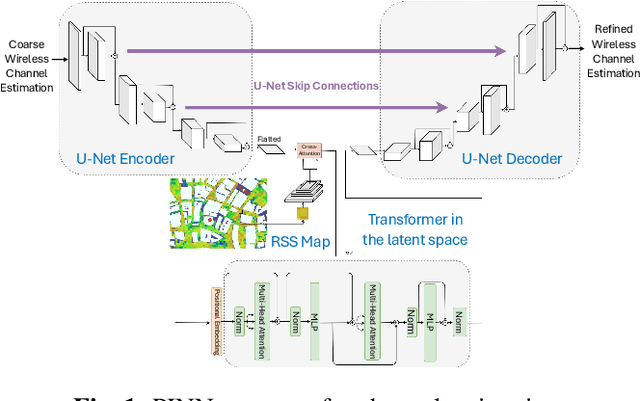

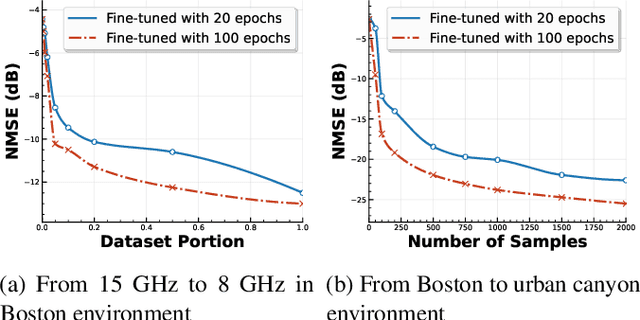

Accurate multiple-input multiple-output (MIMO) channel estimation is critical for next-generation wireless systems, enabling enhanced communication and sensing performance. Traditional model-based channel estimation methods suffer, however, from performance degradation in complex environments with a limited number of pilots, while purely data-driven approaches lack physical interpretability, require extensive data collection, and are usually site-specific. This paper presents a novel physics-informed neural network (PINN) framework that combines model-based channel estimation with a deep network to exploit prior information about the propagation environment and achieve superior performance under pilot-constrained scenarios. The proposed approach employs an enhanced U-Net architecture with cross-attention mechanisms to fuse initial channel estimates with received signal strength (RSS) maps to provide refined channel estimates. Comprehensive evaluation using realistic ray-tracing data from urban environments demonstrates significant performance improvements, achieving over 5 dB gain in normalized mean squared error (NMSE) compared to state-of-the-art methods, with particularly strong performance in pilot-limited scenarios and robustness across different frequencies and environments with only minimal fine-tuning. The proposed framework maintains practical computational complexity, making it viable for massive MIMO systems in upper mid-band frequencies.