 Add to Chrome
 Add to Firefox
 Add to Edge
BHaRNet: Reliability-Aware Body-Hand Modality Expertized Networks for Fine-grained Skeleton Action Recognition
Jan 01, 2026
Skeleton-based human action recognition (HAR) has achieved remarkable progress with graph-based architectures. However, most existing methods remain body-centric, focusing on large-scale motions while neglecting subtle hand articulations that are crucial for fine-grained recognition. This work presents a probabilistic dual-stream framework that unifies reliability modeling and multi-modal integration, generalizing expertized learning under uncertainty across both intra-skeleton and cross-modal domains. The framework comprises three key components: (1) a calibration-free preprocessing pipeline that removes canonical-space transformations and learns directly from native coordinates; (2) a probabilistic Noisy-OR fusion that stabilizes reliability-aware dual-stream learning without requiring explicit confidence supervision; and (3) an intra- to cross-modal ensemble that couples four skeleton modalities (Joint, Bone, Joint Motion, and Bone Motion) to RGB representations, bridging structural and visual motion cues in a unified cross-modal formulation. Comprehensive evaluations across multiple benchmarks (NTU RGB+D~60/120, PKU-MMD, N-UCLA) and a newly defined hand-centric benchmark exhibit consistent improvements and robustness under noisy and heterogeneous conditions.

Body-Hand Modality Expertized Networks with Cross-attention for Fine-grained Skeleton Action Recognition
Mar 19, 2025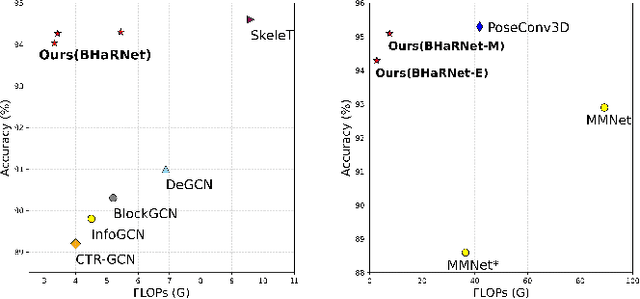
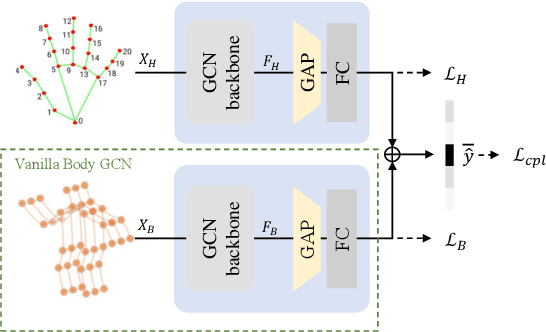
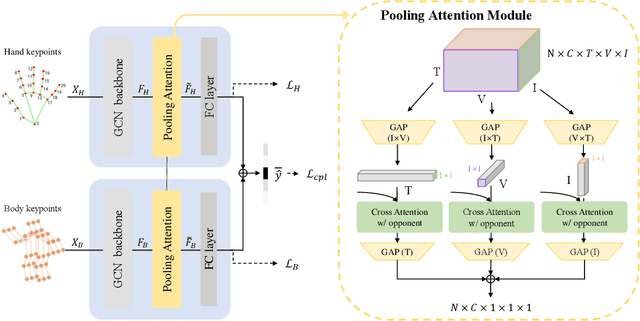
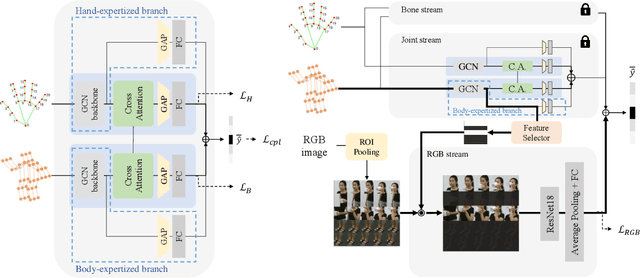
Skeleton-based Human Action Recognition (HAR) is a vital technology in robotics and human-robot interaction. However, most existing methods concentrate primarily on full-body movements and often overlook subtle hand motions that are critical for distinguishing fine-grained actions. Recent work leverages a unified graph representation that combines body, hand, and foot keypoints to capture detailed body dynamics. Yet, these models often blur fine hand details due to the disparity between body and hand action characteristics and the loss of subtle features during the spatial-pooling. In this paper, we propose BHaRNet (Body-Hand action Recognition Network), a novel framework that augments a typical body-expert model with a hand-expert model. Our model jointly trains both streams with an ensemble loss that fosters cooperative specialization, functioning in a manner reminiscent of a Mixture-of-Experts (MoE). Moreover, cross-attention is employed via an expertized branch method and a pooling-attention module to enable feature-level interactions and selectively fuse complementary information. Inspired by MMNet, we also demonstrate the applicability of our approach to multi-modal tasks by leveraging RGB information, where body features guide RGB learning to capture richer contextual cues. Experiments on large-scale benchmarks (NTU RGB+D 60, NTU RGB+D 120, PKU-MMD, and Northwestern-UCLA) demonstrate that BHaRNet achieves SOTA accuracies -- improving from 86.4\% to 93.0\% in hand-intensive actions -- while maintaining fewer GFLOPs and parameters than the relevant unified methods.