 Add to Chrome
 Add to Firefox
 Add to Edge
Distilling Long-CoT Reasoning through Collaborative Step-wise Multi-Teacher Decoding
May 04, 2026
Distilling large reasoning models is essential for making Long-CoT reasoning practical, as full-scale inference remains computationally prohibitive. Existing curation-based approaches select complete reasoning traces post-hoc, overlooking collaboration among heterogeneous teachers and lacking dynamic exploration, which leads to redundant sampling and missed complementary reasoning. We introduce CoRD, a collaborative multi-teacher decoding framework that performs step-wise reasoning synthesis guided by predictive perplexity-based scoring and beam search. This enables heterogeneous LRMs to jointly construct coherent reasoning trajectories while efficiently preserving diverse, high-potential hypotheses. Experiments show that CoRD produces higher-quality reasoning data and achieves near teacher-level student performance with fewer, structured supervision signals, without substantial efficiency overhead. CoRD further generalizes well to out-of-domain and open-ended settings. The dataset and model are available at \href{https://github.com/DISL-Lab/CoRD}{https://github.com/DISL-Lab/CoRD}.

Reasoning over Video: Evaluating How MLLMs Extract, Integrate, and Reconstruct Spatiotemporal Evidence
Mar 13, 2026The growing interest in embodied agents increases the demand for spatiotemporal video understanding, yet existing benchmarks largely emphasize extractive reasoning, where answers can be explicitly presented within spatiotemporal events. It remains unclear whether multimodal large language models can instead perform abstractive spatiotemporal reasoning, which requires integrating observations over time, combining dispersed cues, and inferring implicit spatial and contextual structure. To address this gap, we formalize abstractive spatiotemporal reasoning from videos by introducing a structured evaluation taxonomy that systematically targets its core dimensions and construct a controllable, scenario-driven synthetic egocentric video dataset tailored to evaluate abstractive spatiotemporal reasoning capabilities, spanning object-, room-, and floor-plan-level scenarios. Based on this framework, we present VAEX-BENCH, a benchmark comprising five abstractive reasoning tasks together with their extractive counterparts. Our extensive experiments compare the performance of state-of-the-art MLLMs under extractive and abstractive settings, exposing their limitations on abstractive tasks and providing a fine-grained analysis of the underlying bottlenecks. The dataset will be released soon.
LLM-based User Profile Management for Recommender System
Feb 20, 2025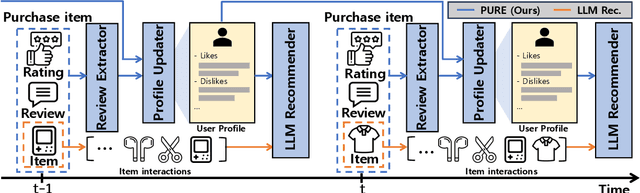
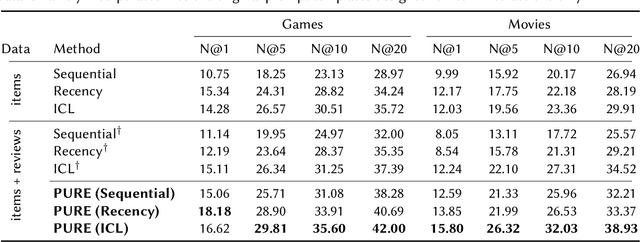
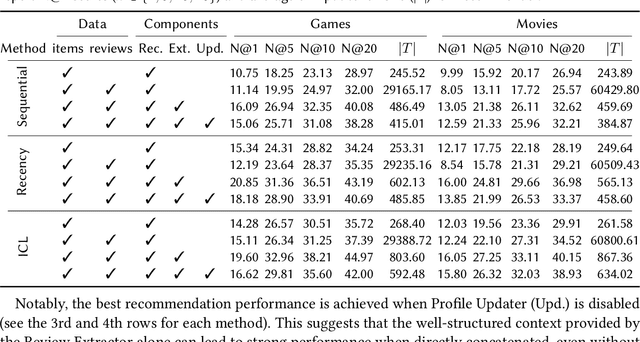
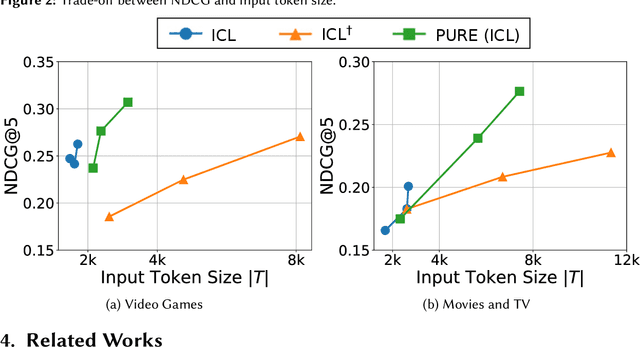
The rapid advancement of Large Language Models (LLMs) has opened new opportunities in recommender systems by enabling zero-shot recommendation without conventional training. Despite their potential, most existing works rely solely on users' purchase histories, leaving significant room for improvement by incorporating user-generated textual data, such as reviews and product descriptions. Addressing this gap, we propose PURE, a novel LLM-based recommendation framework that builds and maintains evolving user profiles by systematically extracting and summarizing key information from user reviews. PURE consists of three core components: a Review Extractor for identifying user preferences and key product features, a Profile Updater for refining and updating user profiles, and a Recommender for generating personalized recommendations using the most current profile. To evaluate PURE, we introduce a continuous sequential recommendation task that reflects real-world scenarios by adding reviews over time and updating predictions incrementally. Our experimental results on Amazon datasets demonstrate that PURE outperforms existing LLM-based methods, effectively leveraging long-term user information while managing token limitations.