 Add to Chrome
 Add to Firefox
 Add to Edge
Conformal Changepoint Localization and Root Cause Analysis with Corrupted Observations
Jul 29, 2026
Detecting when the statistical behavior of an engineered system changes, and identifying which component is responsible, are core problems in the monitoring of telecommunication networks, robotic platforms, security infrastructure, and multi-agent systems. In safety- and mission-critical deployments, such decisions must be accompanied by statistical reliability guarantees rather than by point estimates alone. Conformal changepoint localization (CONCH) and conformal root cause analysis (CROC) meet this need by returning confidence sets that contain the true changepoint, or the true root-cause stream, with a user-specified probability, without parametric assumptions on the data-generating process. In practice, however, observations are frequently corrupted, e.g., by outliers, sensor faults, or adversarial perturbations. While the finite-sample coverage of these procedures is preserved under contamination, the resulting confidence sets can become uninformatively large. Adopting a Huber-type contamination model, this paper proposes weighted CONCH (W-CONCH) and weighted CROC (W-CROC), which downweight observations that are likely to be corrupted with the goal of reducing confidence set size when data may be corrupted. The weighting mechanism, derived from a formal bound on the unknown corrupted data densities, leverages pre-existing second-order classifier-based uncertainty signals, such as those produced by evidential deep learning or Bayesian learning. W-CONCH and W-CROC are further generalized by introducing a meta-learning procedure for the weights that optimizes a differentiable surrogate of the confidence set size. Experiments on image-based and real-world changepoint and root-cause benchmarks show that uncertainty-based weighting substantially reduces confidence set size while maintaining the target coverage.

FedEFC: Federated Learning Using Enhanced Forward Correction Against Noisy Labels
Apr 08, 2025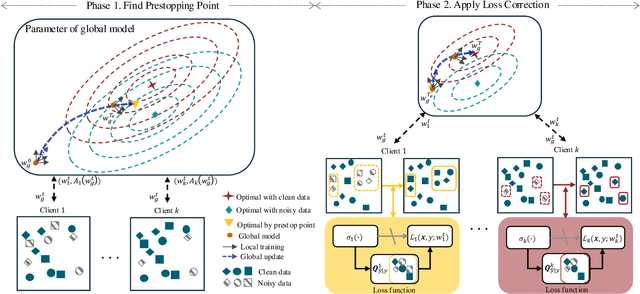
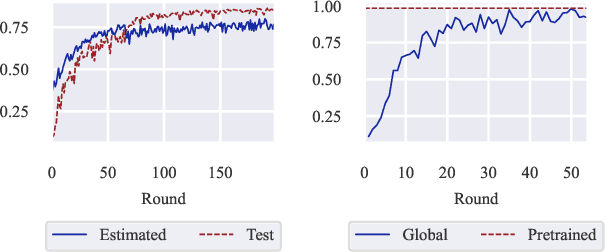
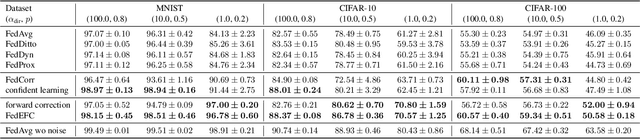
Federated Learning (FL) is a powerful framework for privacy-preserving distributed learning. It enables multiple clients to collaboratively train a global model without sharing raw data. However, handling noisy labels in FL remains a major challenge due to heterogeneous data distributions and communication constraints, which can severely degrade model performance. To address this issue, we propose FedEFC, a novel method designed to tackle the impact of noisy labels in FL. FedEFC mitigates this issue through two key techniques: (1) prestopping, which prevents overfitting to mislabeled data by dynamically halting training at an optimal point, and (2) loss correction, which adjusts model updates to account for label noise. In particular, we develop an effective loss correction tailored to the unique challenges of FL, including data heterogeneity and decentralized training. Furthermore, we provide a theoretical analysis, leveraging the composite proper loss property, to demonstrate that the FL objective function under noisy label distributions can be aligned with the clean label distribution. Extensive experimental results validate the effectiveness of our approach, showing that it consistently outperforms existing FL techniques in mitigating the impact of noisy labels, particularly under heterogeneous data settings (e.g., achieving up to 41.64% relative performance improvement over the existing loss correction method).