 Add to Chrome
 Add to Firefox
 Add to Edge
Hospitality-VQA: Decision-Oriented Informativeness Evaluation for Vision-Language Models
Mar 09, 2026
Recent advances in Vision-Language Models (VLMs) have demonstrated impressive multimodal understanding in general domains. However, their applicability to decision-oriented domains such as hospitality remains largely unexplored. In this work, we investigate how well VLMs can perform visual question answering (VQA) about hotel and facility images that are central to consumer decision-making. While many existing VQA benchmarks focus on factual correctness, they rarely capture what information users actually find useful. To address this, we first introduce Informativeness as a formal framework to quantify how much hospitality-relevant information an image-question pair provides. Guided by this framework, we construct a new hospitality-specific VQA dataset that covers various facility types, where questions are specifically designed to reflect key user information needs. Using this benchmark, we conduct experiments with several state-of-the-art VLMs, revealing that VLMs are not intrinsically decision-aware-key visual signals remain underutilized, and reliable informativeness reasoning emerges only after modest domain-specific finetuning.

Efficient and Effective Vocabulary Expansion Towards Multilingual Large Language Models
Feb 22, 2024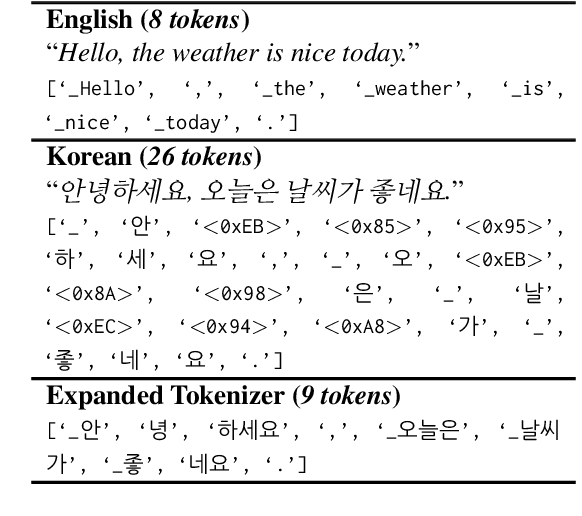
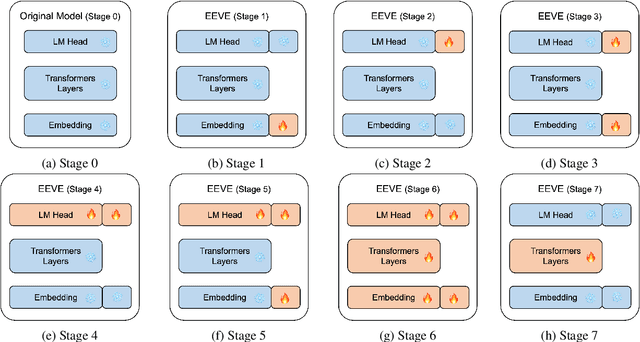
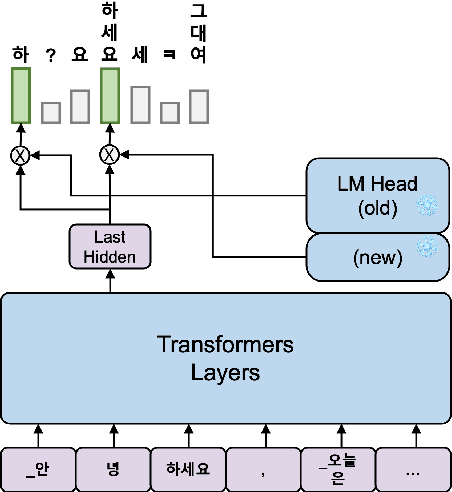
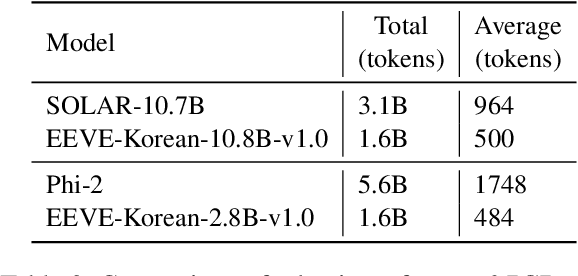
This report introduces \texttt{EEVE-Korean-v1.0}, a Korean adaptation of large language models that exhibit remarkable capabilities across English and Korean text understanding. Building on recent highly capable but English-centric LLMs, such as SOLAR-10.7B and Phi-2, where non-English texts are inefficiently processed with English-centric tokenizers, we present an efficient and effective vocabulary expansion (EEVE) method, which encompasses parameter freezing and subword initialization. In contrast to previous efforts that believe new embeddings require trillions of training tokens, we show that our method can significantly boost non-English proficiency within just 2 billion tokens. Surpassing most instruction-tuned LLMs on the Open Ko-LLM Leaderboard, as of January 2024, our model \texttt{EEVE-Korean-10.8B-v1.0} ranks as the leading Korean pre-trained model in the open-source community, according to Hugging Face's leaderboard. We open-source our models on Huggingface to empower the open research community in various languages.