 Add to Chrome
 Add to Firefox
 Add to Edge
From Static Benchmarks to Dynamic Protocol: Agent-Centric Text Anomaly Detection for Evaluating LLM Reasoning
Feb 27, 2026
The evaluation of large language models (LLMs) has predominantly relied on static datasets, which offer limited scalability and fail to capture the evolving reasoning capabilities of recent models. To overcome these limitations, we propose an agent-centric benchmarking paradigm that moves beyond static datasets by introducing a dynamic protocol in which autonomous agents iteratively generate, validate, and solve problems. Within this protocol, a teacher agent generates candidate problems, an orchestrator agent rigorously verifies their validity and guards against adversarial attacks, and a student agent attempts to solve the validated problems. An invalid problem is revised by the teacher agent until it passes validation. If the student correctly solves the problem, the orchestrator prompts the teacher to generate more challenging variants. Consequently, the benchmark scales in difficulty automatically as more capable agents are substituted into any role, enabling progressive evaluation of large language models without manually curated datasets. Adopting text anomaly detection as our primary evaluation format, which demands cross-sentence logical inference and resists pattern-matching shortcuts, we demonstrate that this protocol systematically exposes corner-case reasoning errors that conventional benchmarks fail to reveal. We further advocate evaluating systems along several complementary axes including cross-model pairwise performance and progress between the initial and orchestrator-finalized problems. By shifting the focus from fixed datasets to dynamic protocols, our approach offers a sustainable direction for evaluating ever-evolving language models and introduces a research agenda centered on the co-evolution of agent-centric benchmarks.

ReTabAD: A Benchmark for Restoring Semantic Context in Tabular Anomaly Detection
Oct 02, 2025In tabular anomaly detection (AD), textual semantics often carry critical signals, as the definition of an anomaly is closely tied to domain-specific context. However, existing benchmarks provide only raw data points without semantic context, overlooking rich textual metadata such as feature descriptions and domain knowledge that experts rely on in practice. This limitation restricts research flexibility and prevents models from fully leveraging domain knowledge for detection. ReTabAD addresses this gap by restoring textual semantics to enable context-aware tabular AD research. We provide (1) 20 carefully curated tabular datasets enriched with structured textual metadata, together with implementations of state-of-the-art AD algorithms including classical, deep learning, and LLM-based approaches, and (2) a zero-shot LLM framework that leverages semantic context without task-specific training, establishing a strong baseline for future research. Furthermore, this work provides insights into the role and utility of textual metadata in AD through experiments and analysis. Results show that semantic context improves detection performance and enhances interpretability by supporting domain-aware reasoning. These findings establish ReTabAD as a benchmark for systematic exploration of context-aware AD.
ImagePiece: Content-aware Re-tokenization for Efficient Image Recognition
Dec 21, 2024
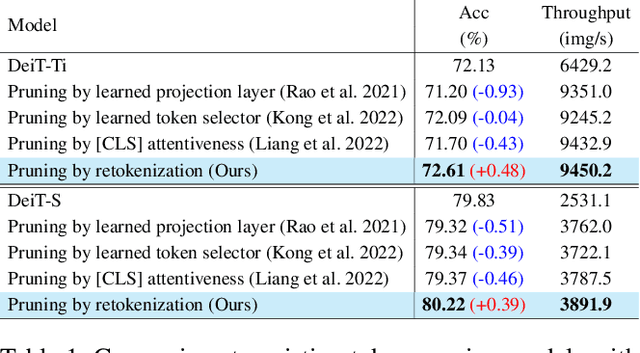


Vision Transformers (ViTs) have achieved remarkable success in various computer vision tasks. However, ViTs have a huge computational cost due to their inherent reliance on multi-head self-attention (MHSA), prompting efforts to accelerate ViTs for practical applications. To this end, recent works aim to reduce the number of tokens, mainly focusing on how to effectively prune or merge them. Nevertheless, since ViT tokens are generated from non-overlapping grid patches, they usually do not convey sufficient semantics, making it incompatible with efficient ViTs. To address this, we propose ImagePiece, a novel re-tokenization strategy for Vision Transformers. Following the MaxMatch strategy of NLP tokenization, ImagePiece groups semantically insufficient yet locally coherent tokens until they convey meaning. This simple retokenization is highly compatible with previous token reduction methods, being able to drastically narrow down relevant tokens, enhancing the inference speed of DeiT-S by 54% (nearly 1.5$\times$ faster) while achieving a 0.39% improvement in ImageNet classification accuracy. For hyper-speed inference scenarios (with 251% acceleration), our approach surpasses other baselines by an accuracy over 8%.