 Add to Chrome
 Add to Firefox
 Add to Edge
CAdam: Context-Adaptive Moment Estimation for 3D Gaussian Densification in Generative Distillation
May 20, 2026
Adaptive densification is the engine of 3D Gaussian Splatting (3DGS). However, when transposed to the optimization-based Generative Distillation paradigm, this reconstruction-native mechanism reveals fundamental limitations, resulting in inefficient representations cluttered with redundant primitives. We diagnose this failure as a Densification Dilemma stemming from the stochastic nature of generative guidance: the standard magnitude-based accumulation indiscriminately aggregates transient noise alongside geometric signals, making it difficult to strike a balance between over-densification and under-fitting. To resolve this, we introduce Context-Adaptive Moment Estimation (CAdam), a novel framework that reinterprets densification as a statistically grounded signal verification problem. CAdam leverages the first moment of gradients to exploit the interference principle, where stochastic fluctuations cancel out via destructive interference while consistent geometric drifts accumulate via constructive interference, effectively disentangling the underlying signal from the generative noise floor. This is further augmented by a quantile-based context awareness and an intrinsic Signal-to-Noise Ratio (SNR) gating mechanism, which ensure robust adaptation across optimization stages and enable the soft termination of densification. Extensive experiments across diverse objectives (SDS, ISM, VFDS) and strong generative 3DGS backbones show that CAdam reduces Gaussian count by 85%-97% relative to standard densification while preserving overall comparable perceptual quality. These results highlight signal-aware density control as a practical way to improve memory efficiency in optimization-based generative distillation.

3DStyleGLIP: Part-Tailored Text-Guided 3D Neural Stylization
Apr 03, 2024

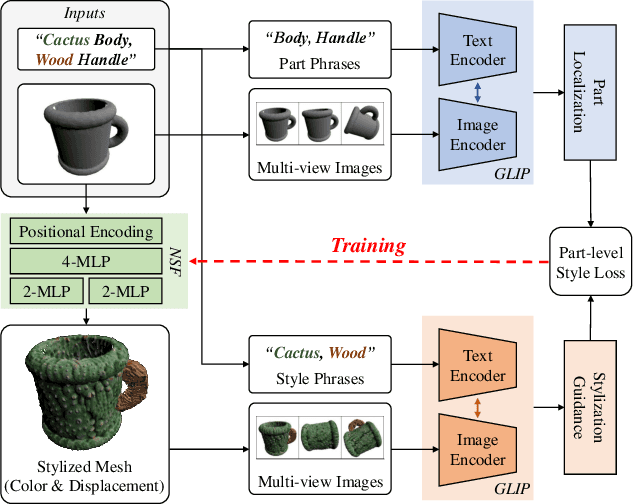
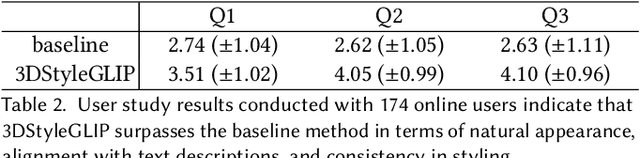
3D stylization, which entails the application of specific styles to three-dimensional objects, holds significant commercial potential as it enables the creation of diverse 3D objects with distinct moods and styles, tailored to specific demands of different scenes. With recent advancements in text-driven methods and artificial intelligence, the stylization process is increasingly intuitive and automated, thereby diminishing the reliance on manual labor and expertise. However, existing methods have predominantly focused on holistic stylization, thereby leaving the application of styles to individual components of a 3D object unexplored. In response, we introduce 3DStyleGLIP, a novel framework specifically designed for text-driven, part-tailored 3D stylization. Given a 3D mesh and a text prompt, 3DStyleGLIP leverages the vision-language embedding space of the Grounded Language-Image Pre-training (GLIP) model to localize the individual parts of the 3D mesh and modify their colors and local geometries to align them with the desired styles specified in the text prompt. 3DStyleGLIP is effectively trained for 3D stylization tasks through a part-level style loss working in GLIP's embedding space, supplemented by two complementary learning techniques. Extensive experimental validation confirms that our method achieves significant part-wise stylization capabilities, demonstrating promising potential in advancing the field of 3D stylization.