 Add to Chrome
 Add to Firefox
 Add to Edge
RenderMem: Rendering as Spatial Memory Retrieval
Mar 15, 2026
Embodied reasoning is inherently viewpoint-dependent: what is visible, occluded, or reachable depends critically on where the agent stands. However, existing spatial memory systems for embodied agents typically store either multi-view observations or object-centric abstractions, making it difficult to perform reasoning with explicit geometric grounding. We introduce RenderMem, a spatial memory framework that treats rendering as the interface between 3D world representations and spatial reasoning. Instead of storing fixed observations, RenderMem maintains a 3D scene representation and generates query-conditioned visual evidence by rendering the scene from viewpoints implied by the query. This enables embodied agents to reason directly about line-of-sight, visibility, and occlusion from arbitrary perspectives. RenderMem is fully compatible with existing vision-language models and requires no modification to standard architectures. Experiments in the AI2-THOR environment show consistent improvements on viewpoint-dependent visibility and occlusion queries over prior memory baselines.

3DStyleGLIP: Part-Tailored Text-Guided 3D Neural Stylization
Apr 03, 2024

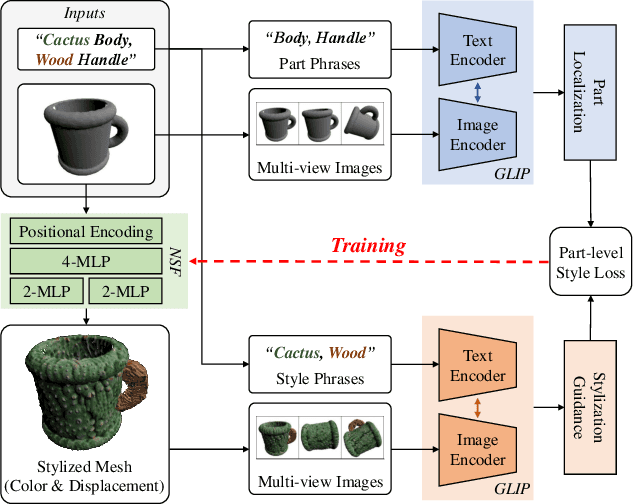
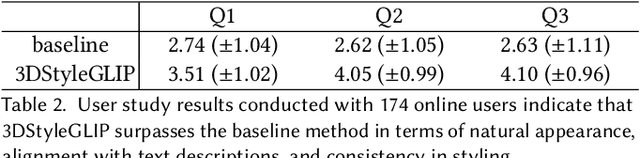
3D stylization, which entails the application of specific styles to three-dimensional objects, holds significant commercial potential as it enables the creation of diverse 3D objects with distinct moods and styles, tailored to specific demands of different scenes. With recent advancements in text-driven methods and artificial intelligence, the stylization process is increasingly intuitive and automated, thereby diminishing the reliance on manual labor and expertise. However, existing methods have predominantly focused on holistic stylization, thereby leaving the application of styles to individual components of a 3D object unexplored. In response, we introduce 3DStyleGLIP, a novel framework specifically designed for text-driven, part-tailored 3D stylization. Given a 3D mesh and a text prompt, 3DStyleGLIP leverages the vision-language embedding space of the Grounded Language-Image Pre-training (GLIP) model to localize the individual parts of the 3D mesh and modify their colors and local geometries to align them with the desired styles specified in the text prompt. 3DStyleGLIP is effectively trained for 3D stylization tasks through a part-level style loss working in GLIP's embedding space, supplemented by two complementary learning techniques. Extensive experimental validation confirms that our method achieves significant part-wise stylization capabilities, demonstrating promising potential in advancing the field of 3D stylization.