 Add to Chrome
 Add to Firefox
 Add to Edge
OpenExempt: A Diagnostic Benchmark for Legal Reasoning and a Framework for Creating Custom Benchmarks on Demand
Jan 19, 2026
Reasoning benchmarks have played a crucial role in the progress of language models. Yet rigorous evaluation remains a significant challenge as static question-answer pairs provide only a snapshot of performance, compressing complex behavior into a single accuracy metric. This limitation is especially true in complex, rule-bound domains such as law, where existing benchmarks are costly to build and ill suited for isolating specific failure modes. To address this, we introduce OpenExempt, a framework and benchmark for diagnostic evaluation of legal reasoning. The OpenExempt Framework uses expert-crafted symbolic representations of U.S. Bankruptcy Code statutes to dynamically generate a large space of natural language reasoning tasks and their machine-computable solutions on demand. This gives users fine-grained control over task complexity and scope, allowing individual reasoning skills to be probed in isolation. Using this system, we construct the OpenExempt Benchmark, a diagnostic benchmark for legal reasoning with 9,765 samples across nine evaluation suites designed to carefully probe model capabilities. Experiments on 13 diverse language models reveal sharp performance cliffs that emerge only under longer reasoning paths and in the presence of obfuscating statements. We release the framework and benchmark publicly to support research aimed at understanding and improving the next generation of reasoning systems.

Chain of Logic: Rule-Based Reasoning with Large Language Models
Feb 23, 2024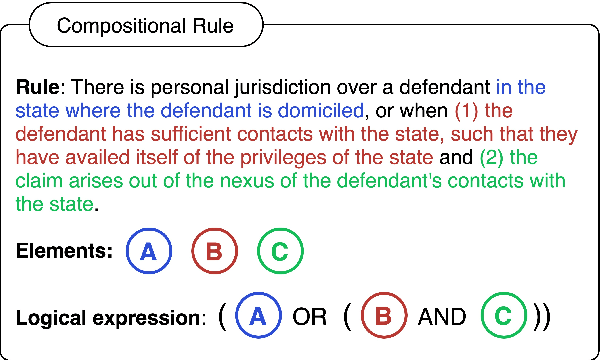
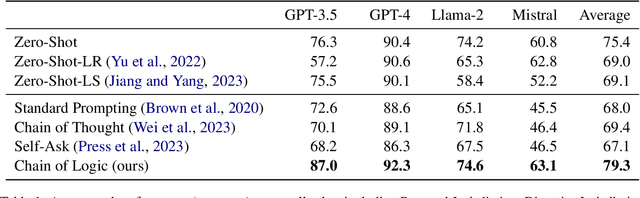
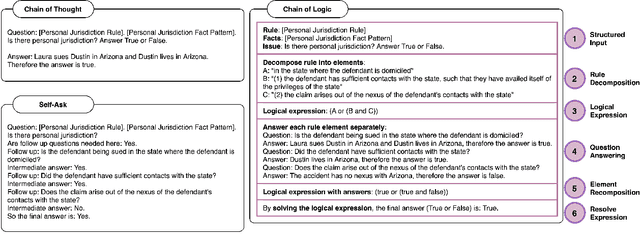
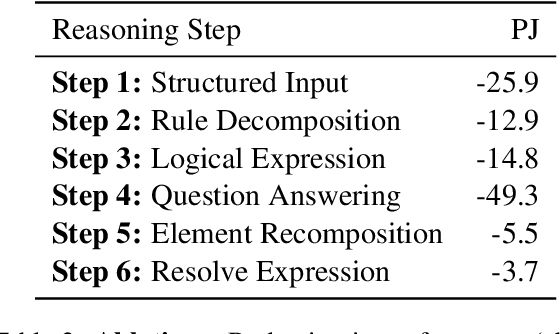
Rule-based reasoning, a fundamental type of legal reasoning, enables us to draw conclusions by accurately applying a rule to a set of facts. We explore causal language models as rule-based reasoners, specifically with respect to compositional rules - rules consisting of multiple elements which form a complex logical expression. Reasoning about compositional rules is challenging because it requires multiple reasoning steps, and attending to the logical relationships between elements. We introduce a new prompting method, Chain of Logic, which elicits rule-based reasoning through decomposition (solving elements as independent threads of logic), and recomposition (recombining these sub-answers to resolve the underlying logical expression). This method was inspired by the IRAC (Issue, Rule, Application, Conclusion) framework, a sequential reasoning approach used by lawyers. We evaluate chain of logic across eight rule-based reasoning tasks involving three distinct compositional rules from the LegalBench benchmark and demonstrate it consistently outperforms other prompting methods, including chain of thought and self-ask, using open-source and commercial language models.
Requirements for Open Political Information: Transparency Beyond Open Data
Dec 06, 2021A politically informed citizenry is imperative for a welldeveloped democracy. While the US government has pursued policies for open data, these efforts have been insufficient in achieving an open government because only people with technical and domain knowledge can access information in the data. In this work, we conduct user interviews to identify wants and needs among stakeholders. We further use this information to sketch out the foundational requirements for a functional political information technical system.