 Add to Chrome
 Add to Firefox
 Add to Edge
Activation-Space Uncertainty Quantification for Pretrained Networks
Feb 16, 2026
Reliable uncertainty estimates are crucial for deploying pretrained models; yet, many strong methods for quantifying uncertainty require retraining, Monte Carlo sampling, or expensive second-order computations and may alter a frozen backbone's predictions. To address this, we introduce Gaussian Process Activations (GAPA), a post-hoc method that shifts Bayesian modeling from weights to activations. GAPA replaces standard nonlinearities with Gaussian-process activations whose posterior mean exactly matches the original activation, preserving the backbone's point predictions by construction while providing closed-form epistemic variances in activation space. To scale to modern architectures, we use a sparse variational inducing-point approximation over cached training activations, combined with local k-nearest-neighbor subset conditioning, enabling deterministic single-pass uncertainty propagation without sampling, backpropagation, or second-order information. Across regression, classification, image segmentation, and language modeling, GAPA matches or outperforms strong post-hoc baselines in calibration and out-of-distribution detection while remaining efficient at test time.

Richer Bayesian Last Layers with Subsampled NTK Features
Feb 01, 2026Bayesian Last Layers (BLLs) provide a convenient and computationally efficient way to estimate uncertainty in neural networks. However, they underestimate epistemic uncertainty because they apply a Bayesian treatment only to the final layer, ignoring uncertainty induced by earlier layers. We propose a method that improves BLLs by leveraging a projection of Neural Tangent Kernel (NTK) features onto the space spanned by the last-layer features. This enables posterior inference that accounts for variability of the full network while retaining the low computational cost of inference of a standard BLL. We show that our method yields posterior variances that are provably greater or equal to those of a standard BLL, correcting its tendency to underestimate epistemic uncertainty. To further reduce computational cost, we introduce a uniform subsampling scheme for estimating the projection matrix and for posterior inference. We derive approximation bounds for both types of sub-sampling. Empirical evaluations on UCI regression, contextual bandits, image classification, and out-of-distribution detection tasks in image and tabular datasets, demonstrate improved calibration and uncertainty estimates compared to standard BLLs and competitive baselines, while reducing computational cost.
Observation Noise and Initialization in Wide Neural Networks
Feb 03, 2025Performing gradient descent in a wide neural network is equivalent to computing the posterior mean of a Gaussian Process with the Neural Tangent Kernel (NTK-GP), for a specific choice of prior mean and with zero observation noise. However, existing formulations of this result have two limitations: i) the resultant NTK-GP assumes no noise in the observed target variables, which can result in suboptimal predictions with noisy data; ii) it is unclear how to extend the equivalence to an arbitrary prior mean, a crucial aspect of formulating a well-specified model. To address the first limitation, we introduce a regularizer into the neural network's training objective, formally showing its correspondence to incorporating observation noise into the NTK-GP model. To address the second, we introduce a \textit{shifted network} that enables arbitrary prior mean functions. This approach allows us to perform gradient descent on a single neural network, without expensive ensembling or kernel matrix inversion. Our theoretical insights are validated empirically, with experiments exploring different values of observation noise and network architectures.
Epistemic Uncertainty and Observation Noise with the Neural Tangent Kernel
Sep 10, 2024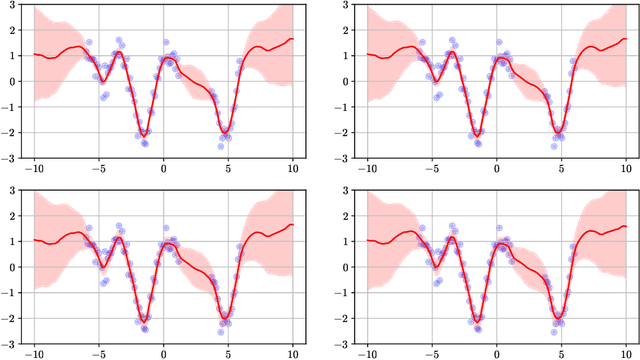
Recent work has shown that training wide neural networks with gradient descent is formally equivalent to computing the mean of the posterior distribution in a Gaussian Process (GP) with the Neural Tangent Kernel (NTK) as the prior covariance and zero aleatoric noise \parencite{jacot2018neural}. In this paper, we extend this framework in two ways. First, we show how to deal with non-zero aleatoric noise. Second, we derive an estimator for the posterior covariance, giving us a handle on epistemic uncertainty. Our proposed approach integrates seamlessly with standard training pipelines, as it involves training a small number of additional predictors using gradient descent on a mean squared error loss. We demonstrate the proof-of-concept of our method through empirical evaluation on synthetic regression.
Uncertainty Modeling in Graph Neural Networks via Stochastic Differential Equations
Sep 01, 2024
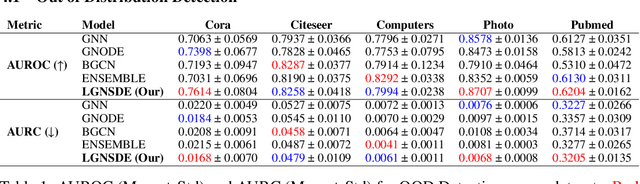
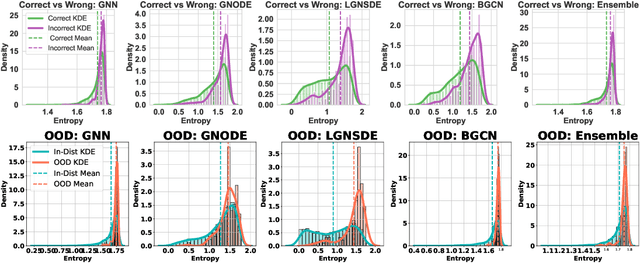
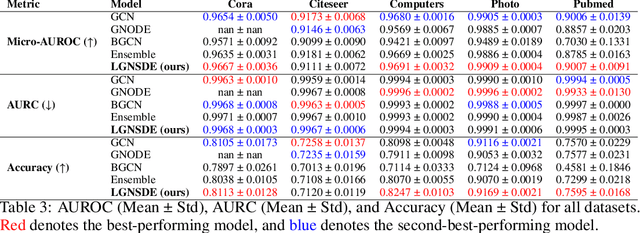
We address the problem of learning uncertainty-aware representations for graph-structured data. While Graph Neural Ordinary Differential Equations (GNODE) are effective in learning node representations, they fail to quantify uncertainty. To address this, we introduce Latent Graph Neural Stochastic Differential Equations (LGNSDE), which enhance GNODE by embedding randomness through Brownian motion to quantify uncertainty. We provide theoretical guarantees for LGNSDE and empirically show better performance in uncertainty quantification.