 Add to Chrome
 Add to Firefox
 Add to Edge
A Data-Free Symbolic Regression Approach for Solving Equations
Jun 05, 2026
Many equations arising in science currently cannot be solved by available analytical techniques and are therefore solved numerically, without yielding explicit symbolic expressions. Existing symbolic regression approaches can recover symbolic expressions, but require training data obtained from the underlying process, rather than the governing equation alone. We propose the Symbolic Equation Solver (SES), a framework that formulates equation solving as an optimization problem over differentiable symbolic models. SES constructs its objective from the equation together with initial or boundary conditions, eliminating the need for paired input-output data. The learned model is expressed in explicit symbolic form, enabling further analysis. We evaluate SES on representative algebraic and differential equations, including a system of algebraic equations, an equation with transcendental terms, an ordinary differential equation, and partial differential equations with different initial or boundary conditions. Across these settings, SES recovers compact symbolic expressions that match the corresponding analytical solutions.

Complex Equation Learner: Rational Symbolic Regression with Gradient Descent in Complex Domain
May 05, 2026Symbolic regression aims to discover interpretable equations from data, yet modern gradient-based methods fail for operators that introduce singularities or domain constraints, including division, logarithms, and square roots. As a result, Equation Learner-type models typically avoid these operators or impose restrictions, e.g. constraining denominators to prevent poles, which narrows the hypothesis class. We propose a complex weight extension of the Equation Learner that mitigates real-valued optimization pathologies by allowing optimization trajectories to bypass real-axis degeneracies. The proposed approach converges stably even when the target expression has real-domain poles, and it enables unconstrained use of operations such as logarithm and square root. We Validate the method on symbolic regression benchmarks and show it can recover singular behavior from experimental frequency response data.
NOMTO: Neural Operator-based symbolic Model approximaTion and discOvery
Jan 14, 2025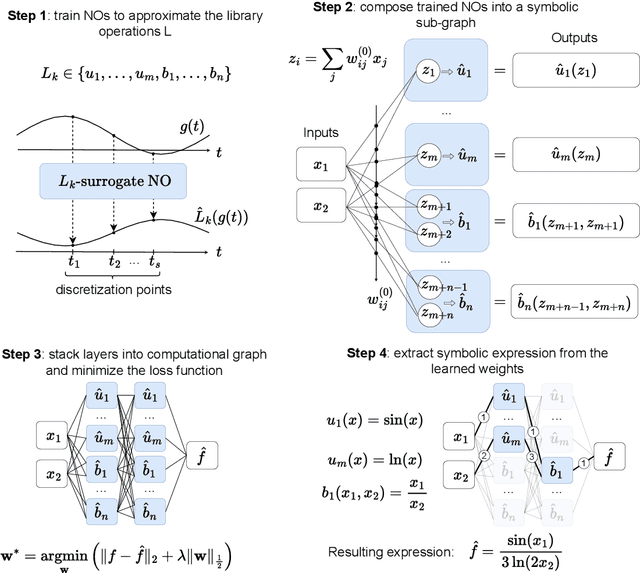
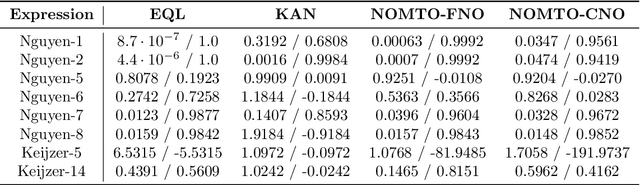
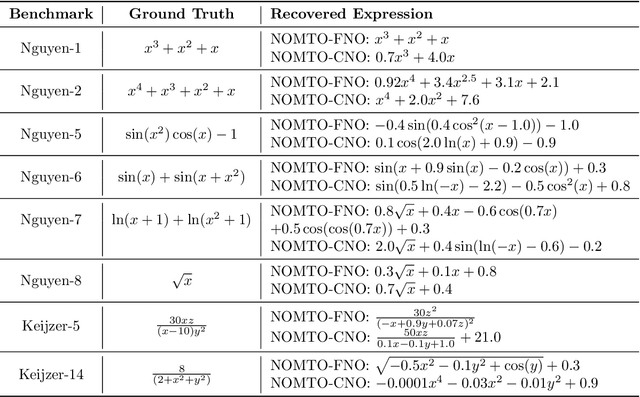
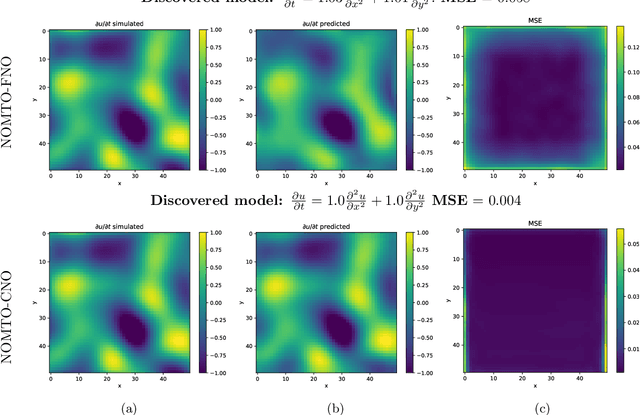
While many physical and engineering processes are most effectively described by non-linear symbolic models, existing non-linear symbolic regression (SR) methods are restricted to a limited set of continuous algebraic functions, thereby limiting their applicability to discover higher order non-linear differential relations. In this work, we introduce the Neural Operator-based symbolic Model approximaTion and discOvery (NOMTO) method, a novel approach to symbolic model discovery that leverages Neural Operators to encompass a broad range of symbolic operations. We demonstrate that NOMTO can successfully identify symbolic expressions containing elementary functions with singularities, special functions, and derivatives. Additionally, our experiments demonstrate that NOMTO can accurately rediscover second-order non-linear partial differential equations. By broadening the set of symbolic operations available for discovery, NOMTO significantly advances the capabilities of existing SR methods. It provides a powerful and flexible tool for model discovery, capable of capturing complex relations in a variety of physical systems.