 Add to Chrome
 Add to Firefox
 Add to Edge
Bridging Online and Offline Handwriting via Differentiable Physical Rendering
Aug 04, 2026
Realistic handwritten text generation plays an important role in numerous applications, such as font design, biometric authentication, and robotic calligraphy. Existing methods are typically divided into two independent paradigms: online approaches that estimate handwriting trajectories and offline approaches that synthesize realistic handwriting images. While online models capture structural and temporal dynamics, they often lack fine-grained textures, whereas offline models reproduce realistic appearance but discard stroke order. However, unifying online and offline models remains challenging due to (1) the lack of an explicit physical model linking stroke kinematics to pixel-level appearance and (2) the absence of paired trajectory-image datasets. Moreover, enabling end-to-end learning requires a differentiable rendering process across motion and appearance domains. To address these challenges, we propose a compact physical brush model that bridges stroke dynamics and visual appearance, together with a differentiable rendering module that converts stroke trajectories into stylized images. By integrating these components, we propose a unified online-offline handwriting generation framework via differentiable brush rendering. The proposed framework consists of four core modules: 1) a text-to-stroke generator that predicts the target stroke conditioned on the given text and style image, 2) a brush parameter observer that extracts brush model parameters from style references, 3) a differentiable brush renderer that maps a stroke sequence and physical brush parameters into a handwritten image, and 4) a zero-shot image refiner that refines rendered images via diffusion models. Extensive experiments and real-world robotic calligraphy demonstrations validate our approach, achieving both structural and visual fidelity.

RehearsalNeRF: Decoupling Intrinsic Neural Fields of Dynamic Illuminations for Scene Editing
Apr 02, 2026Although there has been significant progress in neural radiance fields, an issue on dynamic illumination changes still remains unsolved. Different from relevant works that parameterize time-variant/-invariant components in scenes, subjects' radiance is highly entangled with their own emitted radiance and lighting colors in spatio-temporal domain. In this paper, we present a new effective method to learn disentangled neural fields under the severe illumination changes, named RehearsalNeRF. Our key idea is to leverage scenes captured under stable lighting like rehearsal stages, easily taken before dynamic illumination occurs, to enforce geometric consistency between the different lighting conditions. In particular, RehearsalNeRF employs a learnable vector for lighting effects which represents illumination colors in a temporal dimension and is used to disentangle projected light colors from scene radiance. Furthermore, our RehearsalNeRF is also able to reconstruct the neural fields of dynamic objects by simply adopting off-the-shelf interactive masks. To decouple the dynamic objects, we propose a new regularization leveraging optical flow, which provides coarse supervision for the color disentanglement. We demonstrate the effectiveness of RehearsalNeRF by showing robust performances on novel view synthesis and scene editing under dynamic illumination conditions. Our source code and video datasets will be publicly available.
Kinetic Typography Diffusion Model
Jul 15, 2024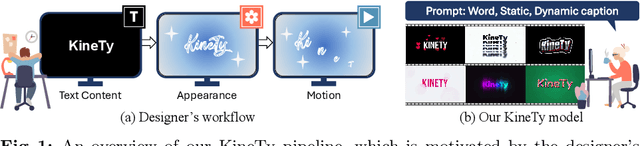
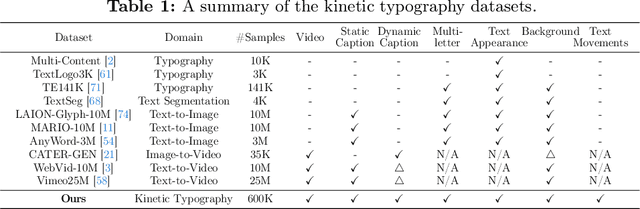
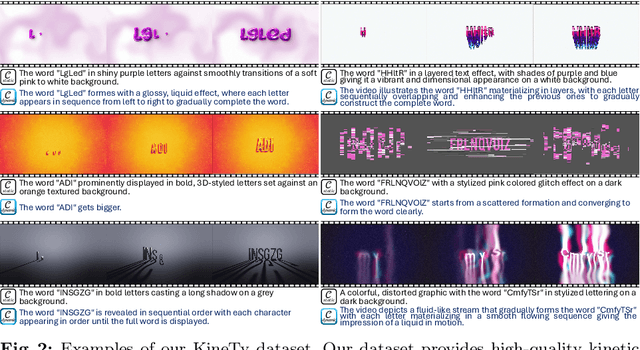
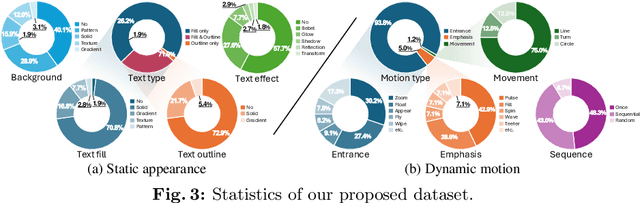
This paper introduces a method for realistic kinetic typography that generates user-preferred animatable 'text content'. We draw on recent advances in guided video diffusion models to achieve visually-pleasing text appearances. To do this, we first construct a kinetic typography dataset, comprising about 600K videos. Our dataset is made from a variety of combinations in 584 templates designed by professional motion graphics designers and involves changing each letter's position, glyph, and size (i.e., flying, glitches, chromatic aberration, reflecting effects, etc.). Next, we propose a video diffusion model for kinetic typography. For this, there are three requirements: aesthetic appearances, motion effects, and readable letters. This paper identifies the requirements. For this, we present static and dynamic captions used as spatial and temporal guidance of a video diffusion model, respectively. The static caption describes the overall appearance of the video, such as colors, texture and glyph which represent a shape of each letter. The dynamic caption accounts for the movements of letters and backgrounds. We add one more guidance with zero convolution to determine which text content should be visible in the video. We apply the zero convolution to the text content, and impose it on the diffusion model. Lastly, our glyph loss, only minimizing a difference between the predicted word and its ground-truth, is proposed to make the prediction letters readable. Experiments show that our model generates kinetic typography videos with legible and artistic letter motions based on text prompts.