 Add to Chrome
 Add to Firefox
 Add to Edge
Neo: Real-Time On-Device 3D Gaussian Splatting with Reuse-and-Update Sorting Acceleration
Nov 17, 2025
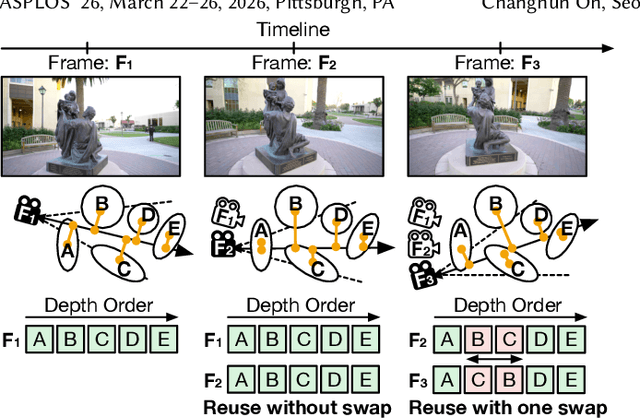
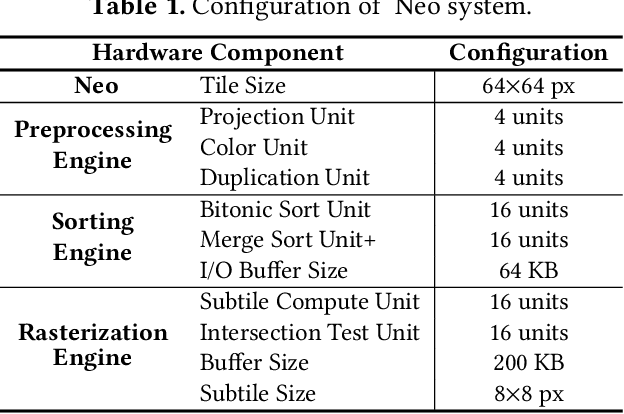

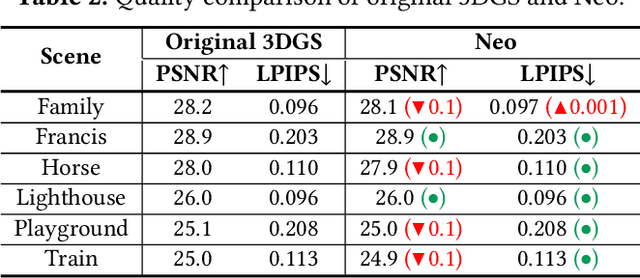
3D Gaussian Splatting (3DGS) rendering in real-time on resource-constrained devices is essential for delivering immersive augmented and virtual reality (AR/VR) experiences. However, existing solutions struggle to achieve high frame rates, especially for high-resolution rendering. Our analysis identifies the sorting stage in the 3DGS rendering pipeline as the major bottleneck due to its high memory bandwidth demand. This paper presents Neo, which introduces a reuse-and-update sorting algorithm that exploits temporal redundancy in Gaussian ordering across consecutive frames, and devises a hardware accelerator optimized for this algorithm. By efficiently tracking and updating Gaussian depth ordering instead of re-sorting from scratch, Neo significantly reduces redundant computations and memory bandwidth pressure. Experimental results show that Neo achieves up to 10.0x and 5.6x higher throughput than state-of-the-art edge GPU and ASIC solution, respectively, while reducing DRAM traffic by 94.5% and 81.3%. These improvements make high-quality and low-latency on-device 3D rendering more practical.

DaCapo: Accelerating Continuous Learning in Autonomous Systems for Video Analytics
Mar 21, 2024Deep neural network (DNN) video analytics is crucial for autonomous systems such as self-driving vehicles, unmanned aerial vehicles (UAVs), and security robots. However, real-world deployment faces challenges due to their limited computational resources and battery power. To tackle these challenges, continuous learning exploits a lightweight "student" model at deployment (inference), leverages a larger "teacher" model for labeling sampled data (labeling), and continuously retrains the student model to adapt to changing scenarios (retraining). This paper highlights the limitations in state-of-the-art continuous learning systems: (1) they focus on computations for retraining, while overlooking the compute needs for inference and labeling, (2) they rely on power-hungry GPUs, unsuitable for battery-operated autonomous systems, and (3) they are located on a remote centralized server, intended for multi-tenant scenarios, again unsuitable for autonomous systems due to privacy, network availability, and latency concerns. We propose a hardware-algorithm co-designed solution for continuous learning, DaCapo, that enables autonomous systems to perform concurrent executions of inference, labeling, and training in a performant and energy-efficient manner. DaCapo comprises (1) a spatially-partitionable and precision-flexible accelerator enabling parallel execution of kernels on sub-accelerators at their respective precisions, and (2) a spatiotemporal resource allocation algorithm that strategically navigates the resource-accuracy tradeoff space, facilitating optimal decisions for resource allocation to achieve maximal accuracy. Our evaluation shows that DaCapo achieves 6.5% and 5.5% higher accuracy than a state-of-the-art GPU-based continuous learning systems, Ekya and EOMU, respectively, while consuming 254x less power.