 Add to Chrome
 Add to Firefox
 Add to Edge
Formalizing Flag Algebras in Lean
Jul 26, 2026
Razborov's flag algebra method is a powerful tool for proving asymptotic inequalities in extremal graph theory, often reducing the task to finding a finite certificate by semidefinite programming. We present a machine-checked formalization of the method for finite simple graphs, together with a certificate-to-proof compiler that turns externally generated certificate data into algebraic proofs checked by Lean. The formalization covers the foundations of the method: partially labeled graphs, their densities in large graphs, the quotient algebra of density expressions, graph-limit semantics through positive homomorphisms, and the downward operators used to average out labels. The compiler treats the external semidefinite programming output as candidate data rather than trusted input: Lean independently computes the required density and multiplication facts, verifies positive semidefiniteness exactly over $\mathbb{Q}$, and carries out the algebraic normalization steps of flag-algebra proofs. Our case studies yield formal proofs of seven Turán-type upper bounds, including Mantel's theorem and the Erdős pentagon theorem, a $C_4$-density bound for triangle-free graphs, and edge-density bounds for $K_4$-free, $K_5$-free, and $C_5$-free graphs. Independently of the compiler, we formalize the matching constructions that complete the exact Turán densities of Mantel's theorem and the Erdős pentagon theorem, and prove two inequalities of Goodman. Our constrained semantics also prompted a meta-theoretic comparison of two ways of imposing graph constraints: building a hereditary constraint into the flag algebra from the start, or testing inequalities afterward on constrained graph limits with labels chosen at random. We state the resulting root-plantability criterion characterizing when the two approaches agree; a forthcoming paper will present the complete account.

Stackelberg Games with $k$-Submodular Function under Distributional Risk-Receptiveness and Robustness
Jun 18, 2024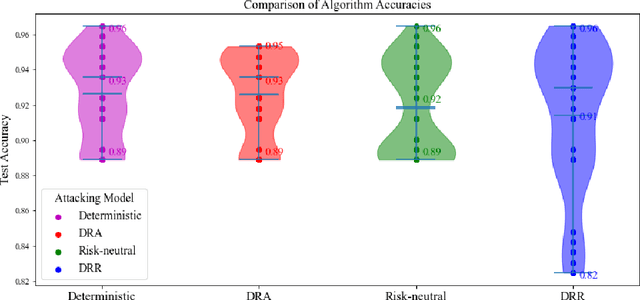
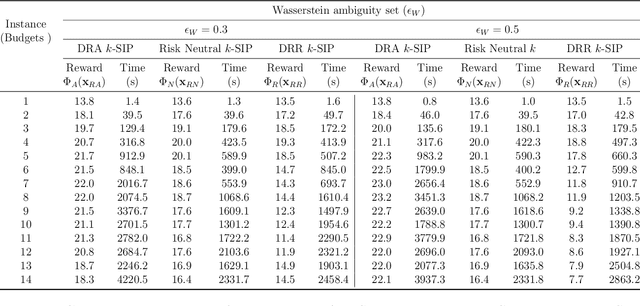
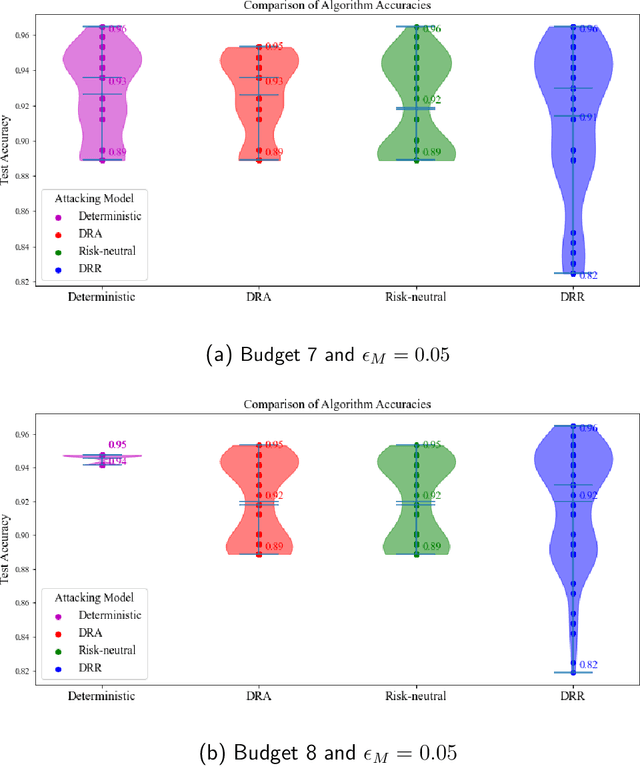
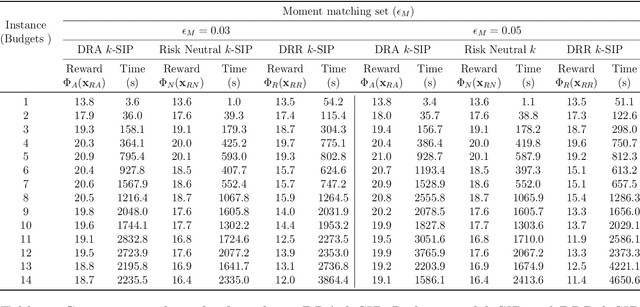
We study submodular optimization in adversarial context, applicable to machine learning problems such as feature selection using data susceptible to uncertainties and attacks. We focus on Stackelberg games between an attacker (or interdictor) and a defender where the attacker aims to minimize the defender's objective of maximizing a $k$-submodular function. We allow uncertainties arising from the success of attacks and inherent data noise, and address challenges due to incomplete knowledge of the probability distribution of random parameters. Specifically, we introduce Distributionally Risk-Averse $k$-Submodular Interdiction Problem (DRA $k$-SIP) and Distributionally Risk-Receptive $k$-Submodular Interdiction Problem (DRR $k$-SIP) along with finitely convergent exact algorithms for solving them. The DRA $k$-SIP solution allows risk-averse interdictor to develop robust strategies for real-world uncertainties. Conversely, DRR $k$-SIP solution suggests aggressive tactics for attackers, willing to embrace (distributional) risk to inflict maximum damage, identifying critical vulnerable components, which can be used for the defender's defensive strategies. The optimal values derived from both DRA $k$-SIP and DRR $k$-SIP offer a confidence interval-like range for the expected value of the defender's objective function, capturing distributional ambiguity. We conduct computational experiments using instances of feature selection and sensor placement problems, and Wisconsin breast cancer data and synthetic data, respectively.