 Add to Chrome
 Add to Firefox
 Add to Edge
Demand-Aware Cooperative Transmission Design for Energy-Efficient LEO Satellite Networks
Aug 10, 2026
Low Earth orbit (LEO) satellite networks are envisioned as a promising solution for providing ubiquitous connectivity and narrowing the digital divide. The extensive footprint of LEO satellite constellations enables broad coverage, resulting in spatially non-uniform traffic demand across the serviced areas. Meanwhile, stringent on-board power constraints make power-intensive transmission architectures less attractive and motivate energy-efficient transmission strategies that effectively exploit scarce satellite network resources. To this end, this paper proposes a cooperative transmission framework that jointly accounts for non-uniform traffic demand and network-wide power consumption. Each LEO satellite integrates hybrid precoding (HPC), radio frequency (RF) chain activation, and hardware quantization, while user-equipment (UE)-centric satellite clusters are organized using statistical channel state information (sCSI) and traffic demands. A framework for joint optimization of cooperative transmission architecture and resource allocation is designed to maximize demand-aware energy efficiency (EE), resulting in a mixed-integer nonlinear program (MINLP) for which finding a globally optimal solution is generally intractable. Accordingly, a two-stage algorithm is developed under a distributed linear precoding structure, in which a modified cross-entropy (CE) method searches over discrete variables, while fractional programming is employed for transmit power allocation. Numerical results indicate that the proposed framework outperforms benchmark schemes while accounting for traffic demands and EE.

Demo: A Transparent Antenna System for In-Building Networks
May 19, 2022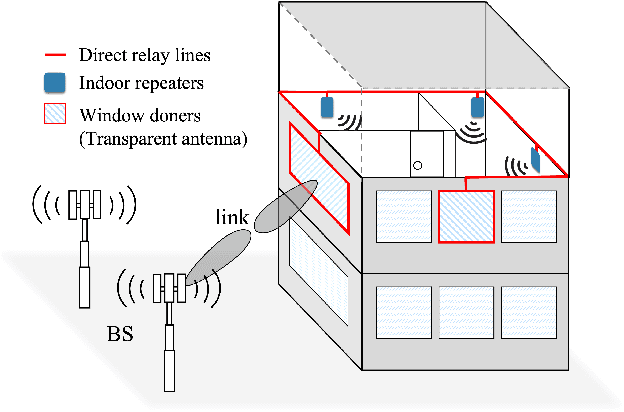
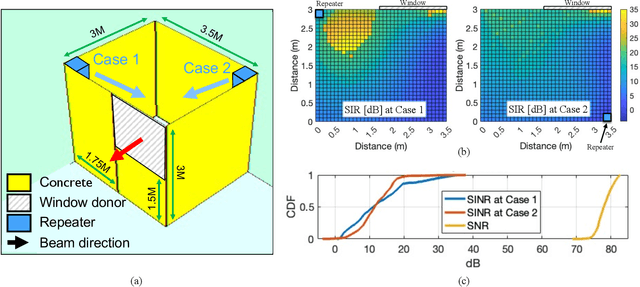
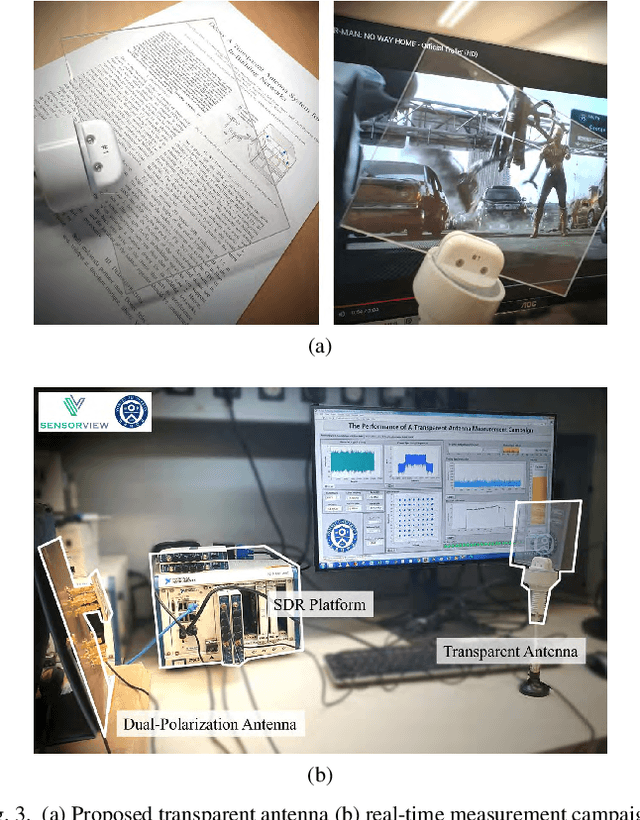
For in-building networks, the potential of transparent antennas, which are used as windows of a building, is presented in this paper. In this scenario, a transparent window antenna communicates with outdoor devices or base stations, and the indoor repeaters act as relay stations of the transparent window antenna for indoor devices. At indoor, back lobe waves of the transparent window antenna are defined as interference to in-building networks. Hence, we analyze different SIR and SINR results according to the location of an indoor repeater through 3D ray tracing system-level simulation. Furthermore, a link-level simulation through a full-duplex software-defined radio platform with the fabricated transparent antenna is presented to examine the feasibility of the transparent antenna.
LightMove: A Lightweight Next-POI Recommendation for Taxicab Rooftop Advertising
Aug 18, 2021
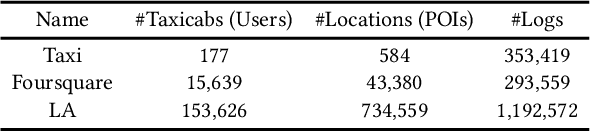
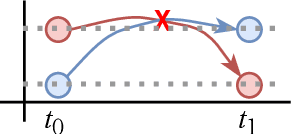
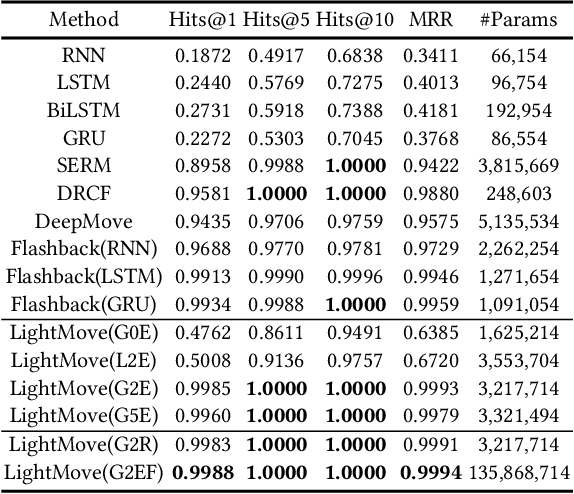
Mobile digital billboards are an effective way to augment brand-awareness. Among various such mobile billboards, taxicab rooftop devices are emerging in the market as a brand new media. Motov is a leading company in South Korea in the taxicab rooftop advertising market. In this work, we present a lightweight yet accurate deep learning-based method to predict taxicabs' next locations to better prepare for targeted advertising based on demographic information of locations. Considering the fact that next POI recommendation datasets are frequently sparse, we design our presented model based on neural ordinary differential equations (NODEs), which are known to be robust to sparse/incorrect input, with several enhancements. Our model, which we call LightMove, has a larger prediction accuracy, a smaller number of parameters, and/or a smaller training/inference time, when evaluating with various datasets, in comparison with state-of-the-art models.