 Add to Chrome
 Add to Firefox
 Add to Edge
Reading the Mood Behind Words: Integrating Prosody-Derived Emotional Context into Socially Responsive VR Agents
Mar 10, 2026
In VR interactions with embodied conversational agents, users' emotional intent is often conveyed more by how something is said than by what is said. However, most VR agent pipelines rely on speech-to-text processing, discarding prosodic cues and often producing emotionally incongruent responses despite correct semantics. We propose an emotion-context-aware VR interaction pipeline that treats vocal emotion as explicit dialogue context in an LLM-based conversational agent. A real-time speech emotion recognition model infers users' emotional states from prosody, and the resulting emotion labels are injected into the agent's dialogue context to shape response tone and style. Results from a within-subjects VR study (N=30) show significant improvements in dialogue quality, naturalness, engagement, rapport, and human-likeness, with 93.3% of participants preferring the emotion-aware agent.
* 12 pages, 4 figures, Accepted to CHI EA 2026 (Extended Abstracts of the 2026 CHI Conference on Human Factors in Computing Systems)

PC-MCL: Patient-Consistent Multi-Cycle Learning with multi-label bias correction for respiratory sound classification
Jan 23, 2026Automated respiratory sound classification supports the diagnosis of pulmonary diseases. However, many deep models still rely on cycle-level analysis and suffer from patient-specific overfitting. We propose PC-MCL (Patient-Consistent Multi-Cycle Learning) to address these limitations by utilizing three key components: multi-cycle concatenation, a 3-label formulation, and a patient-matching auxiliary task. Our work resolves a multi-label distributional bias in respiratory sound classification, a critical issue inherent to applying multi-cycle concatenation with the conventional 2-label formulation (crackle, wheeze). This bias manifests as a systematic loss of normal signal information when normal and abnormal cycles are combined. Our proposed 3-label formulation (normal, crackle, wheeze) corrects this by preserving information from all constituent cycles in mixed samples. Furthermore, the patient-matching auxiliary task acts as a multi-task regularizer, encouraging the model to learn more robust features and improving generalization. On the ICBHI 2017 benchmark, PC-MCL achieves an ICBHI Score of 65.37%, outperforming existing baselines. Ablation studies confirm that all three components are essential, working synergistically to improve the detection of abnormal respiratory events.
iMedic: Towards Smartphone-based Self-Auscultation Tool for AI-Powered Pediatric Respiratory Assessment
Apr 22, 2025Respiratory auscultation is crucial for early detection of pediatric pneumonia, a condition that can quickly worsen without timely intervention. In areas with limited physician access, effective auscultation is challenging. We present a smartphone-based system that leverages built-in microphones and advanced deep learning algorithms to detect abnormal respiratory sounds indicative of pneumonia risk. Our end-to-end deep learning framework employs domain generalization to integrate a large electronic stethoscope dataset with a smaller smartphone-derived dataset, enabling robust feature learning for accurate respiratory assessments without expensive equipment. The accompanying mobile application guides caregivers in collecting high-quality lung sound samples and provides immediate feedback on potential pneumonia risks. User studies show strong classification performance and high acceptance, demonstrating the system's ability to facilitate proactive interventions and reduce preventable childhood pneumonia deaths. By seamlessly integrating into ubiquitous smartphones, this approach offers a promising avenue for more equitable and comprehensive remote pediatric care.
Mitigating Memorization in Sample Selection for Learning with Noisy Labels
Jul 08, 2021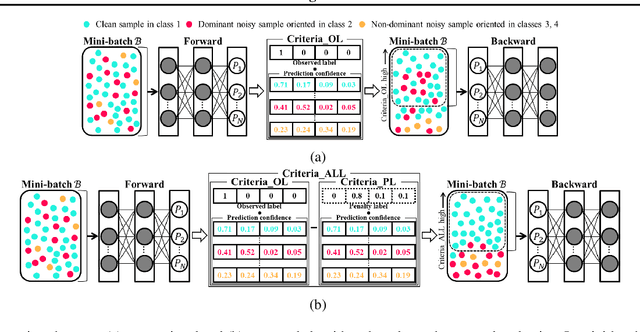
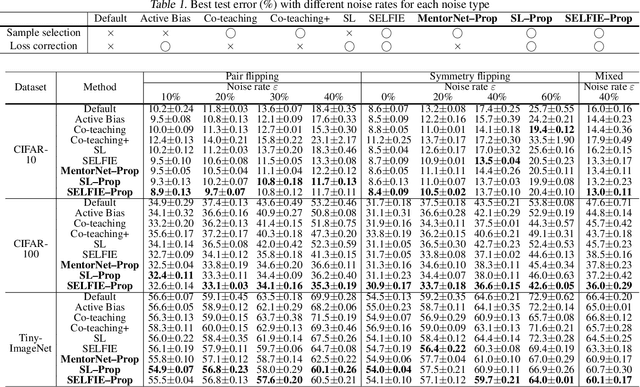
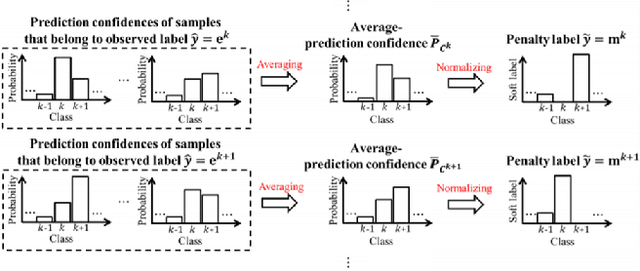
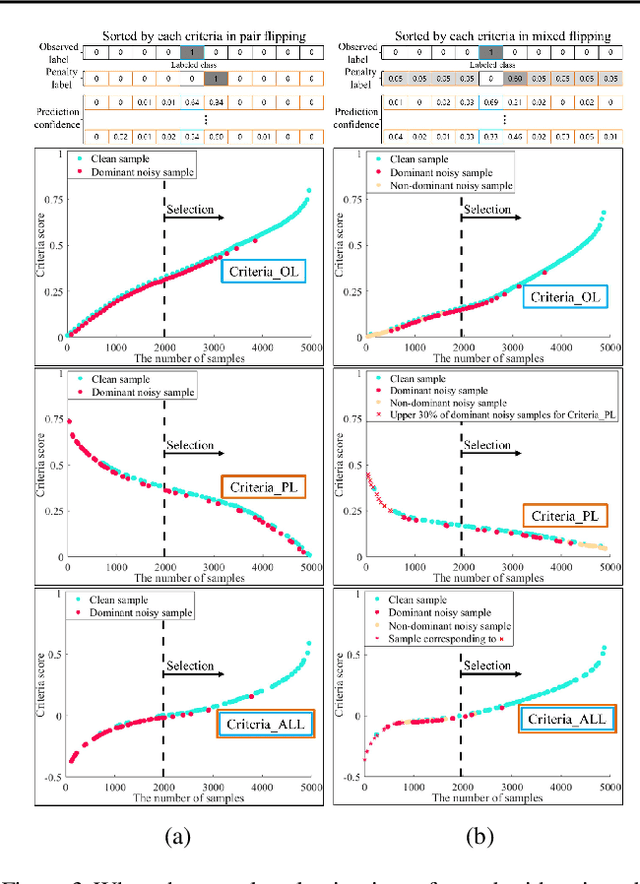
Because deep learning is vulnerable to noisy labels, sample selection techniques, which train networks with only clean labeled data, have attracted a great attention. However, if the labels are dominantly corrupted by few classes, these noisy samples are called dominant-noisy-labeled samples, the network also learns dominant-noisy-labeled samples rapidly via content-aware optimization. In this study, we propose a compelling criteria to penalize dominant-noisy-labeled samples intensively through class-wise penalty labels. By averaging prediction confidences for the each observed label, we obtain suitable penalty labels that have high values if the labels are largely corrupted by some classes. Experiments were performed using benchmarks (CIFAR-10, CIFAR-100, Tiny-ImageNet) and real-world datasets (ANIMAL-10N, Clothing1M) to evaluate the proposed criteria in various scenarios with different noise rates. Using the proposed sample selection, the learning process of the network becomes significantly robust to noisy labels compared to existing methods in several noise types.