 Add to Chrome
 Add to Firefox
 Add to Edge
ZeD-MAP: Bundle Adjustment Guided Zero-Shot Depth Maps for Real-Time Aerial Imaging
Apr 06, 2026
Real-time depth reconstruction from ultra-high-resolution UAV imagery is essential for time-critical geospatial tasks such as disaster response, yet remains challenging due to wide-baseline parallax, large image sizes, low-texture or specular surfaces, occlusions, and strict computational constraints. Recent zero-shot diffusion models offer fast per-image dense predictions without task-specific retraining, and require fewer labelled datasets than transformer-based predictors while avoiding the rigid capture geometry requirement of classical multi-view stereo. However, their probabilistic inference prevents reliable metric accuracy and temporal consistency across sequential frames and overlapping tiles. We present ZeD-MAP, a cluster-level framework that converts a test-time diffusion depth model into a metrically consistent, SLAM-like mapping pipeline by integrating incremental cluster-based bundle adjustment (BA). Streamed UAV frames are grouped into overlapping clusters; periodic BA produces metrically consistent poses and sparse 3D tie-points, which are reprojected into selected frames and used as metric guidance for diffusion-based depth estimation. Validation on ground-marker flights captured at approximately 50 m altitude (GSD is approximately 0.85 cm/px, corresponding to 2,650 square meters ground coverage per frame) with the DLR Modular Aerial Camera System (MACS) shows that our method achieves sub-meter accuracy, with approximately 0.87 m error in the horizontal (XY) plane and 0.12 m in the vertical (Z) direction, while maintaining per-image runtimes between 1.47 and 4.91 seconds. Results are subject to minor noise from manual point-cloud annotation. These findings show that BA-based metric guidance provides consistency comparable to classical photogrammetric methods while significantly accelerating processing, enabling real-time 3D map generation.

Local Path Planning with Dynamic Obstacle Avoidance in Unstructured Environments
Nov 11, 2025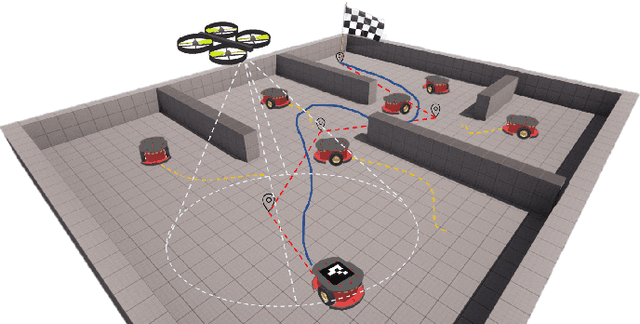
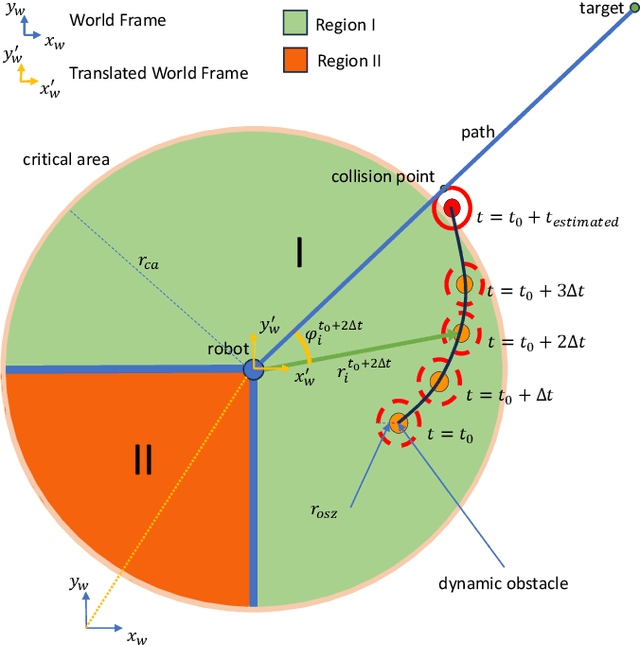
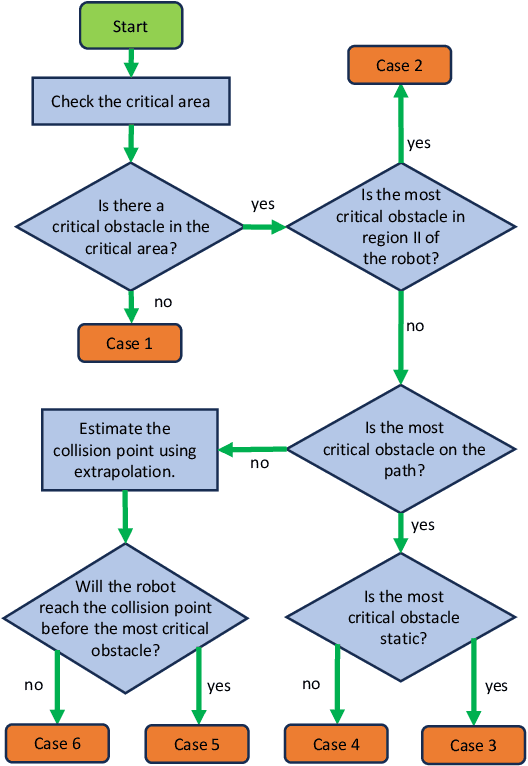
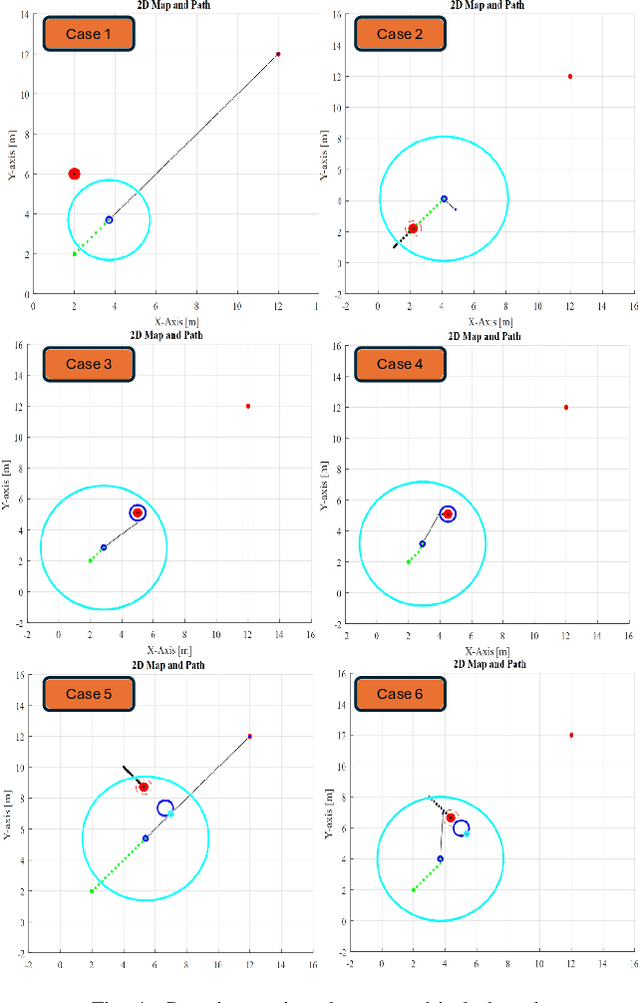
Obstacle avoidance and path planning are essential for guiding unmanned ground vehicles (UGVs) through environments that are densely populated with dynamic obstacles. This paper develops a novel approach that combines tangentbased path planning and extrapolation methods to create a new decision-making algorithm for local path planning. In the assumed scenario, a UGV has a prior knowledge of its initial and target points within the dynamic environment. A global path has already been computed, and the robot is provided with waypoints along this path. As the UGV travels between these waypoints, the algorithm aims to avoid collisions with dynamic obstacles. These obstacles follow polynomial trajectories, with their initial positions randomized in the local map and velocities randomized between O and the allowable physical velocity limit of the robot, along with some random accelerations. The developed algorithm is tested in several scenarios where many dynamic obstacles move randomly in the environment. Simulation results show the effectiveness of the proposed local path planning strategy by gradually generating a collision free path which allows the robot to navigate safely between initial and the target locations.
An Image-Based Path Planning Algorithm Using a UAV Equipped with Stereo Vision
Nov 11, 2025This paper presents a novel image-based path planning algorithm that was developed using computer vision techniques, as well as its comparative analysis with well-known deterministic and probabilistic algorithms, namely A* and Probabilistic Road Map algorithm (PRM). The terrain depth has a significant impact on the calculated path safety. The craters and hills on the surface cannot be distinguished in a two-dimensional image. The proposed method uses a disparity map of the terrain that is generated by using a UAV. Several computer vision techniques, including edge, line and corner detection methods, as well as the stereo depth reconstruction technique, are applied to the captured images and the found disparity map is used to define candidate way-points of the trajectory. The initial and desired points are detected automatically using ArUco marker pose estimation and circle detection techniques. After presenting the mathematical model and vision techniques, the developed algorithm is compared with well-known algorithms on different virtual scenes created in the V-REP simulation program and a physical setup created in a laboratory environment. Results are promising and demonstrate effectiveness of the proposed algorithm.
Vision-Based System Identification of a Quadrotor
Nov 10, 2025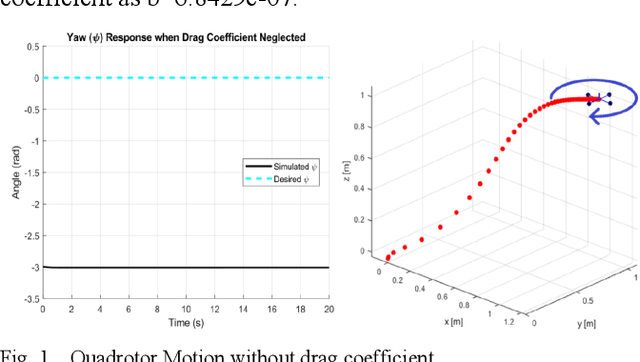
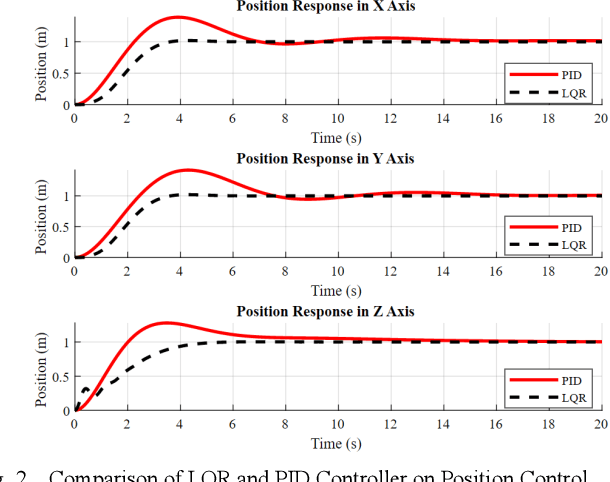
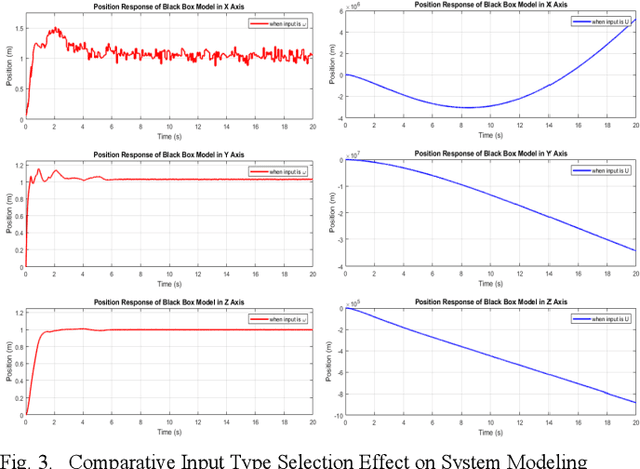
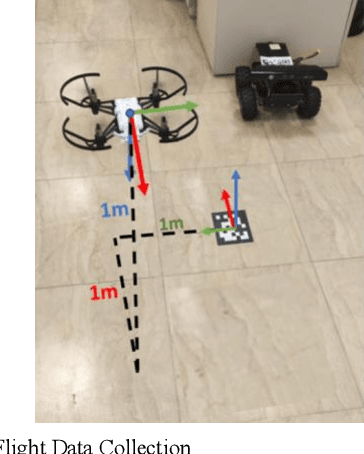
This paper explores the application of vision-based system identification techniques in quadrotor modeling and control. Through experiments and analysis, we address the complexities and limitations of quadrotor modeling, particularly in relation to thrust and drag coefficients. Grey-box modeling is employed to mitigate uncertainties, and the effectiveness of an onboard vision system is evaluated. An LQR controller is designed based on a system identification model using data from the onboard vision system. The results demonstrate consistent performance between the models, validating the efficacy of vision based system identification. This study highlights the potential of vision-based techniques in enhancing quadrotor modeling and control, contributing to improved performance and operational capabilities. Our findings provide insights into the usability and consistency of these techniques, paving the way for future research in quadrotor performance enhancement, fault detection, and decision-making processes.
Aerial Image Stitching Using IMU Data from a UAV
Nov 10, 2025Unmanned Aerial Vehicles (UAVs) are widely used for aerial photography and remote sensing applications. One of the main challenges is to stitch together multiple images into a single high-resolution image that covers a large area. Featurebased image stitching algorithms are commonly used but can suffer from errors and ambiguities in feature detection and matching. To address this, several approaches have been proposed, including using bundle adjustment techniques or direct image alignment. In this paper, we present a novel method that uses a combination of IMU data and computer vision techniques for stitching images captured by a UAV. Our method involves several steps such as estimating the displacement and rotation of the UAV between consecutive images, correcting for perspective distortion, and computing a homography matrix. We then use a standard image stitching algorithm to align and blend the images together. Our proposed method leverages the additional information provided by the IMU data, corrects for various sources of distortion, and can be easily integrated into existing UAV workflows. Our experiments demonstrate the effectiveness and robustness of our method, outperforming some of the existing feature-based image stitching algorithms in terms of accuracy and reliability, particularly in challenging scenarios such as large displacements, rotations, and variations in camera pose.
Real-Time Bundle Adjustment for Ultra-High-Resolution UAV Imagery Using Adaptive Patch-Based Feature Tracking
Nov 08, 2025Real-time processing of UAV imagery is crucial for applications requiring urgent geospatial information, such as disaster response, where rapid decision-making and accurate spatial data are essential. However, processing high-resolution imagery in real time presents significant challenges due to the computational demands of feature extraction, matching, and bundle adjustment (BA). Conventional BA methods either downsample images, sacrificing important details, or require extensive processing time, making them unsuitable for time-critical missions. To overcome these limitations, we propose a novel real-time BA framework that operates directly on fullresolution UAV imagery without downsampling. Our lightweight, onboard-compatible approach divides each image into user-defined patches (e.g., NxN grids, default 150x150 pixels) and dynamically tracks them across frames using UAV GNSS/IMU data and a coarse, globally available digital surface model (DSM). This ensures spatial consistency for robust feature extraction and matching between patches. Overlapping relationships between images are determined in real time using UAV navigation system, enabling the rapid selection of relevant neighbouring images for localized BA. By limiting optimization to a sliding cluster of overlapping images, including those from adjacent flight strips, the method achieves real-time performance while preserving the accuracy of global BA. The proposed algorithm is designed for seamless integration into the DLR Modular Aerial Camera System (MACS), supporting largearea mapping in real time for disaster response, infrastructure monitoring, and coastal protection. Validation on MACS datasets with 50MP images demonstrates that the method maintains precise camera orientations and high-fidelity mapping across multiple strips, running full bundle adjustment in under 2 seconds without GPU acceleration.