 Add to Chrome
 Add to Firefox
 Add to Edge
An Adaptive KKT-Based Indicator for Convergence Assessment in Multi-Objective Optimization
Mar 04, 2026
Performance indicators are essential tools for assessing the convergence behavior of multi-objective optimization algorithms, particularly when the true Pareto front is unknown or difficult to approximate. Classical reference-based metrics such as hypervolume and inverted generational distance are widely used, but may suffer from scalability limitations and sensitivity to parameter choices in many-objective scenarios. Indicators derived from Karush--Kuhn--Tucker (KKT) optimality conditions provide an intrinsic alternative by quantifying stationarity without relying on external reference sets. This paper revisits an entropy-inspired KKT-based convergence indicator and proposes a robust adaptive reformulation based on quantile normalization. The proposed indicator preserves the stationarity-based interpretation of the original formulation while improving robustness to heterogeneous distributions of stationarity residuals, a recurring issue in many-objective optimization.

Lyapunov Stability of Stochastic Vector Optimization: Theory and Numerical Implementation
Mar 04, 2026The use of stochastic differential equations in multi-objective optimization has been limited, in practice, by two persistent gaps: incomplete stability analyses and the absence of accessible implementations. We revisit a drift--diffusion model for unconstrained vector optimization in which the drift is induced by a common descent direction and the diffusion term preserves exploratory behavior. The main theoretical contribution is a self-contained Lyapunov analysis establishing global existence, pathwise uniqueness, and non-explosion under a dissipativity condition, together with positive recurrence under an additional coercivity assumption. We also derive an Euler--Maruyama discretization and implement the resulting iteration as a \emph{pymoo}-compatible algorithm -- \emph{pymoo} being an open-source Python framework for multi-objective optimization -- with an interactive \emph{PymooLab} front-end for reproducible experiments. Empirical results on DTLZ2 with objective counts from three to fifteen indicate a consistent trade-off: compared with established evolutionary baselines, the method is less competitive in low-dimensional regimes but remains a viable option under restricted evaluation budgets in higher-dimensional settings. Taken together, these observations suggest that stochastic drift--diffusion search occupies a mathematically tractable niche alongside population-based heuristics -- not as a replacement, but as an alternative whose favorable properties are amenable to rigorous analysis.
A Convergence indicator for Multi-Objective Optimisation Algorithms
Oct 29, 2018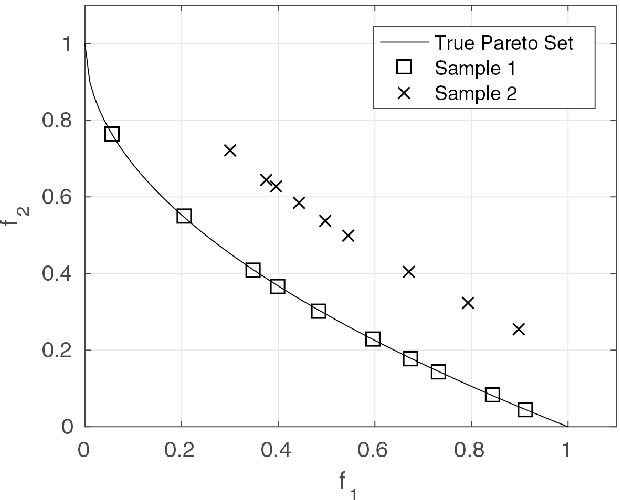

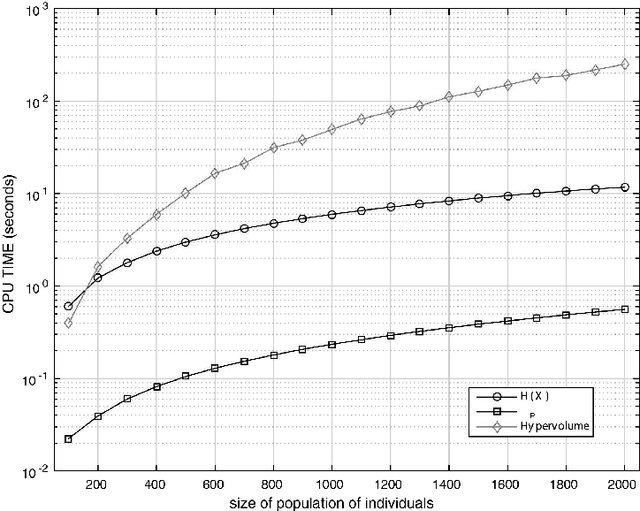

The algorithms of multi-objective optimisation had a relative growth in the last years. Thereby, it's requires some way of comparing the results of these. In this sense, performance measures play a key role. In general, it's considered some properties of these algorithms such as capacity, convergence, diversity or convergence-diversity. There are some known measures such as generational distance (GD), inverted generational distance (IGD), hypervolume (HV), Spread($\Delta$), Averaged Hausdorff distance ($\Delta_p$), R2-indicator, among others. In this paper, we focuses on proposing a new indicator to measure convergence based on the traditional formula for Shannon entropy. The main features about this measure are: 1) It does not require tho know the true Pareto set and 2) Medium computational cost when compared with Hypervolume.