 Add to Chrome
 Add to Firefox
 Add to Edge
Architecture Shape Governs QNN Trainability: Jacobian Null Space Growth and Parameter Efficiency
May 07, 2026
Variational quantum circuits with angle encoding implement truncated Fourier series, and architectures arranging $N$ qubits with $L$ encoding layers each -- sharing encoding budget $E = NL$ -- generate identical frequency spectra, identical frequency redundancy, and require the same minimum parameter count for coefficient control. Despite this equivalence, trainability varies substantially with architecture shape $(N,L)$ at fixed $E$. We identify structural rank deficiency of the coefficient matching Jacobian $J$ as the mechanism responsible. For serial single-qubit architectures, we prove $\mathrm{rank}(J) \leq 2L+1$ regardless of parameter count $P$, with $\dim(\ker J) \geq P-(2L+1)$ growing without bound -- a phenomenon we term \emph{structural gradient starvation}: a growing fraction of parameters become structurally decoupled from the loss as $P$ increases at fixed $L$. Parallel architectures avoid this via independent phase trajectories, ensuring $σ_{\min}(J^{(\mathrm{par})}) > 0$ generically for $P \leq 2E+1$, so no parameter lies in $\ker J$. For practitioners, we further show that the two natural routes to increasing parameter count have fundamentally different effects: adding feature map (FM) layers monotonically strengthens the Jacobian QFIM eigenvalue spectrum and achieves $R^2 \geq 0.95$ with $1.6$--$2.2\times$ fewer parameters than adding trainable blocks across all tested architectures, while trainable blocks improve training only through the classical interpolation mechanism with no quantum-specific benefit.

Evaluating Parameter-Based Training Performance of Neural Networks and Variational Quantum Circuits
Apr 09, 2025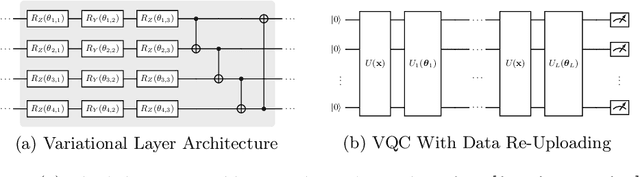
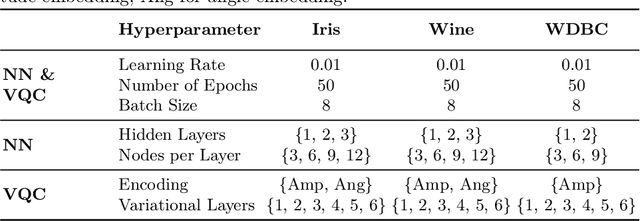
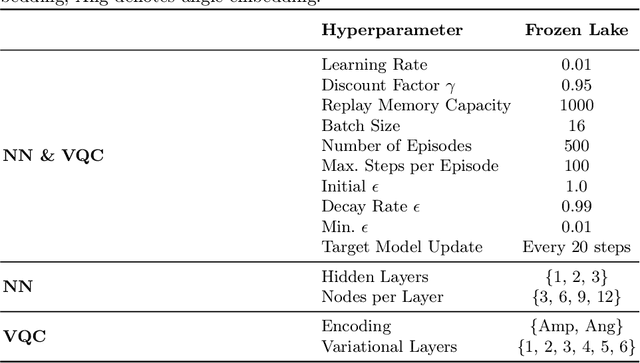
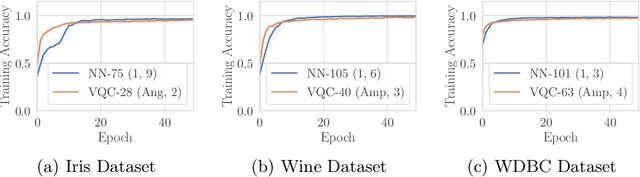
In recent years, neural networks (NNs) have driven significant advances in machine learning. However, as tasks grow more complex, NNs often require large numbers of trainable parameters, which increases computational and energy demands. Variational quantum circuits (VQCs) offer a promising alternative: they leverage quantum mechanics to capture intricate relationships and typically need fewer parameters. In this work, we evaluate NNs and VQCs on simple supervised and reinforcement learning tasks, examining models with different parameter sizes. We simulate VQCs and execute selected parts of the training process on real quantum hardware to approximate actual training times. Our results show that VQCs can match NNs in performance while using significantly fewer parameters, despite longer training durations. As quantum technology and algorithms advance, and VQC architectures improve, we posit that VQCs could become advantageous for certain machine learning tasks.
Investigating Parameter-Efficiency of Hybrid QuGANs Based on Geometric Properties of Generated Sea Route Graphs
Jan 15, 2025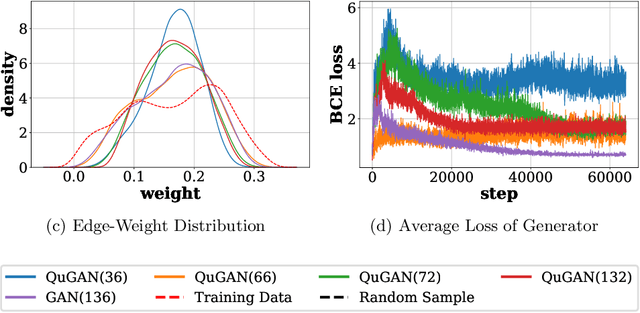
The demand for artificially generated data for the development, training and testing of new algorithms is omnipresent. Quantum computing (QC), does offer the hope that its inherent probabilistic functionality can be utilised in this field of generative artificial intelligence. In this study, we use quantum-classical hybrid generative adversarial networks (QuGANs) to artificially generate graphs of shipping routes. We create a training dataset based on real shipping data and investigate to what extent QuGANs are able to learn and reproduce inherent distributions and geometric features of this data. We compare hybrid QuGANs with classical Generative Adversarial Networks (GANs), with a special focus on their parameter efficiency. Our results indicate that QuGANs are indeed able to quickly learn and represent underlying geometric properties and distributions, although they seem to have difficulties in introducing variance into the sampled data. Compared to classical GANs of greater size, measured in the number of parameters used, some QuGANs show similar result quality. Our reference to concrete use cases, such as the generation of shipping data, provides an illustrative example and demonstrate the potential and diversity in which QC can be used.