 Add to Chrome
 Add to Firefox
 Add to Edge
Compiling Differentiable Audio Graphs to Real-Time DSP
Jun 19, 2026
Differentiable audio processors are habitually designed and optimised in machine-learning frameworks, but deploying them as real-time audio effects still often requires non-automatic implementation in a dedicated digital signal processing language. The translation is error-prone, demands an onerous verification process, and detaches research prototypes from usable production tools. That being so, we present ADAC, a compiler that lowers a trained model to a framework-agnostic intermediate representation and emits efficient FAUST code whose impulse response matches the source model to within floating-point arithmetic noise, direct paths included. The optimisation loop is made audible by replacing the model in a running plugin after each gradient step. The exported processor carries a small set of macro-controls that leave its stability intact. A stability certificate computed from the shipped parameters is checked before the plugin is built. At the demonstration, a feedback delay network is trained and exported to a working plugin.

Audio-to-Audio via Diffusion Warm Initialization
Jun 17, 2026In this paper, we propose diffusion warm initialization as a simple yet effective approach for a range of audio-to-audio transformation tasks. To illustrate the generality of the approach, we demonstrate its use in timbre transfer, MIDI-to-Real synthesis, and multiple audio enhancement tasks. We conduct a detailed empirical analysis on timbre transfer to investigate the role of the initialization time $t_\text{init}$. The effect of $t_\text{init}$ is evaluated using pitch-based Jaccard Distance and Fréchet Audio Distance to quantify faithfulness to the input signal and alignment with the target distribution. Our results provide practical guidance for selecting $t_\text{init}$ and show that, once properly chosen, a single pretrained diffusion model combined with warm initialization can support multiple transformation objectives without task-specific training or conditioning. Despite its simplicity, this approach already achieves competitive results when compared with more complex pipelines designed specifically for these tasks. We further observe that warm initialization does not necessarily require explicit noise injection, as the guide signal itself can often serve as a valid initialization state for the backward diffusion process. Together, these findings show that warm initialization provides a simple and effective framework that serves as a fundamental building block for more complex audio transformation pipelines.
Solving Room Impulse Response Inverse Problems Using Flow Matching with Analytic Wiener Denoiser
Jan 31, 2026Room impulse response (RIR) estimation naturally arises as a class of inverse problems, including denoising and deconvolution. While recent approaches often rely on supervised learning or learned generative priors, such methods require large amounts of training data and may generalize poorly outside the training distribution. In this work, we present RIRFlow, a training-free Bayesian framework for RIR inverse problems using flow matching. We derive a flow-consistent analytic prior from the statistical structure of RIRs, eliminating the need for data-driven priors. Specifically, we model RIR as a Gaussian process with exponentially decaying variance, which yields a closed-form minimum mean squared error (MMSE) Wiener denoiser. This analytic denoiser is integrated as a prior in an existing flow-based inverse solver, where inverse problems are solved via guided posterior sampling. Furthermore, we extend the solver to nonlinear and non-Gaussian inverse problems via a local Gaussian approximation of the guided posterior, and empirically demonstrate that this approximation remains effective in practice. Experiments on real RIRs across different inverse problems demonstrate robust performance, highlighting the effectiveness of combining a classic RIR model with the recent flow-based generative inference.
Learning Recursive Attenuation Filters Under Noisy Conditions
Dec 18, 2025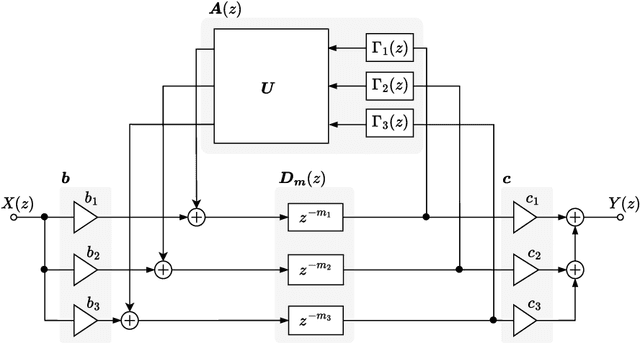
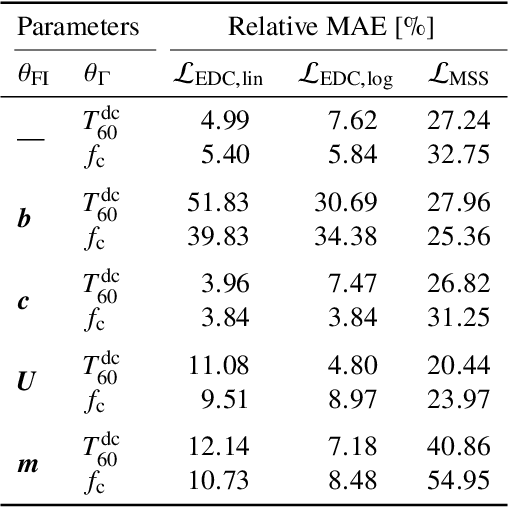
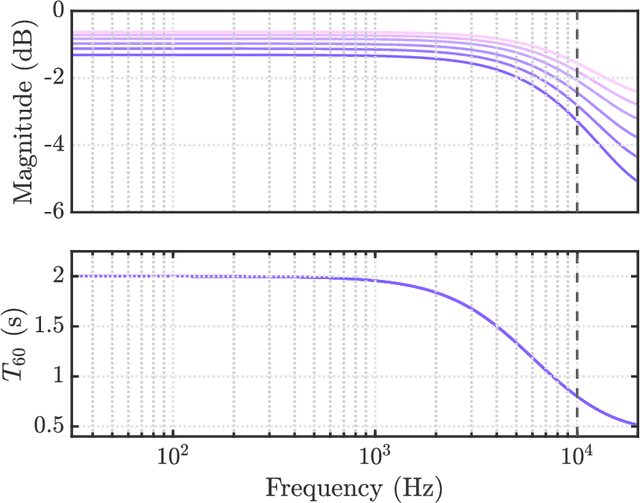
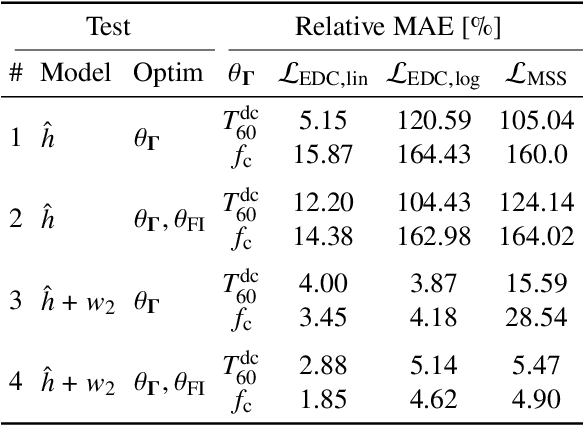
Recursion is a fundamental concept in the design of filters and audio systems. In particular, artificial reverberation systems that use delay networks depend on recursive paths to control both echo density and the decay rate of modal components. The differentiable digital signal processing framework has shown promise in automatically tuning both recursive and non-recursive elements given a target room impulse response. This is done by applying gradient descent to loss functions based on energy-decay or spectrogram differences. However, these representations are highly sensitive to background noise, which is ubiquitous in real measurements, producing spurious loss minima and leading to incorrect attenuation. This paper addresses the problem of tuning recursive attenuation filters of a feedback delay network when targets are noisy. We examine the loss landscape associated with different optimization objectives and propose a method that ensures correct minima under low signal-to-noise conditions. We demonstrate the effectiveness of the proposed approach through statistical analysis on 80 individual optimization examples. The results reveal that explicitly modeling the noise restores correct minima. Furthermore, we identify the sensitivity of attenuation filter parameters tuning to perturbations in frequency-independent parameters. These findings provide practical guidelines for more robust and reproducible gradient-based optimization of feedback delay networks.
Joint Spectrogram Separation and TDOA Estimation using Optimal Transport
Mar 24, 2025Separating sources is a common challenge in applications such as speech enhancement and telecommunications, where distinguishing between overlapping sounds helps reduce interference and improve signal quality. Additionally, in multichannel systems, correct calibration and synchronization are essential to separate and locate source signals accurately. This work introduces a method for blind source separation and estimation of the Time Difference of Arrival (TDOA) of signals in the time-frequency domain. Our proposed method effectively separates signal mixtures into their original source spectrograms while simultaneously estimating the relative delays between receivers, using Optimal Transport (OT) theory. By exploiting the structure of the OT problem, we combine the separation and delay estimation processes into a unified framework, optimizing the system through a block coordinate descent algorithm. We analyze the performance of the OT-based estimator under various noise conditions and compare it with conventional TDOA and source separation methods. Numerical simulation results demonstrate that our proposed approach can achieve a significant level of accuracy across diverse noise scenarios for physical speech signals in both TDOA and source separation tasks.
MoD-ART: Modal Decomposition of Acoustic Radiance Transfer
Dec 05, 2024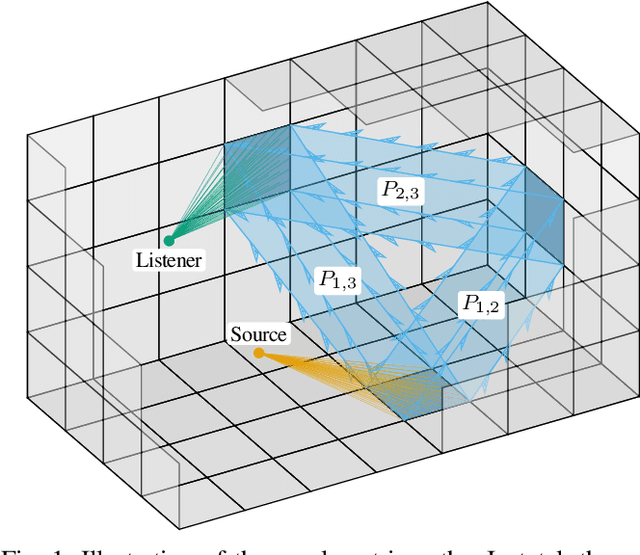
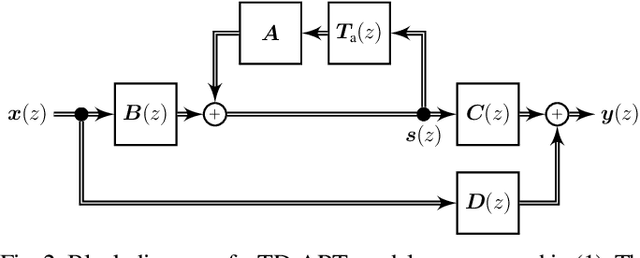
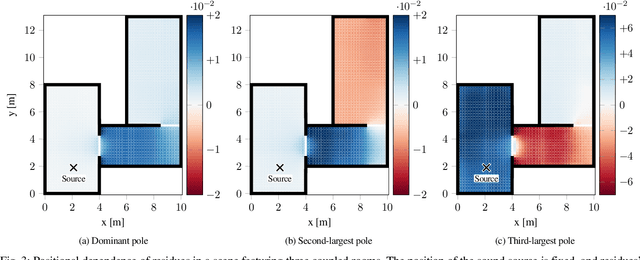
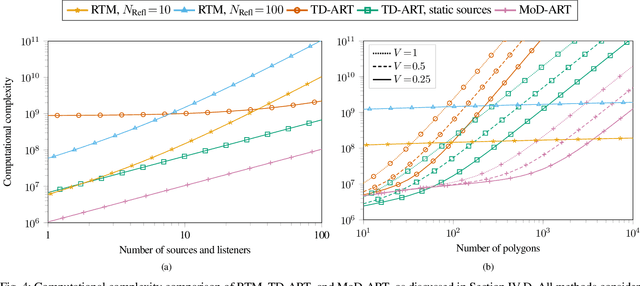
Modeling late reverberation at interactive speeds is a challenging task when multiple sound sources and listeners are present in the same environment. This is especially problematic when the environment is geometrically complex and/or features uneven energy absorption (e.g. coupled volumes), because in such cases the late reverberation is dependent on the sound sources' and listeners' positions, and therefore must be adapted to their movements in real time. We present a novel approach to the task, named modal decomposition of Acoustic Radiance Transfer (MoD-ART), which can handle highly complex scenarios with efficiency. The approach is based on the geometrical acoustics method of Acoustic Radiance Transfer, from which we extract a set of energy decay modes and their positional relationships with sources and listeners. In this paper, we describe the physical and mathematical meaningfulness of MoD-ART, highlighting its advantages and applicability to different scenarios. Through an analysis of the method's computational complexity, we show that it compares very favourably with ray-tracing. We also present simulation results showing that MoD-ART can capture multiple decay slopes and flutter echoes.
FLAMO: An Open-Source Library for Frequency-Domain Differentiable Audio Processing
Sep 13, 2024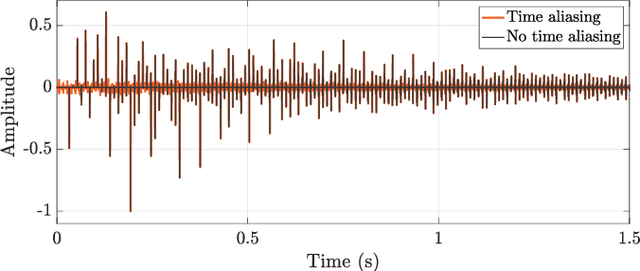
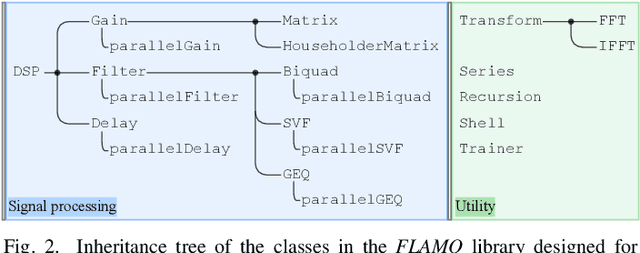
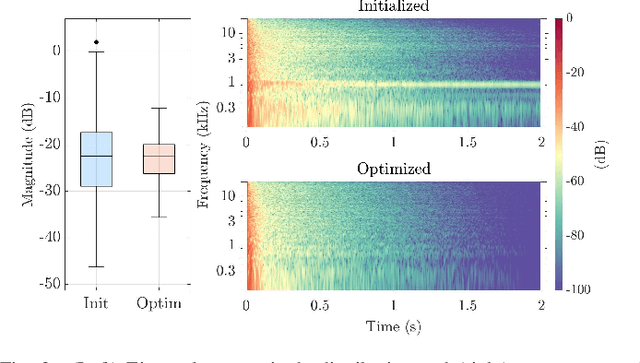
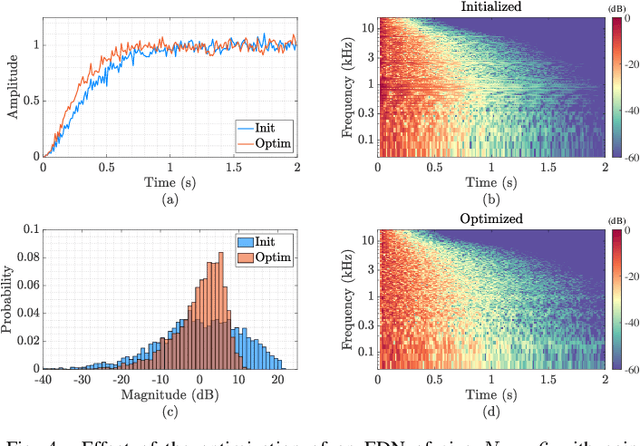
We present FLAMO, a Frequency-sampling Library for Audio-Module Optimization designed to implement and optimize differentiable linear time-invariant audio systems. The library is open-source and built on the frequency-sampling filter design method, allowing for the creation of differentiable modules that can be used stand-alone or within the computation graph of neural networks, simplifying the development of differentiable audio systems. It includes predefined filtering modules and auxiliary classes for constructing, training, and logging the optimized systems, all accessible through an intuitive interface. Practical application of these modules is demonstrated through two case studies: the optimization of an artificial reverberator and an active acoustics system for improved response smoothness.
Similarity Metrics For Late Reverberation
Aug 27, 2024


Automatic tuning of reverberation algorithms relies on the optimization of a cost function. While general audio similarity metrics are useful, they are not optimized for the specific statistical properties of reverberation in rooms. This paper presents two novel metrics for assessing the similarity of late reverberation in room impulse responses. These metrics are differentiable and can be utilized within a machine-learning framework. We compare the performance of these metrics to two popular audio metrics using a large dataset of room impulse responses encompassing various room configurations and microphone positions. The results indicate that the proposed functions based on averaged power and frequency-band energy decay outperform the baselines with the former exhibiting the most suitable profile towards the minimum. The proposed work holds promise as an improvement to the design and evaluation of reverberation similarity metrics.
Fade-in Reverberation in Multi-room Environments Using the Common-Slope Model
Jul 18, 2024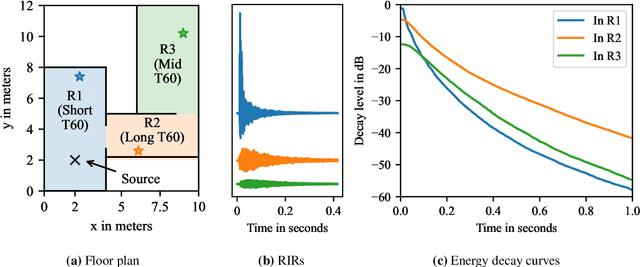
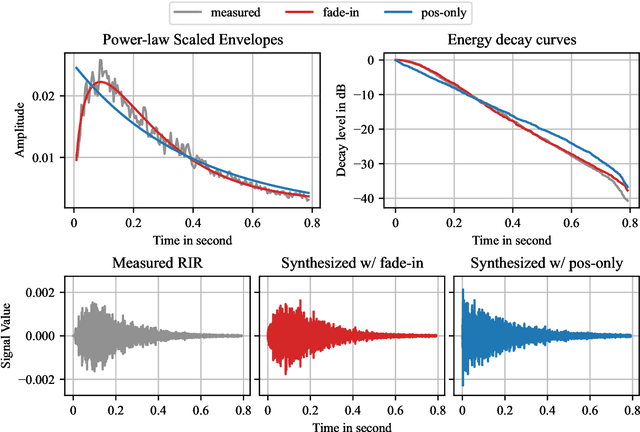
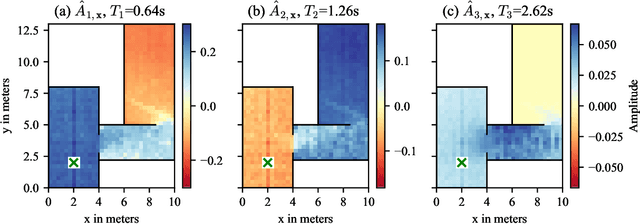
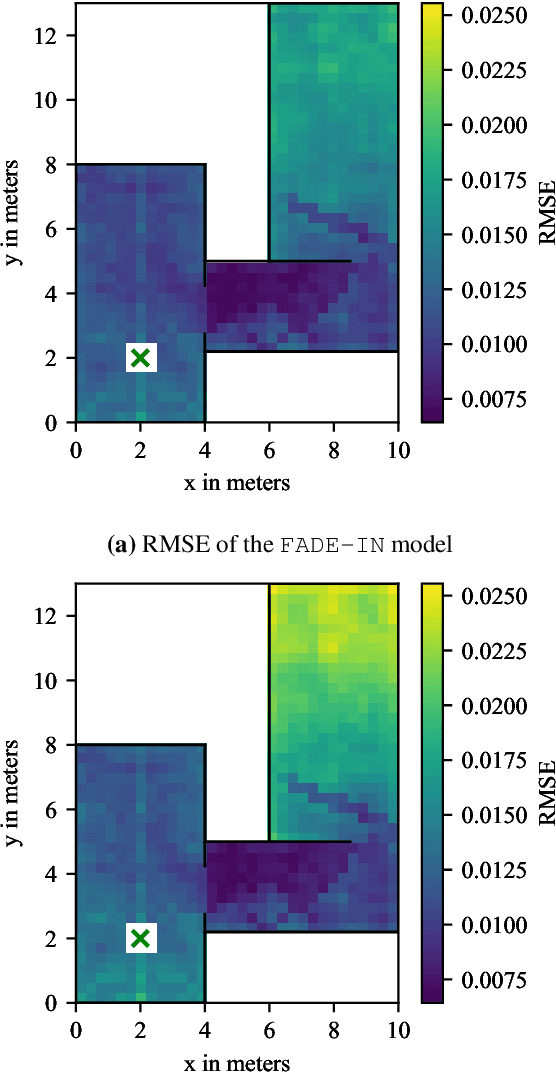
In multi-room environments, modelling the sound propagation is complex due to the coupling of rooms and diverse source-receiver positions. A common scenario is when the source and the receiver are in different rooms without a clear line of sight. For such source-receiver configurations, an initial increase in energy is observed, referred to as the "fade-in" of reverberation. Based on recent work of representing inhomogeneous and anisotropic reverberation with common decay times, this work proposes an extended parametric model that enables the modelling of the fade-in phenomenon. The method performs fitting on the envelopes, instead of energy decay functions, and allows negative amplitudes of decaying exponentials. We evaluate the method on simulated and measured multi-room environments, where we show that the proposed approach can now model the fade-ins that were unrealisable with the previous method.
Feedback Delay Network Optimization
Feb 17, 2024


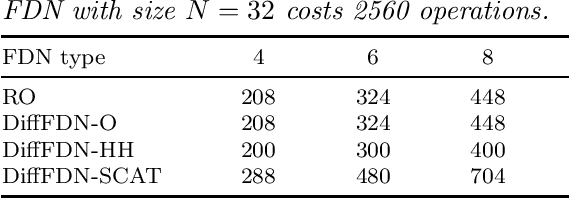
A common bane of artificial reverberation algorithms is spectral coloration, typically manifesting as metallic ringing, leading to a degradation in the perceived sound quality. This paper presents an optimization framework where a differentiable feedback delay network is used to learn a set of parameters to reduce coloration iteratively. The parameters under optimization include the feedback matrix, as well as the input and output gains. The optimization objective is twofold: to maximize spectral flatness through a spectral loss while maintaining temporal density by penalizing sparseness in the parameter values. A favorable narrower distribution of modal excitation is achieved while maintaining the desired impulse response density. In a subjective assessment, the new method proves effective in reducing perceptual coloration of late reverberation. The proposed method achieves computational savings compared to the baseline while preserving its performance. The effectiveness of this work is demonstrated through two application scenarios where natural-sounding synthetic impulse responses are obtained via the introduction of attenuation filters and an optimizable scattering feedback matrix.