 Add to Chrome
 Add to Firefox
 Add to Edge
Detecting RAG Advertisements Across Advertising Styles
Mar 05, 2026
Large language models (LLMs) enable a new form of advertising for retrieval-augmented generation (RAG) systems in which organic responses are blended with contextually relevant ads. The prospect of such "generated native ads" has sparked interest in whether they can be detected automatically. Existing datasets, however, do not reflect the diversity of advertising styles discussed in the marketing literature. In this paper, we (1) develop a taxonomy of advertising styles for LLMs, combining the style dimensions of explicitness and type of appeal, (2) simulate that advertisers may attempt to evade detection by changing their advertising style, and (3) evaluate a variety of ad-detection approaches with respect to their robustness under these changes. Expanding previous work on ad detection, we train models that use entity recognition to exactly locate an ad in an LLM response and find them to be both very effective at detecting responses with ads and largely robust to changes in the advertising style. Since ad blocking will be performed on low-resource end-user devices, we include lightweight models like random forests and SVMs in our evaluation. These models, however, are brittle under such changes, highlighting the need for further efficiency-oriented research for a practical approach to blocking of generated ads.

Ranking Generated Answers: On the Agreement of Retrieval Models with Humans on Consumer Health Questions
Aug 19, 2024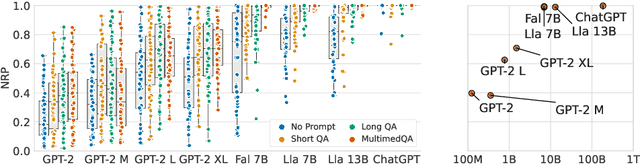
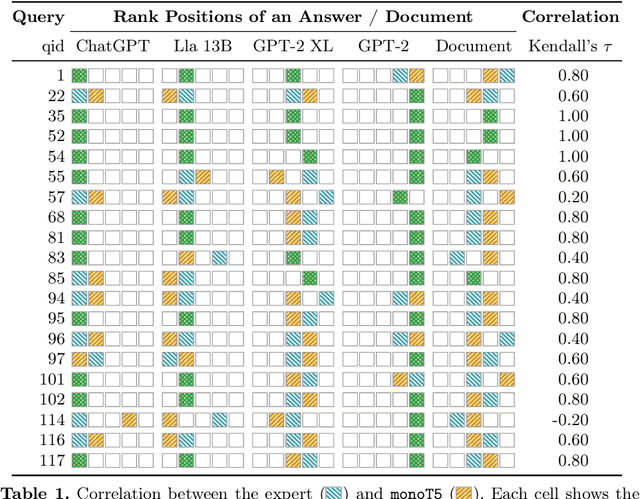
Evaluating the output of generative large language models (LLMs) is challenging and difficult to scale. Most evaluations of LLMs focus on tasks such as single-choice question-answering or text classification. These tasks are not suitable for assessing open-ended question-answering capabilities, which are critical in domains where expertise is required, such as health, and where misleading or incorrect answers can have a significant impact on a user's health. Using human experts to evaluate the quality of LLM answers is generally considered the gold standard, but expert annotation is costly and slow. We present a method for evaluating LLM answers that uses ranking signals as a substitute for explicit relevance judgements. Our scoring method correlates with the preferences of human experts. We validate it by investigating the well-known fact that the quality of generated answers improves with the size of the model as well as with more sophisticated prompting strategies.