 Add to Chrome
 Add to Firefox
 Add to Edge
Integrating Persuasion Theory into the Epidemiological Modelling of Health Misinformation Spread on Social Media
Aug 16, 2026
This study presents a hybrid epidemiological and behavioural framework to simulate the spread of health misinformation on social media. We extend the classical Susceptible--Infected--Recovered (SIR) model to a six-compartment structure (SIRMMM), incorporating Misinformed Susceptible (MS), Misinformed Infected (MI), and Misinformed Recovered (MR) compartments to better reflect the dynamics of the misinformation lifecycle. To account for individual-level behavioural variation, we extend the SIRMMM model by integrating psychological signals from the Elaboration Likelihood Model (ELM), including sentiment polarity, engagement metrics, and cognitive effort, which dynamically modulate the misinformation transmission rate, yielding the ELM-SIRMMM framework. Model parameters were estimated using the FibVID dataset, which captures COVID-19 misinformation on Twitter. Generalisability was tested on two additional datasets: MC-Fake (emotional misinformation) and Monant (general health misinformation). Results show that the ELM-SIRMMM model enhances both predictive accuracy and dynamic realism. On FibVID, it decreases RMSE by 5.5%, delays the misinformation peak from day 150 to day 160, and increases its peak prevalence from 6% to 7%. On MC-Fake, it accurately reproduces a flash-rumour pattern, infecting 38% of users by day 45 and achieving 97% misinformation recovery, all while maintaining model accuracy. In contrast, minimal behavioural signal variability in the Monant dataset leads to marginal benefit, with only a 3% peak and 57% of users remaining susceptible. These findings suggest that structural elaboration alone is insufficient. Functional realism in modelling misinformation spread requires dynamic psychological inputs that vary meaningfully across time and contexts.

BERTopic-Virality Prioritisation: A Scalable Framework for Thematic and Comparative Analysis of COVID-19 and Monkeypox Misinformation on Twitter
Aug 16, 2026Health misinformation circulating during pandemics can gain traction rapidly, creating harmful narratives that compete with public health guidance. Most topic-modelling pipelines treat engagement as an external outcome, limiting their ability to prioritise semantically coherent topics that are also rapidly diffusing. We introduce BERTopic-VP, a virality-prioritised topic-modelling framework that combines contextual embedding-based clustering (BERTopic) with a post hoc Virality Prioritisation (VP) layer. The pipeline is complemented by a two-stage hybrid misinformation detection module that fuses a supervised content-based classifier with an external verification signal derived from public-health knowledge bases. Applied to three benchmark datasets, COVID-19_FNIR, Monkeypox, and Constraint, the framework achieves strong classification performance, with F1 up to 0.950 and ROC-AUC up to 0.989, while identifying high-impact clusters under top 1%, 5%, and 10% VP thresholds. For datasets without native engagement metadata, prioritisation is based on a logistic propensity-to-spread score, used as an ordinal proxy for diffusion potential rather than a direct measure of engagement. The results show that integrating semantic structure, virality-aware ranking, and affective-linguistic profiling enables scalable and interpretable comparative analysis of misinformation across pandemics. The proposed framework supports monitoring-oriented early warning by surfacing low-volume but high-risk narratives for analyst review.
A Comparative Study of Hybrid Models in Health Misinformation Text Classification
Oct 08, 2024This study evaluates the effectiveness of machine learning (ML) and deep learning (DL) models in detecting COVID-19-related misinformation on online social networks (OSNs), aiming to develop more effective tools for countering the spread of health misinformation during the pan-demic. The study trained and tested various ML classifiers (Naive Bayes, SVM, Random Forest, etc.), DL models (CNN, LSTM, hybrid CNN+LSTM), and pretrained language models (DistilBERT, RoBERTa) on the "COVID19-FNIR DATASET". These models were evaluated for accuracy, F1 score, recall, precision, and ROC, and used preprocessing techniques like stemming and lemmatization. The results showed SVM performed well, achieving a 94.41% F1-score. DL models with Word2Vec embeddings exceeded 98% in all performance metrics (accuracy, F1 score, recall, precision & ROC). The CNN+LSTM hybrid models also exceeded 98% across performance metrics, outperforming pretrained models like DistilBERT and RoBERTa. Our study concludes that DL and hybrid DL models are more effective than conventional ML algorithms for detecting COVID-19 misinformation on OSNs. The findings highlight the importance of advanced neural network approaches and large-scale pretraining in misinformation detection. Future research should optimize these models for various misinformation types and adapt to changing OSNs, aiding in combating health misinformation.
* 8 pages, 4 tables presented at the OASIS workshop of the ACM Hypertext and Social Media Conference 2024
A Comparative Study of the Clinical use of Motion Analysis from Kinect Skeleton Data
Jul 31, 2017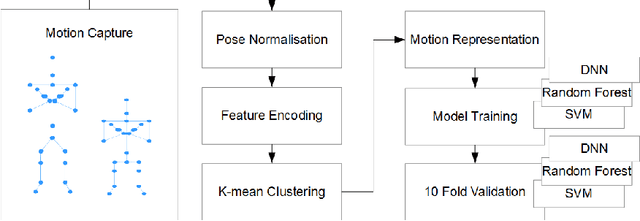
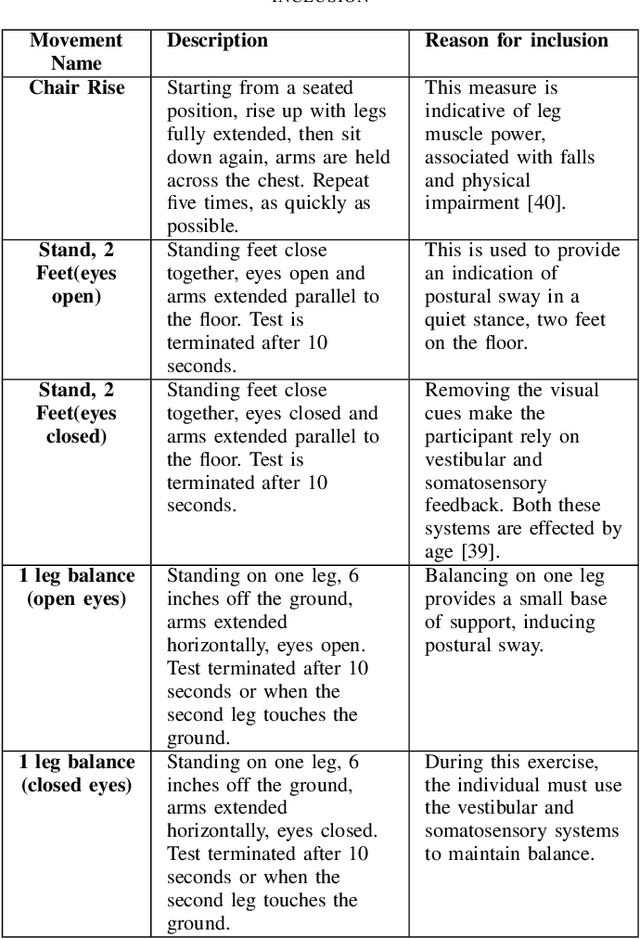
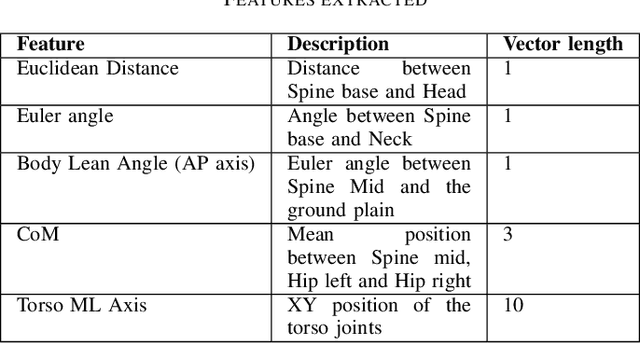
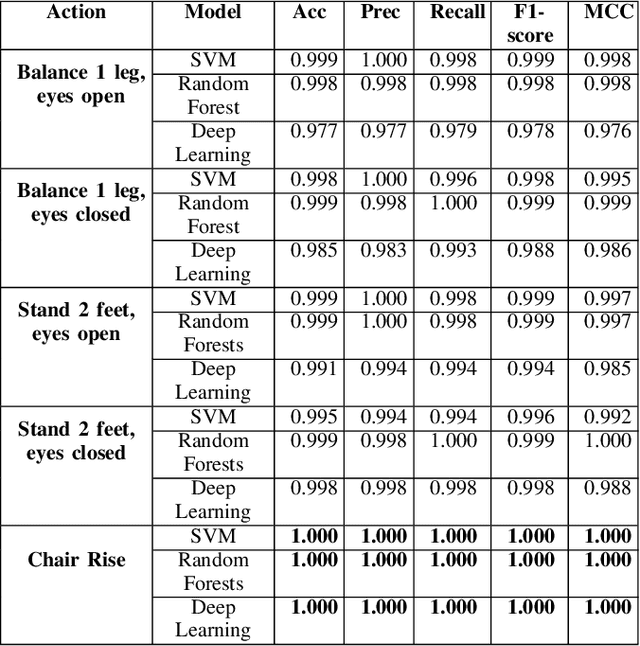
The analysis of human motion as a clinical tool can bring many benefits such as the early detection of disease and the monitoring of recovery, so in turn helping people to lead independent lives. However, it is currently under used. Developments in depth cameras, such as Kinect, have opened up the use of motion analysis in settings such as GP surgeries, care homes and private homes. To provide an insight into the use of Kinect in the healthcare domain, we present a review of the current state of the art. We then propose a method that can represent human motions from time-series data of arbitrary length, as a single vector. Finally, we demonstrate the utility of this method by extracting a set of clinically significant features and using them to detect the age related changes in the motions of a set of 54 individuals, with a high degree of certainty (F1- score between 0.9 - 1.0). Indicating its potential application in the detection of a range of age-related motion impairments.