 Add to Chrome
 Add to Firefox
 Add to Edge
Multilingual Lexical Feature Analysis of Spoken Language for Predicting Major Depression Symptom Severity
Nov 10, 2025
Background: Captured between clinical appointments using mobile devices, spoken language has potential for objective, more regular assessment of symptom severity and earlier detection of relapse in major depressive disorder. However, research to date has largely been in non-clinical cross-sectional samples of written language using complex machine learning (ML) approaches with limited interpretability. Methods: We describe an initial exploratory analysis of longitudinal speech data and PHQ-8 assessments from 5,836 recordings of 586 participants in the UK, Netherlands, and Spain, collected in the RADAR-MDD study. We sought to identify interpretable lexical features associated with MDD symptom severity with linear mixed-effects modelling. Interpretable features and high-dimensional vector embeddings were also used to test the prediction performance of four regressor ML models. Results: In English data, MDD symptom severity was associated with 7 features including lexical diversity measures and absolutist language. In Dutch, associations were observed with words per sentence and positive word frequency; no associations were observed in recordings collected in Spain. The predictive power of lexical features and vector embeddings was near chance level across all languages. Limitations: Smaller samples in non-English speech and methodological choices, such as the elicitation prompt, may have also limited the effect sizes observable. A lack of NLP tools in languages other than English restricted our feature choice. Conclusion: To understand the value of lexical markers in clinical research and practice, further research is needed in larger samples across several languages using improved protocols, and ML models that account for within- and between-individual variations in language.

A Comparative Study of the Clinical use of Motion Analysis from Kinect Skeleton Data
Jul 31, 2017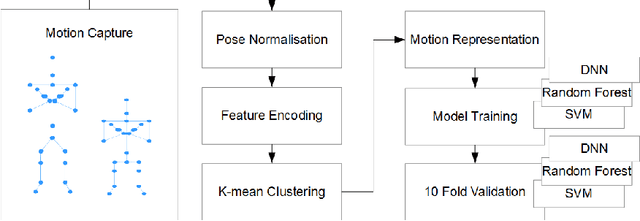
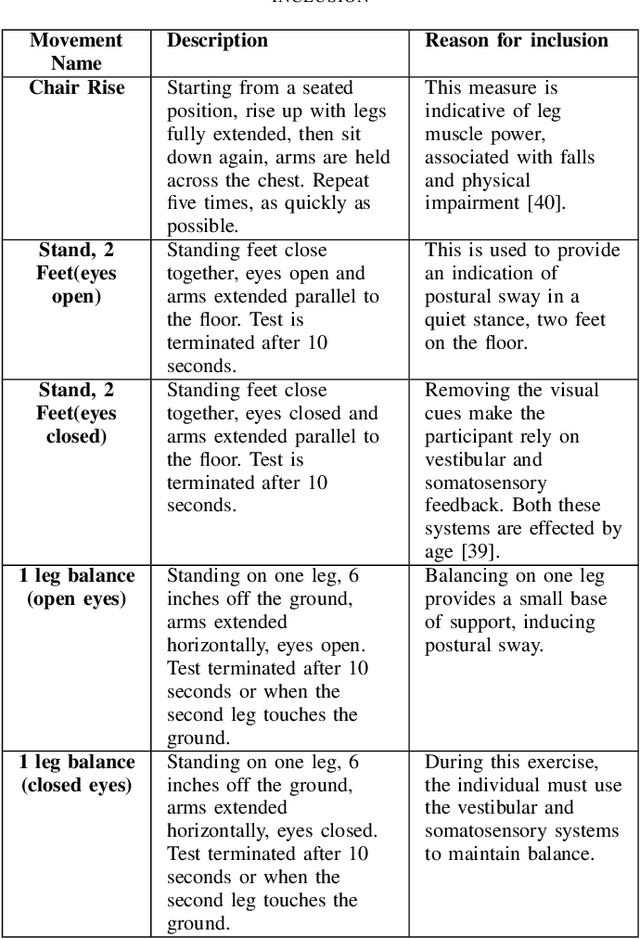
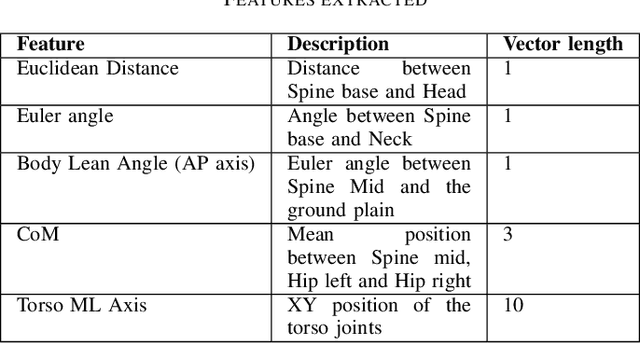
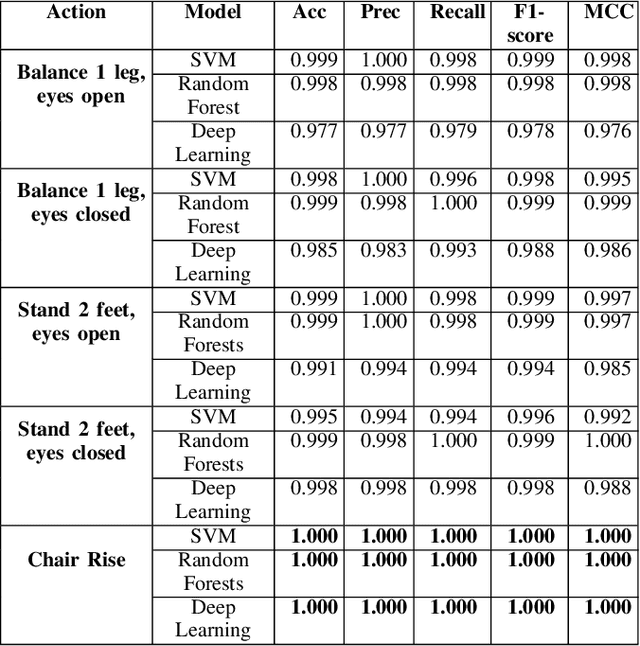
The analysis of human motion as a clinical tool can bring many benefits such as the early detection of disease and the monitoring of recovery, so in turn helping people to lead independent lives. However, it is currently under used. Developments in depth cameras, such as Kinect, have opened up the use of motion analysis in settings such as GP surgeries, care homes and private homes. To provide an insight into the use of Kinect in the healthcare domain, we present a review of the current state of the art. We then propose a method that can represent human motions from time-series data of arbitrary length, as a single vector. Finally, we demonstrate the utility of this method by extracting a set of clinically significant features and using them to detect the age related changes in the motions of a set of 54 individuals, with a high degree of certainty (F1- score between 0.9 - 1.0). Indicating its potential application in the detection of a range of age-related motion impairments.