 Add to Chrome
 Add to Firefox
 Add to Edge
Modeling the Dynamics of Sub-Millisecond Electroadhesive Engagement and Release Times
Dec 21, 2024
Electroadhesion is an electrically controllable switchable adhesive commonly used in soft robots and haptic user interfaces. It can form strong bonds to a wide variety of surfaces at low power consumption. However, electroadhesive clutches in the literature engage to and release from substrates several orders of magnitude slower than a traditional electrostatic model would predict, limiting their usefulness in high-bandwidth applications. We develop a novel electromechanical model for electroadhesion, factoring in polarization dynamics and contact mechanics between the dielectric and substrate. We show in simulation and experimentally how different design parameters affect the engagement and release times of electroadhesive clutches to metallic substrates. In particular, we find that higher drive frequencies and narrower substrate aspect ratios enable significantly faster dynamics. We demonstrate designs with engagement times under 15 us and release times as low as 875 us, which are 10x and 17.1x faster, respectively, than the best times found in prior literature.

Electroadhesive Auxetics as Programmable Layer Jamming Skins for Formable Crust Shape Displays
Nov 10, 2022Shape displays are a class of haptic devices that enable whole-hand haptic exploration of 3D surfaces. However, their scalability is limited by the mechanical complexity and high cost of traditional actuator arrays. In this paper, we propose using electroadhesive auxetic skins as a strain-limiting layer to create programmable shape change in a continuous ("formable crust") shape display. Auxetic skins are manufactured as flexible printed circuit boards with dielectric-laminated electrodes on each auxetic unit cell (AUC), using monolithic fabrication to lower cost and assembly time. By layering multiple sheets and applying a voltage between electrodes on subsequent layers, electroadhesion locks individual AUCs, achieving a maximum in-plane stiffness variation of 7.6x with a power consumption of 50 uW/AUC. We first characterize an individual AUC and compare results to a kinematic model. We then validate the ability of a 5x5 AUC array to actively modify its own axial and transverse stiffness. Finally, we demonstrate this array in a continuous shape display as a strain-limiting skin to programmatically modulate the shape output of an inflatable LDPE pouch. Integrating electroadhesion with auxetics enables new capabilities for scalable, low-profile, and low-power control of flexible robotic systems.
Social-Cultural Factors in the Design of Technology for Hispanic People with Stroke
Mar 16, 2022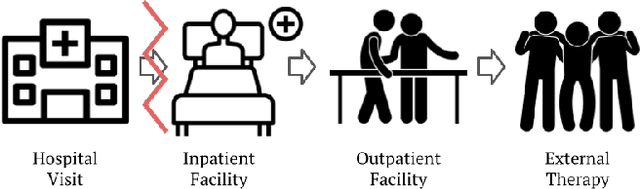
Stroke is a leading cause of serious, long-term disability in the United States. There exist disparities in both stroke prevalence and outcomes between people with stroke in Hispanic and Latinx communities and the general stroke population. Current stroke technology - which aims to improve quality of life and bring people with stroke to the most functional, independent state possible - has shown promising results for the general stroke population, but has failed to close the recovery outcome gap for underserved Hispanic and Latinx people with stroke. Previous work in health education, digital health, and HRI has improved human health outcomes by incorporating social-cultural factors, though not for stroke. In this position paper, we aim to justify accounting for unique cultural factors in stroke technology design for the Hispanic and Latinx community. We review examples of successful culturally appropriate interventions and suggest design considerations (mutually beneficial community consultation, accommodating for barriers beforehand, building on culture, and incorporating education of the family) to provide more culturally appropriate design of Hispanic and Latinx stroke technology and reduce the disparity gap.