 Add to Chrome
 Add to Firefox
 Add to Edge
OpenRTLSet: A Fully Open-Source Dataset for Large Language Model-based Verilog Module Design
Jun 09, 2026
OpenRTLSet introduces the largest fully open-source dataset for hardware design, offering over 131,000 diverse Verilog code samples to the research community and industry. Our dataset uniquely combines Verilog code from GitHub repositories (102k modules), VHDL translations (5k modules), and synthesizable C/C++ translations (24k modules), all freely accessible without proprietary restrictions. Using the reasoning model DeepSeek-R1, we generated paired natural language descriptions for each code sample, enabling fine-tuning of various language model families (e.g., Qwen and Granite) for Verilog code generation. Our dataset explores multiple options, including Verilator-generated C++ files as additional context during labeling, quantization techniques (INT4 vs. BF16), and performance differences across model sizes (7B-32B parameters). OpenRTLSet demonstrates that open-source approaches can achieve superior performance in hardware design tasks, establishing a new foundation for accessible research and commercial use in this domain.
* Accepted by ICLAD'25

Statistically adaptive learning for a general class of cost functions (SA L-BFGS)
Sep 05, 2012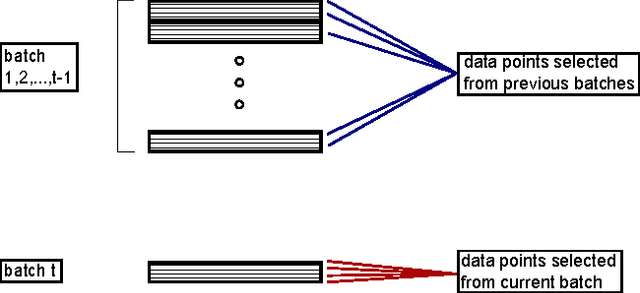
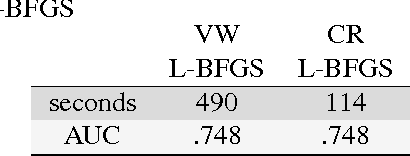
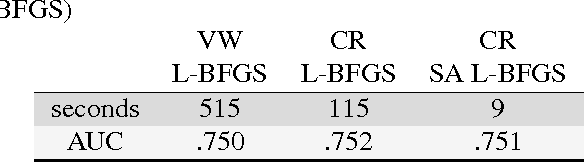
We present a system that enables rapid model experimentation for tera-scale machine learning with trillions of non-zero features, billions of training examples, and millions of parameters. Our contribution to the literature is a new method (SA L-BFGS) for changing batch L-BFGS to perform in near real-time by using statistical tools to balance the contributions of previous weights, old training examples, and new training examples to achieve fast convergence with few iterations. The result is, to our knowledge, the most scalable and flexible linear learning system reported in the literature, beating standard practice with the current best system (Vowpal Wabbit and AllReduce). Using the KDD Cup 2012 data set from Tencent, Inc. we provide experimental results to verify the performance of this method.